

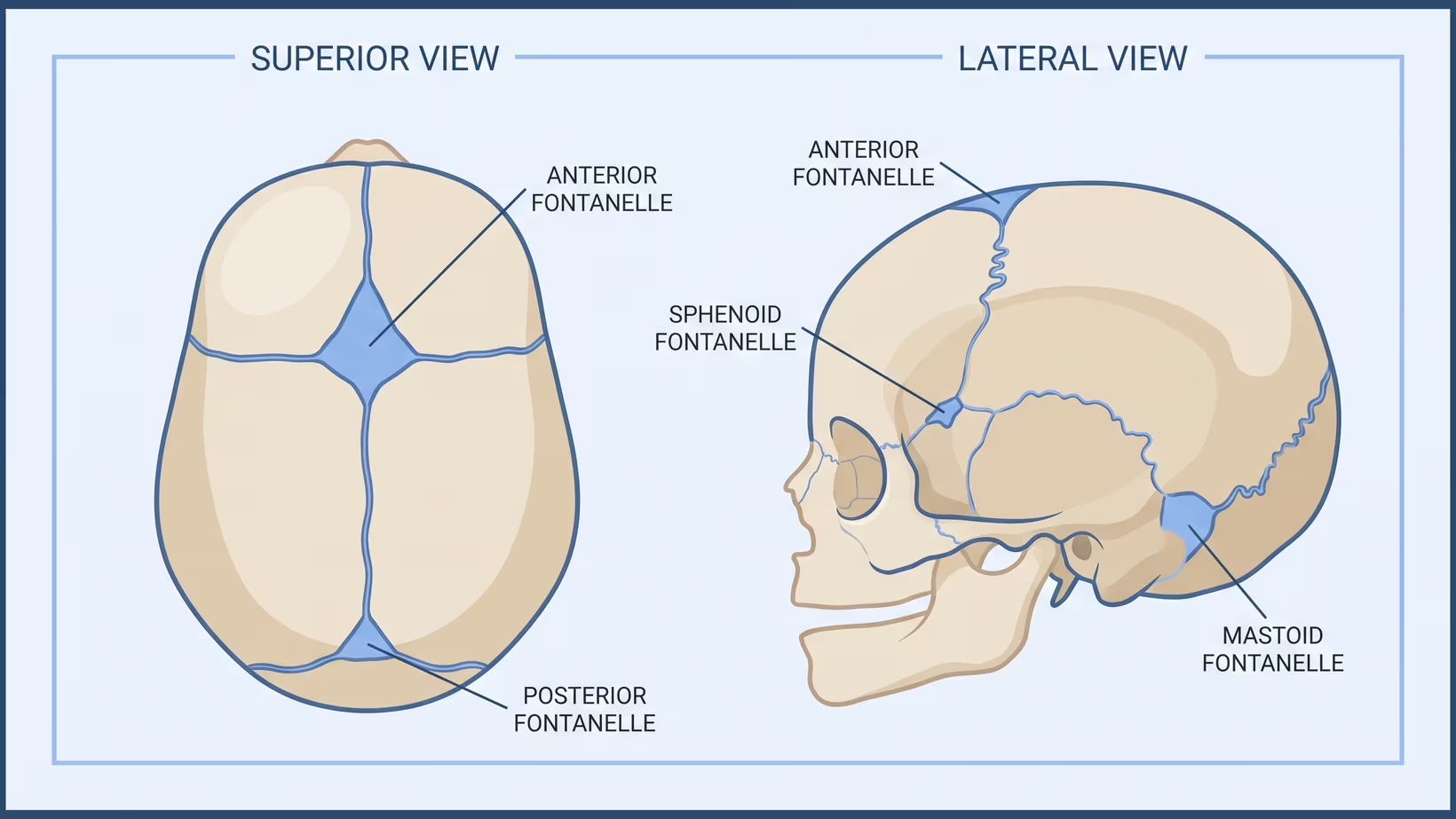
The soft spots on the head are called fontanelles. There is one on the top-front, top-back and two on each side. The front-top (anterior) fontanelle closes on average at around 14 months, and anywhere between seven to 22 months is still normal. The top-back (posterior) fontanelle closes at around two months.
What Do Soft Spot, Fontanelle, and Bumbunan Mean?
They are three names for one thing. Fontanelle is the medical word, soft spot is the English one, and bumbunan is what most Filipino families actually say. All three describe the space between the bony plates of a baby’s skull, which is covered by a tough fibrous membrane.
That fibrous membrane is the part worth understanding. It is not a hole in the skull, and the brain is not exposed: under that membrane lie the same coverings that protect the brain everywhere else on the head.
We cover whether it is safe to touch the soft spot on its own page.
What Is the Fontanelle For?
The soft spots exist so the skull can grow. A brain that is doubling in size cannot expand inside a skull that is already sealed shut, so the fontanelles and the seams between them, called sutures, let the plates of the skull spread apart as the brain pushes outward.
They also let the head change shape during birth. The plates slide and overlap slightly, which is why some newborns arrive with a head that looks pointed or uneven and then settles over the next few days.
Growth is fastest early: the soft spot shrinks most steeply between roughly three and nine months, and the skull grows most in the first eight. Nakikita mo iyon sa bonnet na hindi na kasya pagkatapos ng ilang buwan.
Seek care now
Which Soft-Spot Signs Mean Going to the Emergency Room Now?
Check the soft spot when your baby is calm, not crying, and look at it both lying down and held upright.
Go to the nearest hospital emergency room now if you see:
- A soft spot that is tense or bulging while your baby is calm and being held upright
- A bulging soft spot together with fever, especially under two months old
- A bulging soft spot with unusual irritability, or a cry you cannot settle
- A bulging or tense soft spot after any bump or fall involving the head
A soft spot that bulges in a calm, upright baby can mean rising pressure inside the head. The conditions behind it include meningitis (an infection of the membranes that cover the brain), encephalitis (swelling of the brain, usually from infection), hydrocephalus (too much fluid inside the brain), injury and bleeding. Those are not things to watch overnight. More detail is on when a bulging fontanelle is an emergency.
Where Is the Anterior Fontanelle?
The anterior fontanelle is the big one on top, towards the front, where the two frontal bones meet the two parietal bones. It is roughly diamond shaped, and it is the one people mean when they say bumbunan.
It is the largest of the six and the one doctors actually check. Across 26 studies and 8,661 term newborns, the pooled average size at birth was about 2.6 cm, nearer 2.5 cm in the Asian studies, while older reference work puts it at about 2.1 cm. The spread between healthy babies is genuinely wide.
Its size is not the point on its own. What a clinician reads from it is shape, tension and how it changes over visits, alongside head circumference and how your baby is feeding and behaving.
When Does the Posterior Fontanelle Close?
The posterior fontanelle is the small triangular one at the back of the head, where the two parietal bones meet the occipital bone. It is usually completely closed by about two months of age.
It is much smaller than the front one. When the back one shuts at two months and the front one is still open, that is the usual pattern.
What Are the Sphenoid and Mastoid Fontanelles?
There are six fontanelles in a newborn skull, not two. Besides the anterior and posterior, there are two sphenoid fontanelles at the temples and two mastoid fontanelles behind and below the ears.
These four are small, sit low on the sides of the head, and are not what anyone means by the soft spot. Most parents will never locate them, and there is no home check that involves them.
The mastoid ones matter in one practical way. They are acoustic windows, meaning gaps in the skull that sound waves can pass through, and so is the posterior fontanelle.
Ultrasound can see through them into parts of the brain the top of the head does not reach. The mastoid fontanelle shows the cerebellum (the part that controls balance and movement) and the brainstem (the part that links the brain to the spinal cord) at the back. The posterior fontanelle shows bleeding into the ventricles (the fluid spaces inside the brain) more reliably than the front window alone. That is why a sonographer moves the probe around a newborn’s head instead of holding it on top.
Why Is the Soft Spot Pulsating?
A gentle pulse at the soft spot is normal. Palpating the fontanelle with a baby held upright may reveal a normal, slight pulsation, and it follows the heartbeat because the membrane sits directly over the brain and its blood vessels.
Ito ang isa sa mga unang napapansin ng mga magulang. What you are feeling is circulation, not damage.
What matters is not whether it pulses, but whether it is flat and soft when your baby is calm and upright and feeding well.
How Old Is a Baby When the Fontanelle Closes?
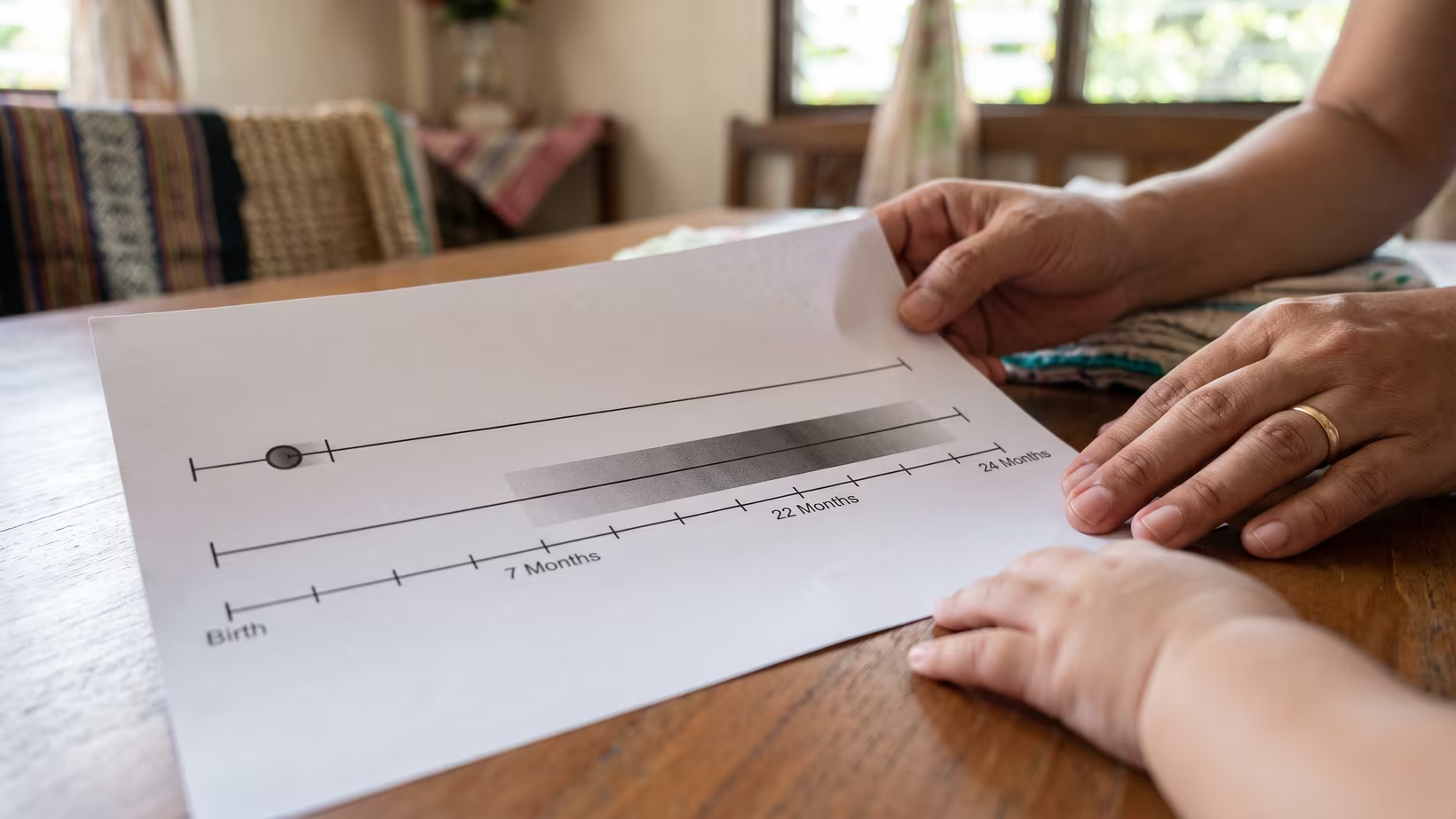
The anterior fontanelle usually closes in the second year. In a study of 104,147 healthy children, the mean age of closure was 14.5 months, and the range for most children ran from 6.6 to 22.4 months. Older reference work gives a median of 13.8 months.
The spread is the part parents are rarely told. In one series of head scans of healthy full-term children, the soft spot was already closed in three to five percent of babies at five to six months, and still open in nearly half at 16 months. The authors concluded that early or late closure may simply be normal variants.
We found no Philippine data on fontanelle closure timing. The figures above come from Chinese and American studies, and ethnic variation in closure timing has been documented directly, including in Maori and Pasifika infants. Treat them as a guide rather than a local standard. Ang mahalaga ay hindi ang eksaktong buwan kundi kung normal ang paglaki ng ulo at ang pag-unlad ng bata.
What If the Soft Spot Closed Early?
Most babies whose soft spot closes early do not have craniosynostosis, the condition where the seams between skull plates fuse too soon. In head scans of healthy full-term children, three to five percent already had a closed soft spot at five to six months, while the national registers in Finland and Norway put craniosynostosis at about five to six babies in every 10,000 live births. Early closure on its own is a poor guide either way, and it has been studied directly against that diagnosis.
It performed badly in both directions. A fontanelle closed before six months found only about a third of the children who did have craniosynostosis, and roughly a quarter of the children without it also had a closed fontanelle. The authors concluded that early closure does not imply the diagnosis, and warned that a wide-open soft spot does not rule it out either.
So the soft spot is not the test. In practice, what carries the diagnosis is head shape, a ridge along a seam, and how head circumference tracks over time. We go into this on what an early-closing fontanelle actually means and on why a baby’s skull fuses too early.
What Does a Bulging Fontanelle Mean?
A soft spot that bulges while a baby is calm and upright suggests raised pressure inside the head. The disorders behind it include meningitis, encephalitis, hydrocephalus, hypoxic-ischemic injury (brain injury from too little oxygen and blood flow), trauma (a blow or injury to the head) and intracranial bleeding, meaning bleeding inside the skull.
How often is it serious? In one emergency department series of 45 infants brought in with a bulging fontanelle, about a third had a clinically significant abnormality on cranial ultrasound, most commonly brain swelling from infection. That is a small study at a single hospital, but it is the shape of the risk.
Two groups stood out: babies under two months with fever, and babies without fever who had an abnormal neurological examination. Nearly nine in ten of those had a significant finding, against about one in 25 of the rest. Even outside these two groups, a soft spot that bulges in a calm, upright baby needs the emergency room now. Separately, in children aged one year and under, bacterial meningitis has been found to be more often linked to irritability and a bulging fontanelle.
When to Refer a Closed or Bulging Fontanelle
A bulging fontanelle in a calm, upright infant warrants emergency referral now, and a normal-looking fontanelle is not a reason to withhold one. A pediatric neurologist or a neurosurgeon will be best to evaluate if further assessment should be done.
For a bulging fontanelle, the high-risk groups are the febrile infant under two months and the afebrile infant with abnormal neurology, where the yield on urgent cranial ultrasound is high. In infants under one year already being checked for possible meningitis, irritability and a bulging fontanelle were the two signs most often linked to bacterial meningitis.
For a closed or closing fontanelle, isolated early closure is a weak signal. Against a diagnosis of non-syndromic craniosynostosis, meaning the early fusion is not part of a wider genetic condition, closure before six months was found in about 36 in 100 children who had the condition (36 percent). Among children without the condition, about 72 in 100 did not have early closure (72 percent). An open (patent) soft spot has also been documented in children who still had craniosynostosis.
Referral rests on head shape, a palpable ridge along a suture, and serial head circumference crossing centiles, not on fontanelle status alone. The signs that carry the diagnosis are set out in the ridge parents can feel along a fused suture.
One further caution after head trauma in infants under one year: the absence of clinical signs of brain injury, a bulging fontanelle included, does not exclude intracranial injury. If your baby under one year has had a fall or a blow to the head, a flat soft spot does not mean the brain is unhurt. Have a doctor check your baby the same day, at a hospital emergency room or a clinic that can see your baby today.
Frequently Asked Questions
Is a big soft spot a problem?
Not by itself, because the normal range of size is wide. A large or late-closing fontanelle is followed up when it comes with other findings, since conditions such as hypothyroidism, rickets, Down syndrome, achondroplasia and raised intracranial pressure are recognised causes.
Does a closed soft spot mean the brain has stopped growing?
No. The skull keeps growing at the sutures after the fontanelles close, and in one large study fontanelle closure showed no significant correlation with head circumference.
Is a soft spot that looks full when she cries bulging?
No. A fontanelle that fills when a baby cries, strains or lies flat, then settles when she is calm and upright, is behaving normally. That is exactly why the check is done with a calm baby in both positions.
Bring and ask
What to Bring and What to Ask at the Consult
Bring:
- The baby book with every head circumference measurement recorded, not just the latest
- Photos of the head from the front, the top and both sides, taken in good light
- A note of when you first noticed the change, and whether it has moved since
- Any earlier ultrasound or scan reports, even from another hospital
Ask:
- Is the head circumference crossing the lines on its growth chart, or following one
- Can you feel a ridge along any of the seams
- Does this need imaging now, or a review in a few weeks
- If a scan is needed, which one, and where can we have it done
What to do now
What to Do Now
If the soft spot is bulging while your baby is calm and upright, go to the nearest hospital emergency room now.
If nothing is urgent and the question is simply whether closure is on time, this belongs at the next well-baby check-up. Bring the baby book, so head circumference can be read as a line over time rather than as a single number. That line is what actually answers the question. You can book a consultation, or your pediatrician can refer you.
If a referral to a neurosurgeon follows, that is usually for the head shape and the growth curve, not for the fontanelle alone. Expect an examination, a look at the measurements you brought, and a discussion of whether imaging adds anything. Hindi ibig sabihin ng referral na may malaking problema. It means someone wants a closer look at the skull.
See sources
- D’Antoni AV, Donaldson OI, Schmidt C, Macchi V, De Caro R, Oskouian RJ, Loukas M, Tubbs RS. A comprehensive review of the anterior fontanelle: embryology, anatomy, and clinical considerations. Child’s Nervous System. 2017;33(6):909-914. PMID 28396968. doi:10.1007/s00381-017-3406-1
- Oumer M, Tazebew A, Alemayehu M. Anterior fontanel size among term newborns: a systematic review and meta-analysis. Public Health Reviews. 2021;42:1604044. PMID 34692179. doi:10.3389/phrs.2021.1604044
- Kiesler J, Ricer R. The abnormal fontanel. American Family Physician. 2003;67(12):2547-2552. PMID 12825844
- Liu Y, Li H, Zhang YQ, Zong XN. Development of anterior fontanelle in Chinese children in 2015. Chinese Journal of Pediatrics. 2017;55(8):602-607. PMID 28822436. doi:10.3760/cma.j.issn.0578-1310.2017.08.011
- Pindrik J, Ye X, Ji BG, Pendleton C, Ahn ES. Anterior fontanelle closure and size in full-term children based on head computed tomography. Clinical Pediatrics. 2014;53(12):1149-1157. PMID 24920348. doi:10.1177/0009922814538492
- Kirkpatrick J, Bowie S, Mirjalili SA. Closure of the anterior and posterior fontanelle in the New Zealand population: a computed tomography study. Journal of Paediatrics and Child Health. 2019;55(5):588-593. PMID 30311284. doi:10.1111/jpc.14253
- Furtado LMF, da Costa Val Filho JA, Freitas LS, Dantas Dos Santos AK. Anterior fontanelle closure and diagnosis of non-syndromic craniosynostosis: a comparative study using computed tomography. Jornal de Pediatria. 2022;98(4):413-418. PMID 34861206. doi:10.1016/j.jped.2021.10.004
- Tu YF, Chuang HY, Huang CC, Chuang CC, Wang SM, Tsai MC, Chi CH, Chuang MC. Frequency and prediction of abnormal findings on neuroimaging of infants with bulging anterior fontanelles. Academic Emergency Medicine. 2005;12(12):1185-1190. PMID 16293891. doi:10.1197/j.aem.2005.05.038
- Oostenbrink R, Moons KG, Theunissen CC, Derksen-Lubsen G, Grobbee DE, Moll HA. Signs of meningeal irritation at the emergency department: how often bacterial meningitis? Pediatric Emergency Care. 2001;17(3):161-164. PMID 11437138. doi:10.1097/00006565-200106000-00003
- Di Salvo DN. A new view of the neonatal brain: clinical utility of supplemental neurologic US imaging windows. Radiographics. 2001;21(4):943-955. PMID 11452069. doi:10.1148/radiographics.21.4.g01jl14943
- Lottering N, Alston CL, Barry MD, MacGregor DM, Gregory LS. Temporal mapping of the closure of the anterior fontanelle and contiguous sutures using computed tomography, in silico models of modern infants. Journal of Anatomy. 2020;237(2):379-390. PMID 32285470. doi:10.1111/joa.13200
- Greenes DS, Schutzman SA. Occult intracranial injury in infants. Annals of Emergency Medicine. 1998;32(6):680-686. PMID 9832664. doi:10.1016/s0196-0644(98)70067-8
- Vuola P, Pakkasjarvi N, Ritvanen A, Heliovaara A, Tukiainen E, Gissler M. Prevalence of craniosynostosis in Finland, 1987-2010: a population-based study. Birth Defects Research. 2024;116(2):e2319. PMID 38348760. doi:10.1002/bdr2.2319
- Tonne E, Due-Tonnessen BJ, Wiig U, Stadheim BF, Meling TR, Helseth E, Heimdal KR. Epidemiology of craniosynostosis in Norway. Journal of Neurosurgery: Pediatrics. 2020;26(1):68-75. PMID 32244202. doi:10.3171/2020.1.PEDS2051
- Massimi L, Bianchi F, Frassanito P, Calandrelli R, Tamburrini G, Caldarelli M. Imaging in craniosynostosis: when and what? Child’s Nervous System. 2019;35(11):2055-2069. PMID 31289853. doi:10.1007/s00381-019-04278-x
- Whitsell N, Meyer L. Craniosynostosis: a review for providers. South Dakota Medicine. 2021;74(2):83-88. PMID 34161690