
A brain aneurysm is a weak bulge on a blood vessel in the brain, and it is not a stroke until it bursts. A stroke is sudden brain damage from a blocked or bleeding vessel. A burst aneurysm is one kind of stroke. A sudden worst headache, or weakness on one side, means the nearest emergency room now.
Is an aneurysm a stroke?
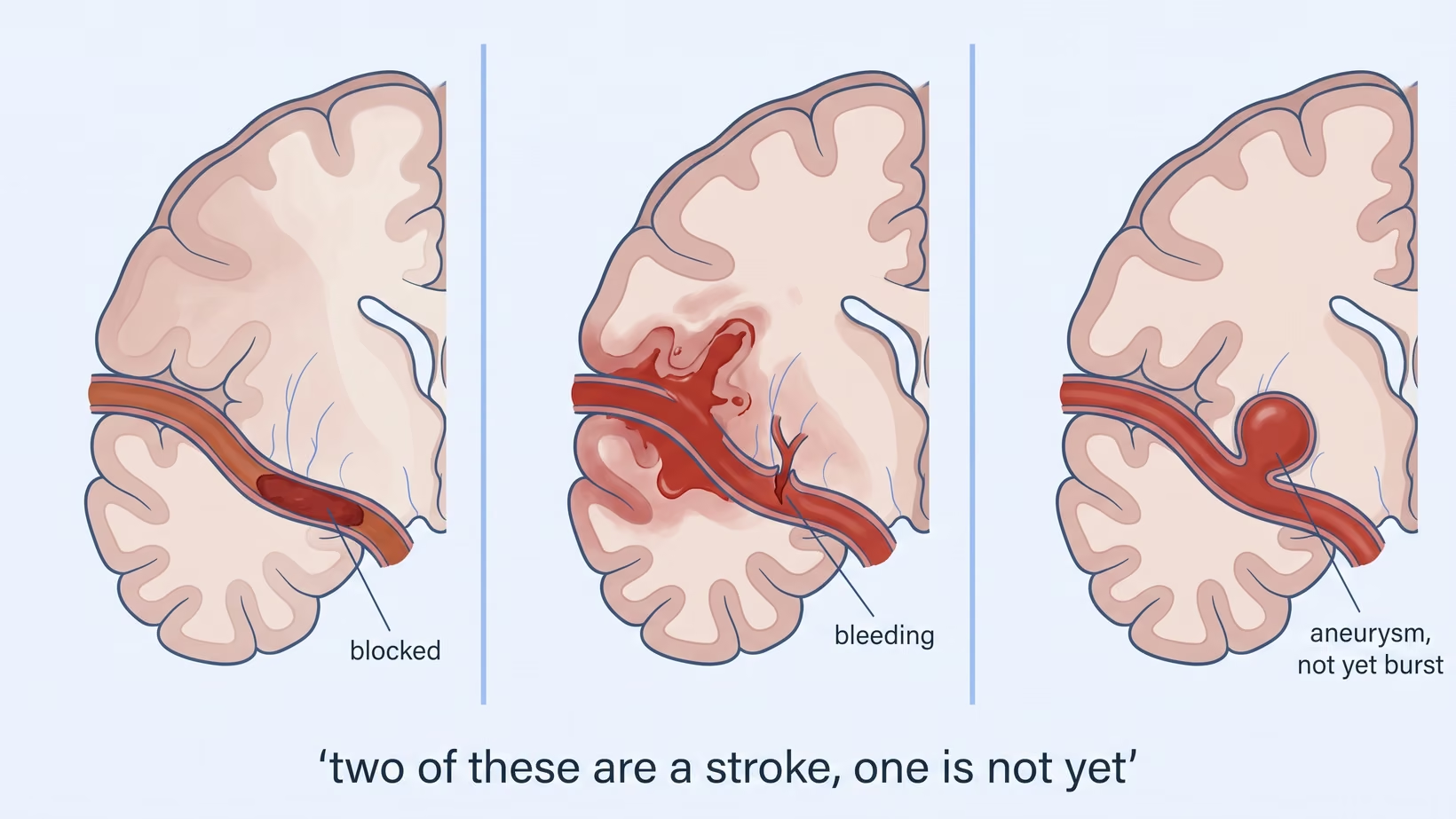
An aneurysm is not a stroke while its wall holds. An aneurysm is a weak bulge on the wall of an artery in the brain, shaped like a small pouch. A stroke is sudden damage to part of the brain because a vessel is blocked or bleeding. When an aneurysm bursts, the bleeding is one kind of stroke.
There are two kinds of stroke. In the blockage kind, called ischemic, meaning the blood supply is cut off, a clot plugs an artery and the brain beyond that point is starved. In the bleeding kind, called hemorrhagic, meaning blood escapes from a vessel, the vessel tears and blood enters the brain or the space around it. Most strokes are the blockage kind.
While the wall holds, an aneurysm almost never causes a stroke. When one tears, blood escapes into the space around the brain. It is a severe condition that can kill, and it is treated as an emergency from the first minute.
How can you tell which one is happening?
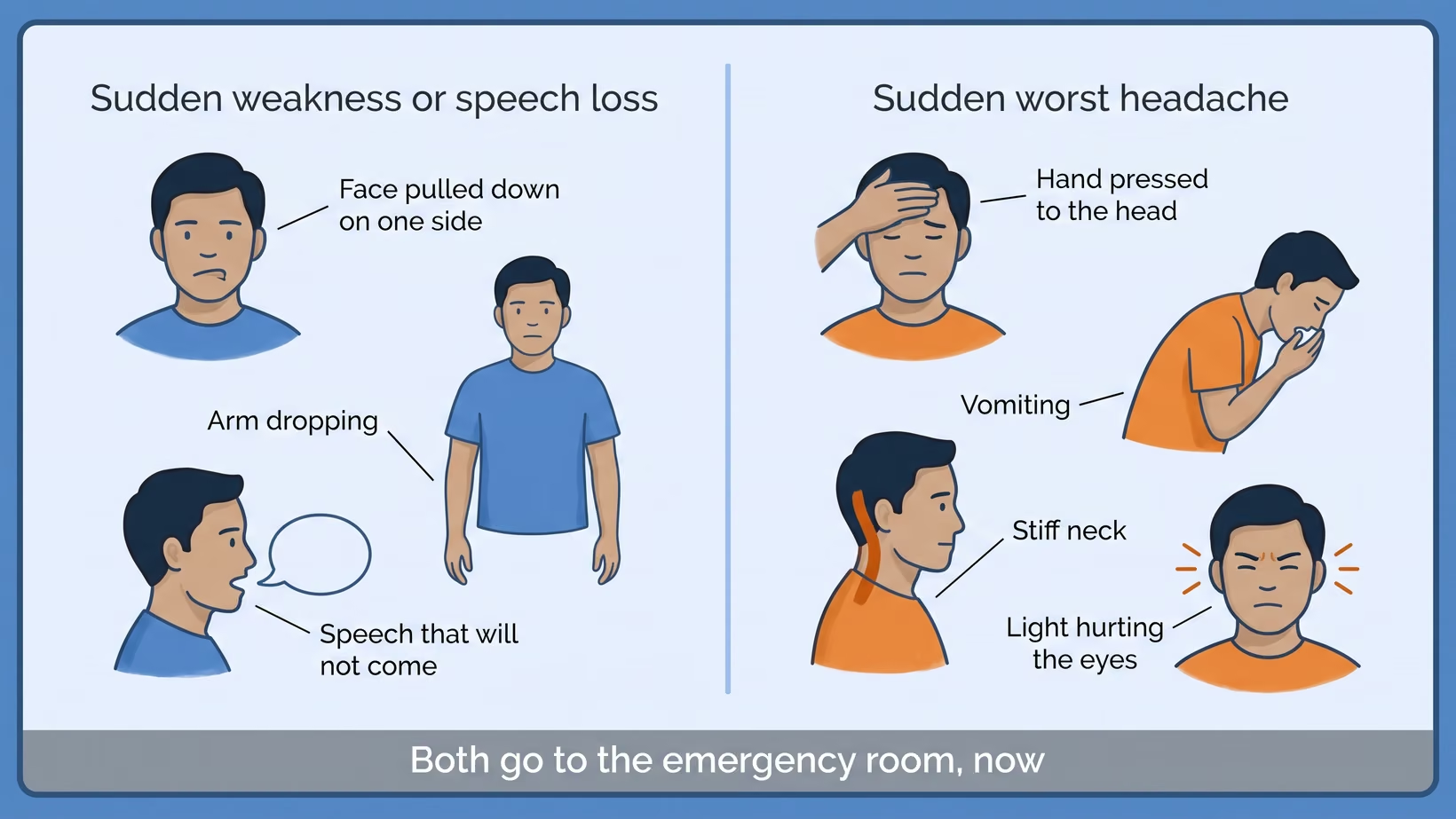
Often you cannot tell at home, and you do not need to. A blocked artery usually causes weakness, a pulled face or lost speech, and a burst aneurysm usually causes a sudden, very severe headache. The signs can overlap. A scan in the emergency room settles it, so get the person there now.
A blocked artery usually appears as a face pulled to one side, an arm that drops when it is lifted, or speech that will not come. It starts suddenly, over seconds or minutes, and it usually does not hurt.
A burst aneurysm usually appears as the worst headache of the person’s life, reaching full force in seconds. Vomiting, a stiff neck, light hurting the eyes, a seizure or a collapse can come with it.
Neither pattern is reliable enough to decide at home, and one person can have signs from both lists.
When to go to the ER, and what to bring
Go now, for any of the signs below, whatever the time of day, and do not wait to see if they pass. A stroke caused by a blockage has emergency treatments that are given in the first hours, so the time you arrive changes what can still be done.
Seek care now
Which signs mean the emergency room now?
- A headache that reaches full force in under a minute, or the worst headache the person has ever felt
- Sudden weakness or numbness on one side of the body
- A face pulled to one side
- Speech that will not come, or words that make no sense
- Sudden loss of vision, or double vision
- A seizure in someone who has never had one
- A stiff neck together with a severe headache
- Any loss of consciousness, even a brief one
Bring and ask
What to bring, what to say, and what not to do
- Go to the nearest emergency room that can do a CT scan of the head. If you do not know which can, go to the nearest one, and ask for a plain CT scan of the head
- Bring the person’s maintenance medicines, or a written list of them, and say if one of them is a blood thinner (an anticoagulant, a medicine that slows clotting)
- Bring previous scans on disc or USB if there are any
- Say out loud what time the symptoms started, because the clock decides which treatments can still be given
- Do not wait for morning, and do not give medicine at home and watch for a few hours
- Do not give food or water if speech or swallowing is affected
- Do not drive the person yourself if someone else can drive; if no one else can, go by the fastest way you have. If you are the one with the signs, do not drive yourself: ask someone to take you to the nearest emergency room now.
High blood pressure bleed or burst aneurysm?
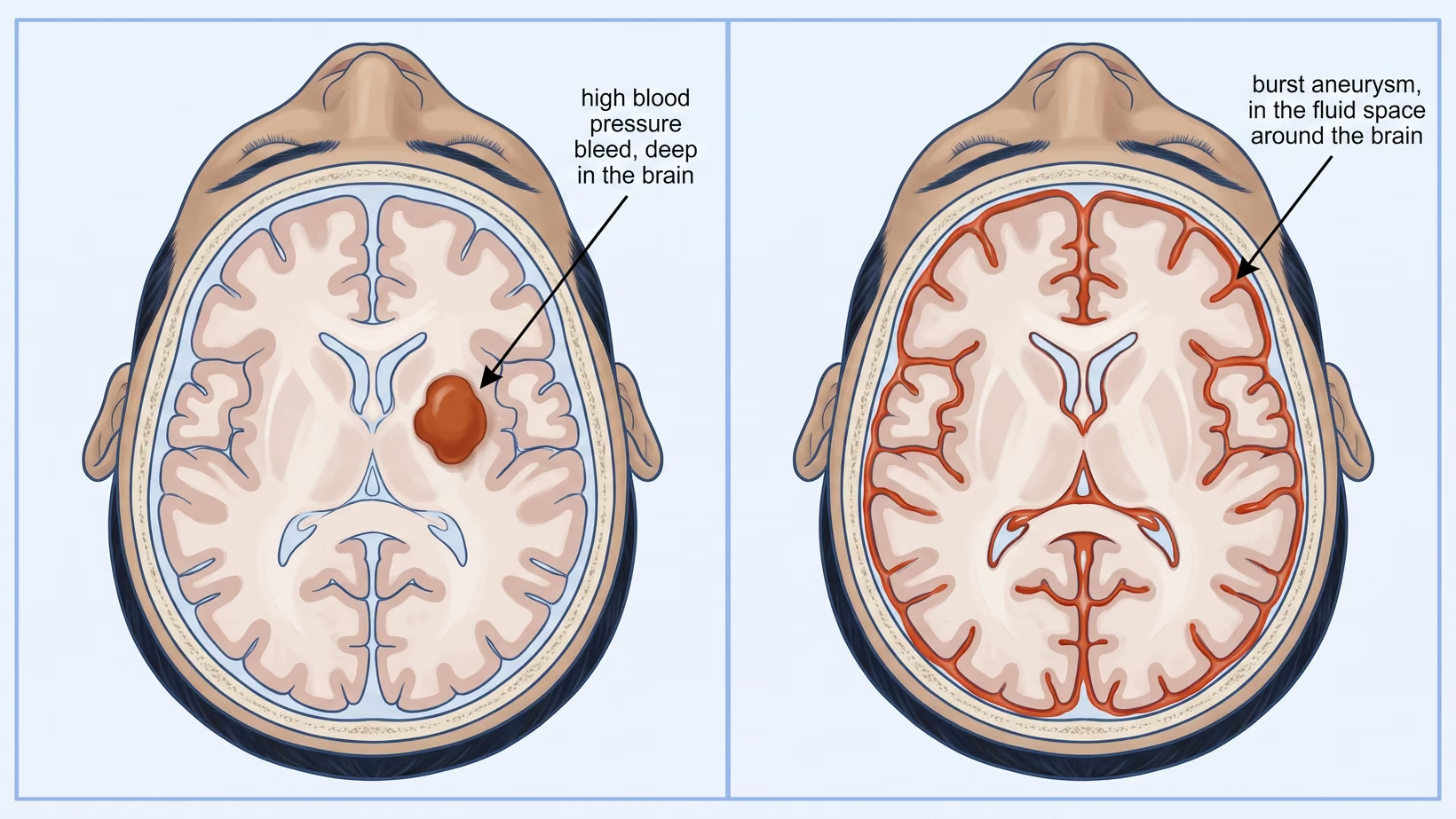
Both are bleeding in the brain, and they are not the same disease. The high blood pressure kind tears a small artery deep inside the brain. The burst aneurysm kind empties into the thin fluid space wrapped around the outside of the brain.
That difference in place changes what the person feels. Blood pushed into brain tissue damages the part it enters, so weakness or numbness on one side can begin in the first minute. Blood in the fluid space around the brain irritates the coverings there, so the headache is the loudest symptom.
The cause is different as well. The deep bleed usually follows years of high blood pressure that was not controlled. The aneurysm bleed follows a weak spot in the artery wall that finally tears. The first treatment is different, and so is what the team watches for in the days after. Bleeding into this fluid space around the brain is called a subarachnoid hemorrhage.
Why the CT scan and the angiogram tell them apart
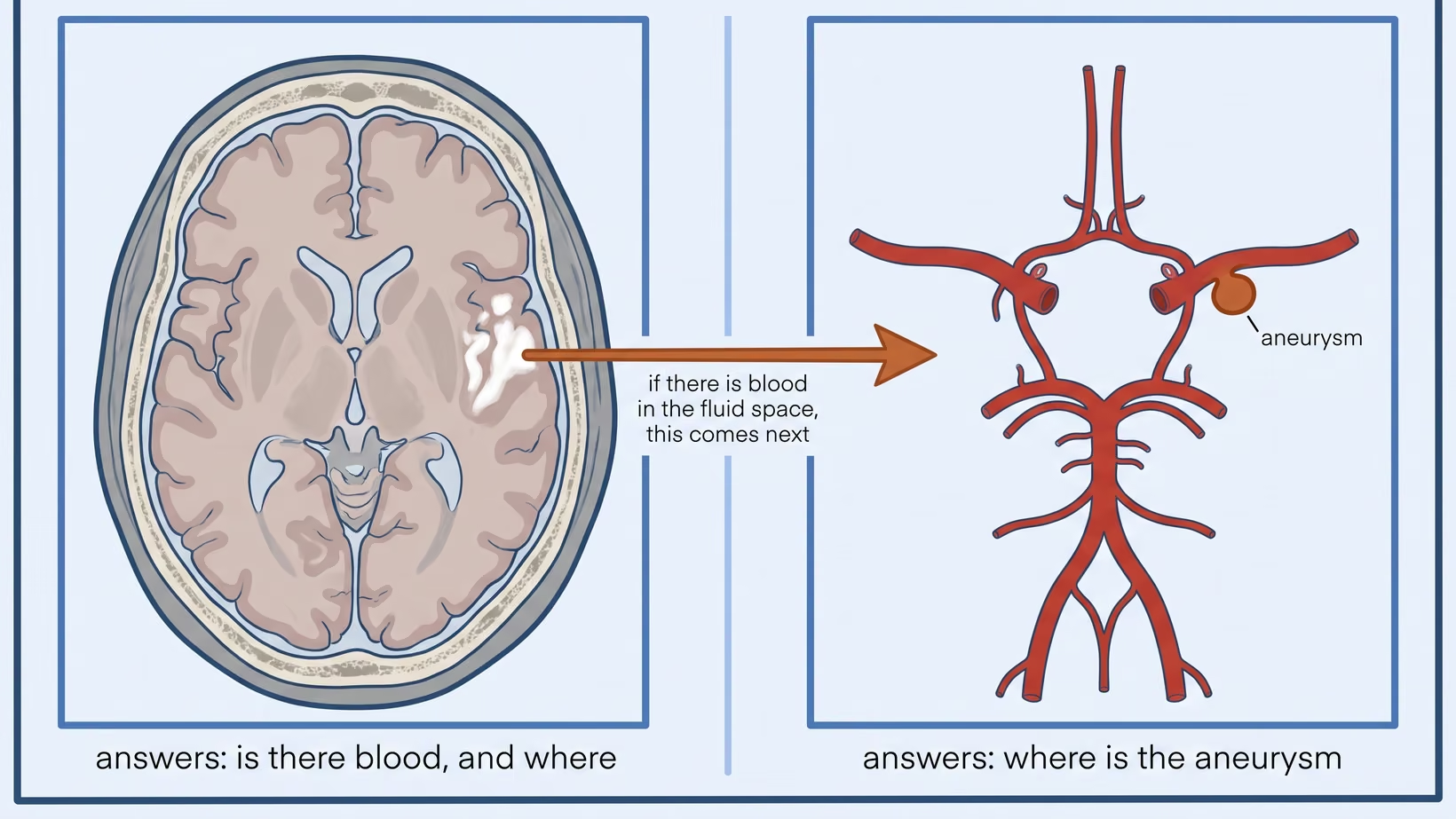
A plain CT scan of the head shows whether there is blood, and where. An angiogram, a scan of the blood vessels, shows where the bulge is. Both are usually done. The plain CT comes first, because it is fast and in the first hours it separates a bleed from a blockage.
In a review that pooled five studies of about 8,900 patients whose examination by the doctor was otherwise normal, a modern CT done within six hours of a sudden severe headache missed about 3 bleeds in every 2,000 scans. The review only looked at scans done within six hours of the headache, so its figure does not tell us how well a scan done days later would perform.
Finding the aneurysm is the angiogram’s work. It is done either with dye injected into a vein, or with a thin tube passed through an artery in the groin or the wrist. It maps the blood vessels, so it is the test that shows which vessel carries the bulge and where on that vessel it sits.
A normal plain CT does not close the question when the story is a sudden worst headache. In that situation more tests follow a normal scan, and the team decides which ones.
Why the treatment is different
The two treatments are opposite. A blocked artery is treated by opening it, with a clot-busting medicine or by pulling the clot out through a thin tube. A burst aneurysm is treated by sealing the bulge off with a clip or with coils. Nobody is treated on a guess, so the scan comes first.
For a blockage, a clot-busting medicine is given into a vein, and the sooner it is given the more it helps. In a pooled analysis of trials, about 33 in 100 people treated within three hours had little or no disability afterwards, against about 23 in 100 who were not treated. The same analysis found serious bleeding in the brain in about 7 in 100 people treated, against about 1 in 100 not treated. So the medicine is given only once the scan has shown there is no bleeding already.
When the blockage sits in one of the large arteries, pulling the clot out through a thin tube leaves people less disabled three months later than medicine alone.
For a burst aneurysm, the bulge is closed off. A small metal clip is placed across its neck through an opening in the skull, or soft coils are packed into it through a thin tube threaded up from an artery.
In a trial of patients whose aneurysm could have been treated either way, about 24 in 100 of those coiled were dead or dependent on others, needing help in daily life, a year later, against about 31 in 100 of those clipped. Some aneurysms suit only one of the two methods, and coiling carried a higher risk of bleeding again later, so clipping or coiling an aneurysm is decided one aneurysm at a time.
How to explain an aneurysm to the family
Explain it to the family in one sentence: there is a weak bulge on one of the blood vessels in the brain. Then say which of the two situations you are in. Either it has not burst, or it has burst and the team is sealing it.
Families ask two questions first. It is not cancer. It is not contagious, and nobody caught it from anyone.
Ask the team five questions: which blood vessel, how big is the bulge, has it bled, what is the plan, and what happens if nothing is done. For a bulge found on a scan that has not bled, there is published guidance on when it is watched and when it is treated, so ask the team which part applies here. In a Japanese study that followed 5,720 patients with aneurysms of 3 mm or more, about 1 in 100 burst each year, and the bigger ones burst more often.
Cost and PhilHealth coverage are not the same in every hospital, and they change, so a figure found online is not the figure you will pay. Ask the billing section and the hospital social worker on the day you are admitted, and ask them again before discharge.
What the first doctor who sees you has to rule out
A sudden severe headache that reaches full force in seconds is a bleed around the brain until a plain head CT without dye says otherwise. A sudden loss of function on one side, meaning weakness, numbness or speech loss, is treated as a stroke instead: go to the emergency room, and tell the team the time the symptoms started, because that time matters most for the decision.
The CT is strongest early. A normal CT within six hours of the headache, in a person whose neurological examination is normal, makes a bleed around the brain very unlikely. Outside that window a normal scan does not settle it.
A normal scan with a convincing story does not end the tests either: a lumbar puncture, meaning a needle sample of the fluid from the lower back, or a CT angiogram, a CT scan of the blood vessels, follows, and the choice between them belongs to the team seeing the patient. If a person is sent home after a normal scan and the headache comes back or worsens, they go back to the emergency room now.
If you are sent from one hospital to another, the family should carry the time the symptoms started, the actual CT images and not only the printed report, and the list of the person’s medicines, including any blood thinner (anticoagulant).
What to do now
The next step for you and your family
Signs happening now mean the emergency room. A bulge found on a scan means a visit to a neurosurgeon.
- If the signs are happening now, go to the nearest emergency room now, day or night. Bring the person’s medicines or a list of them, any previous scans, and the time the symptoms started.
- For a bulge found on a scan that has not bled, see a neurosurgeon. Bring the scan discs, the written reports and your list of medicines.
- If a sudden worst headache starts before your visit, go to the emergency room now.
- If you would like to see me, I see adults at my clinic at the Lung Center of the Philippines, Room 1101, Quezon Avenue, Quezon City, on Tuesday and Thursday from 2 PM. Your doctor can also refer you to me.
- If you live too far to travel to the clinic, you can book an online consult on the consultation page.
Frequently asked questions
Is an aneurysm the same as a blood clot in the brain?
An aneurysm is not the same as a blood clot in the brain. An aneurysm is a bulge on the wall of an artery, and a clot is a plug that stops blood from moving through it. One can bleed, and the other blocks.
Can a brain aneurysm cause a stroke without bursting?
A brain aneurysm almost never causes a stroke while its wall holds. When the wall tears, it bleeds into the space around the brain, which is a stroke of the bleeding kind.
Can you have a stroke and an aneurysm at the same time?
Yes, you can have a stroke and an aneurysm at the same time. A bulge can sit on an artery for years while something else causes the symptoms of that day, which is why the team reads the whole scan and not only the part that explains the symptoms.
Does high blood pressure cause aneurysms, or only bleeds?
High blood pressure over years tears the small deep arteries and causes the deep brain bleed. It is also linked to aneurysms forming and to aneurysms bursting, so keeping it controlled matters in both.
Can a CT scan miss a brain aneurysm?
A plain CT scan is not the test that finds a brain aneurysm. It looks for blood, which is why an angiogram follows when blood is found in the fluid space around the brain.
Is a mini stroke caused by an aneurysm?
A mini stroke, also called a TIA, belongs to the blockage side, not to the aneurysm side. It is a brief loss of blood flow to part of the brain that clears by itself. Even if the signs have gone, go to the emergency room now rather than waiting for a clinic visit.
If my relative had a burst aneurysm, do I need to be checked?
Whether you need to be checked depends on how many of your close relatives have had one, and on your own history, so this is a question for a neurosurgeon rather than for a page. Bring the relative’s diagnosis and the scan report if you have it, and ask whether screening applies to you.
See sources
- Hoh BL, et al; American Heart Association/American Stroke Association. 2023 Guideline for the Management of Patients With Aneurysmal Subarachnoid Hemorrhage. Stroke. 2023. PMID 37212182. doi:10.1161/STR.0000000000000436
- Dubosh NM, Bellolio MF, Rabinstein AA, Edlow JA. Sensitivity of Early Brain Computed Tomography to Exclude Aneurysmal Subarachnoid Hemorrhage: A Systematic Review and Meta-Analysis. Stroke. 2016. PMID 26797666. doi:10.1161/STROKEAHA.115.011386
- UCAS Japan Investigators; Morita A, et al. The natural course of unruptured cerebral aneurysms in a Japanese cohort. New England Journal of Medicine. 2012. PMID 22738097. doi:10.1056/NEJMoa1113260
- Emberson J, et al; Stroke Thrombolysis Trialists’ Collaborative Group. Effect of treatment delay, age, and stroke severity on the effects of intravenous thrombolysis with alteplase for acute ischaemic stroke: a meta-analysis of individual patient data from randomised trials. Lancet. 2014. PMID 25106063. doi:10.1016/S0140-6736(14)60584-5
- Goyal M, et al; HERMES collaboration. Endovascular thrombectomy after large-vessel ischaemic stroke: a meta-analysis of individual patient data from five randomised trials. Lancet. 2016. PMID 26898852. doi:10.1016/S0140-6736(16)00163-X
- Molyneux AJ, et al; ISAT collaborative group. International subarachnoid aneurysm trial (ISAT) of neurosurgical clipping versus endovascular coiling in 2143 patients with ruptured intracranial aneurysms. Lancet. 2005. PMID 16139655. doi:10.1016/S0140-6736(05)67214-5
- Thompson BG, Brown RD, Amin-Hanjani S, et al; American Heart Association/American Stroke Association. Guidelines for the Management of Patients With Unruptured Intracranial Aneurysms. Stroke. 2015. PMID 26089327. doi:10.1161/STR.0000000000000070
- Powers WJ, Rabinstein AA, Ackerson T, et al; American Heart Association/American Stroke Association. Guidelines for the Early Management of Patients With Acute Ischemic Stroke: 2019 Update. Stroke. 2019. PMID 31662037. doi:10.1161/STR.0000000000000211
- Greenberg SM, Ziai WC, Cordonnier C, et al; American Heart Association/American Stroke Association. 2022 Guideline for the Management of Patients With Spontaneous Intracerebral Hemorrhage. Stroke. 2022. PMID 35579034. doi:10.1161/STR.0000000000000407