
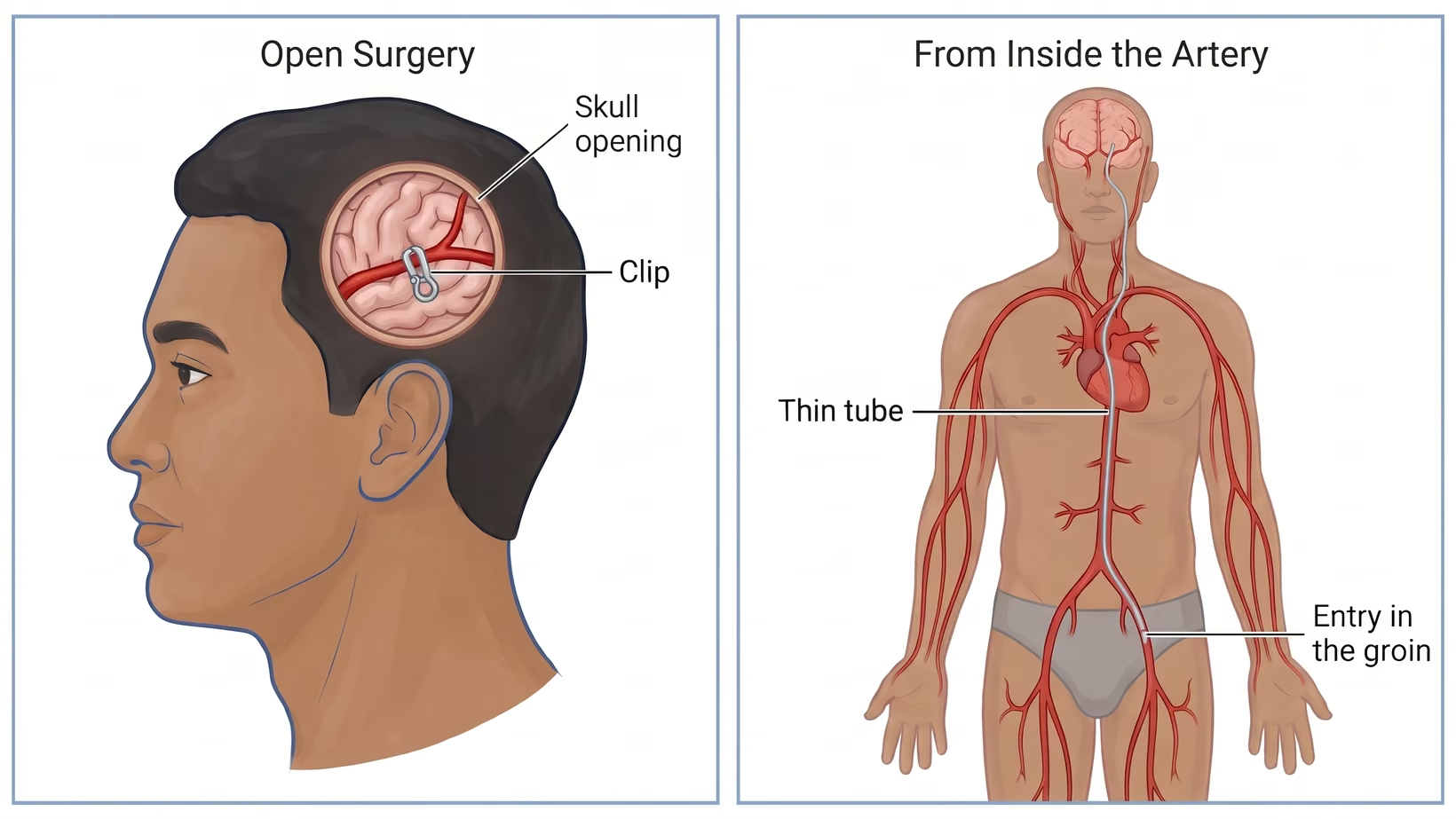
Brain aneurysm surgery closes off a bulge on a brain blood vessel so blood stops flowing into it. Clipping places a small metal clip in an open operation. Coiling and flow diverters work from inside the artery, through a thin tube. A burst aneurysm is treated at the earliest opportunity.
How is a brain aneurysm treated?
A brain aneurysm is treated by sealing it off from the blood flow. Surgeons do this in one of three ways: clipping, coiling or a flow diverter. The choice depends on the aneurysm and on your condition. Your surgeon will talk to you about the way they feel is most suitable for you.
A brain aneurysm is a bulge on the wall of a blood vessel in the brain. Treatment aims to stop blood from entering the bulge.
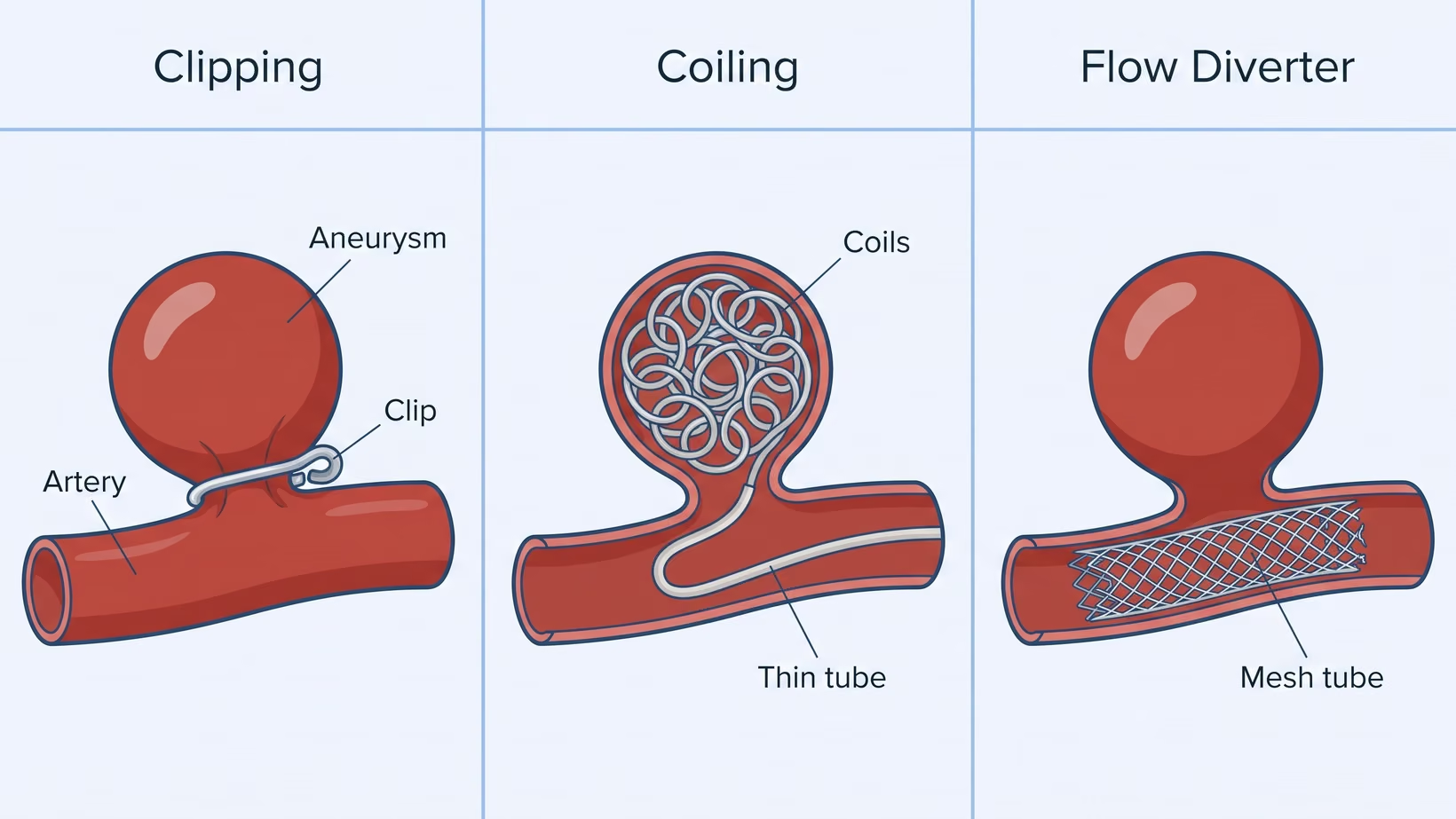
- Clipping: a small metal clip is attached to the blood vessel to seal the aneurysm. It is an open operation on the brain.
- Coiling: tiny metal coils are passed up a thin tube into the aneurysm to block it.
- Flow diverter: a stent, which is a fine mesh tube, is placed inside the artery where the aneurysm is. It is also placed through a thin tube.
For a burst aneurysm, two specialists decide together: a neurosurgeon (a brain surgeon) and an interventional neuroradiologist (a doctor who treats blood vessels from inside). They look at your condition, the aneurysm, and how much blood there is and where. For an aneurysm that has not burst, a European guideline suggests a team decision shared with you. Each option fits some aneurysms better. How doctors choose between clipping and coiling depends on these same points.
Why is a burst aneurysm treated quickly?
A burst aneurysm is treated quickly because it can bleed again. A Cochrane review found that, if it is not treated, around 30 in 100 people admitted to hospital with a burst aneurysm bleed again in the first month. The risk of bleeding again is highest within 24 hours of the first symptoms. For this reason, the NICE guideline from the United Kingdom says treatment is carried out at the earliest opportunity.
Does every brain aneurysm need surgery?
Not every brain aneurysm needs surgery. Small brain aneurysms that are not causing symptoms usually do not need treatment. An aneurysm that has already burst, or is at risk of bursting, will usually need surgery. For an aneurysm that has not burst, the decision weighs the risk of it bursting against the risk of the operation.
The European Stroke Organisation suggests treatment when the estimated risk of bursting within 5 years is higher than the risk of the treatment. It suggests a team of a neurosurgeon, a neuroradiologist and a neurologist. The final choice is shared between that team and you. It rates the evidence for all its advice on aneurysms that have not burst as “very low”.
A large study called ISUIA followed people with aneurysms that had not burst. The risk of bursting was often equal to or lower than the risk of repairing a similar aneurysm. Age strongly predicted how people did after open surgery. The size and location of the aneurysm predicted how people did after either open surgery or treatment from inside the artery.
When should you see a doctor, and how soon?
Go to the nearest hospital emergency room now, with someone else driving, if you have signs of a burst aneurysm. A burst aneurysm causes a subarachnoid hemorrhage, a bleed around the brain. For headaches that keep coming back or pain around the eye, ask for an urgent appointment with a doctor.
Seek care now
Go to the emergency room now if
Go to the nearest hospital emergency room now, with someone else driving. The signs include, but are not limited to:
- A sudden, severe headache that reaches its worst within 1 to 5 minutes (a thunderclap headache)
- A headache that is extremely painful and does not go away
- Neck pain or stiffness, or a neck that is painful to bend forward
- Pain from light
- Nausea and vomiting
- Reduced consciousness, meaning drowsy or hard to wake
- A seizure
- New weakness or loss of function in part of the body
- Weakness in the face: one side may droop, and it may be hard to smile
- Weakness or numbness in one arm or down one side of the body
- Speech problems, such as slurred words, sounding confused, or trouble finding the right words
- Blurred vision or loss of sight in one or both eyes
Ask for an urgent appointment if
Ask for an urgent appointment with a doctor if:
- You keep getting headaches, they do not go away, or they are getting worse
- You have pain above or around your eye. If you also have an enlarged pupil with blurred or double vision, go to the nearest hospital emergency room now, with someone else driving.
- You have any other symptoms of a brain aneurysm that do not go away
After treatment for a burst aneurysm, NICE advises a written follow-up care plan. It names who to contact at the specialist center if you have questions or concerns.
What to do now
Your next step
Start with where you are now.
- Signs of a burst aneurysm: go to the nearest hospital emergency room now, with someone else driving.
- Symptoms in the urgent list above: ask for an urgent appointment with a doctor.
- An aneurysm found on a scan, with no symptoms: book a consultation with a neurosurgeon.
- Bring your CT or MRI scans on a disc, with their written reports.
- Bring your angiogram, a scan of the blood vessels, if you had one.
- Bring a list of all your medicines, including any blood thinner.
I treat brain aneurysms by clipping. I see adults at the Lung Center of the Philippines clinic on Tuesday and Thursday from 2 PM. I see children at the Philippine Children’s Medical Center on Wednesday from 2 PM.
If travel is not practical, book an online consult on the consultation page. Your doctor can also refer you.
What is aneurysm clipping?
Aneurysm clipping is an open operation that seals the aneurysm from outside the blood vessel. You are asleep under general anesthesia. The surgeon opens the skull, finds the aneurysm under a microscope, and attaches a small metal clip to the blood vessel. In long-term trials, clipped aneurysms needed a second treatment less often than coiled ones.
The Barrow Ruptured Aneurysm Trial (BRAT) followed people with burst aneurysms for 10 years. Poor outcomes and deaths did not differ between clipping and coiling over that time. The difference was in how well the aneurysm stayed closed.
Among the people in BRAT who actually had each treatment, 2 of 241 clipped aneurysms needed treatment again after the first hospital stay. For coiled aneurysms it was 23 of 115. At 10 years, 50 of the 54 clipped aneurysms that were scanned were completely closed (93 percent). For coiled aneurysms it was 5 of 23 (22 percent).
BRAT was done in one hospital. Only a small number of people had a scan at 10 years. Still, a review of the two trials that followed people for 10 years found the same pattern: retreatment was more common after coiling.
I perform clipping. For a planned operation in an adult, I operate at the Lung Center of the Philippines and the National Kidney and Transplant Institute, both in Quezon City.
What is aneurysm coiling?
Aneurysm coiling seals the aneurysm from inside the blood vessel. It is done under general anesthesia. A thin tube, called a catheter, is passed up through the arteries to the aneurysm. Tiny metal coils are passed up the tube into the aneurysm to block it.
Where coiling suits an aneurysm better, it is done by an endovascular specialist, a doctor who treats blood vessels from the inside.
The largest trial was ISAT. It enrolled people with a burst aneurysm that suited both treatments. Most of them were in good condition, with small aneurysms at the front of the brain. At 1 year, about 24 in 100 people who had coiling were dead or dependent on others. After clipping, it was about 31 in 100.
In ISAT, seizures were less common after coiling. The risk of bleeding again later was low, but higher after coiling. BRAT showed that coiled aneurysms also needed treatment again more often. Coiling is one of the options, and the team weighs it against clipping for each aneurysm.
What is a flow diverter?
A flow diverter is a stent, a fine mesh tube, placed inside the artery where the aneurysm is. Like coiling, it is put in through a thin tube from inside the blood vessel. A European guideline suggests a flow diverter as an option only when there are no other low-risk options for an aneurysm that has not burst.
A 2013 review pooled 29 studies of 1,451 people treated with flow diverters. At 6 months, 76 in 100 aneurysms were completely closed. About 5 in 100 people had harm caused by the procedure, and about 4 in 100 died from it.
About 6 in 100 people had a stroke from a blocked blood vessel. People with aneurysms at the back of the brain had a higher risk of stroke. These studies were not trials, and they used early devices. The review did not compare flow diverters with clipping or coiling.
How long does brain aneurysm surgery take?
How long brain aneurysm surgery takes depends on the aneurysm, where it is, and which method is used. Your surgeon tells you the expected time at the consultation. Clipping and the treatments from inside the artery are both done under general anesthesia. You are asleep for the whole procedure.
Ask your surgeon these questions before the operation:
- How long will the operation take?
- How long will I stay in the intensive care unit (ICU)?
- How long will I stay in the hospital?
What are the risks of aneurysm surgery?
Every method of brain aneurysm surgery carries risk. That risk is weighed against the risk of leaving the aneurysm alone. For aneurysms that had not burst, the ISUIA study found the risk of repair was often equal to or higher than the risk of bursting. Age predicted how people did after open surgery. The aneurysm’s size and location predicted results after both methods.
For a burst aneurysm, the trials compared clipping and coiling directly. In ISAT, seizures were less common after coiling. The risk of bleeding again later was low, but higher after coiling. In the UK group of ISAT, the risk of bleeding again was small.
A Cochrane review looked for complications caused by the treatment itself. Only two small trials, with 129 people in all, measured them. They found no clear difference between coiling and clipping. The review rated this evidence as low quality.
Flow diverters carry their own risks. In the 2013 review of 29 studies, about 3 in 100 people had bleeding around the brain after the procedure. About 3 in 100 had bleeding inside the brain, and about 6 in 100 had a stroke.
Before you sign the consent form, your surgeon explains the risks for your own aneurysm. Ask what each risk means for you.
What does recovery from aneurysm surgery look like?
Recovery after brain aneurysm surgery includes regular follow-up visits, rehabilitation where it is needed, and advice on returning to work, driving and exercise. After a burst aneurysm, the bleed itself can cause problems such as seizures, memory problems and tiredness.
After going home, go to the nearest hospital emergency room now, with someone else driving, if you have any sign in the emergency list above, such as a seizure or a sudden, severe headache.
After a subarachnoid hemorrhage, people may have:
- Seizures
- Heart, lung or liver problems
- Problems with memory, concentration and communication
- Depression and mood changes
- Feeling restless and extremely tired
- Headaches and unusual feelings in the head
NICE advises a written follow-up care plan after a burst aneurysm. It also advises rehabilitation, and advice on returning to work, exercise, driving and sexual activity. At discharge, doctors check that you have advice on wound care and medicines. NICE also advises doctors to consider follow-up scans, based on the treatment you had. This applies to recovery after clipping as well as after coiling.
Clipping vs coiling: what referring doctors should know
For a ruptured aneurysm, NICE offers coiling, or clipping if coiling is not suitable. ISAT, the largest trial, enrolled a selected group. The 10-year trials found more retreatment after coiling. Randomized data on aneurysms of the middle cerebral artery, a main artery on the side of the brain, suggest clipping may work better.
What the clipping and coiling trials show, and which patients they apply to
ISAT randomized 2,143 patients with ruptured aneurysms suitable for both treatments. At 1 year, 250 of 1,063 (23.5 percent) allocated coiling were dead or dependent, against 326 of 1,055 (30.9 percent) allocated clipping. Its results apply to patients like those it enrolled.
Those patients were in clinical equipoise, meaning their doctors judged either treatment suitable. Of them, 88 percent were in good clinical grade (WFNS grade 1 or 2) with anterior circulation aneurysms, at the front of the brain, smaller than 10 mm. Enrollment ranged from about 50 in 100 to under 2 in 100 patients, depending on the center. The Cochrane review found no reliable trial evidence for patients in poor clinical condition.
In the UK cohort of ISAT at 10 years, 674 of 809 (83 percent) allocated coiling and 657 of 835 (79 percent) allocated clipping were alive. Independence at 10 years, 82 percent against 78 percent, was not significantly different.
BRAT, at 10 years, found no significant difference in mRS score above 2, meaning dependent, or death. In BRAT, 64 of 178 patients assigned coiling (about 36 in 100) crossed over to clipping. A 2022 meta-analysis of the two 10-year trials found no long-term difference in functional outcome, deaths, rebleeding or occlusion, meaning how well the aneurysm was blocked off. Retreatment was more common after coiling.
For middle cerebral artery aneurysms, interim data from CURES and ISAT-2 covered 171 patients. Treatment failure of unruptured aneurysms was 3 of 42 with clipping against 13 of 48 with coiling. Complete occlusion at 1 year was 30 of 40 against 14 of 40 (unruptured), and 24 of 34 against 15 of 28 (ruptured).
NICE’s preference for coiling, in recommendation 1.2.6, should be read with these limits. For unruptured aneurysms, the European guideline cannot recommend endovascular over microsurgical treatment.
When and how to refer a patient with an aneurysm
Refer a patient with suspected subarachnoid hemorrhage to an emergency department immediately. If the patient cannot describe the onset, NICE advises asking anyone who saw it, without delaying referral. Once the aneurysm is confirmed, the neurosurgeon and the interventional neuroradiologist plan treatment together.
For an unruptured aneurysm, the European guideline suggests a check by a team in neurosurgery, neuroradiology and neurology, with shared decision-making.
Send these with the patient:
- The CT, CT angiogram or MR angiogram images on a disc
- The radiologist’s report
- A history of how the headache began
- A list of medicines, including any blood thinner
I perform clipping and can see your patient for an opinion. A patient who needs admission soon can be admitted under my care at Capitol Medical Center, Quezon City. A patient who needs an ICU bed quickly can be transferred to Manila Central University (MCU) Hospital, Caloocan.
Frequently asked questions
Can an aneurysm come back after clipping or coiling?
A treated aneurysm can need treatment again, and this happens more often after coiling than after clipping. In BRAT, 23 of 115 coiled aneurysms needed retreatment, against 2 of 241 clipped ones. In ISAT, the risk of bleeding again later was low, but higher after coiling.
Will I need scans after treatment?
You may need follow-up scans after brain aneurysm treatment. For an aneurysm that had not burst, a European guideline suggests scans after it is closed, to find it if it comes back. After a burst aneurysm, NICE advises doctors to consider follow-up scans, planned around the treatment you had.
Am I asleep during brain aneurysm surgery?
You are asleep during brain aneurysm surgery. Clipping and the treatments from inside the artery are both done under general anesthesia. This means you are asleep and do not feel the procedure while it is being done.
Can children have brain aneurysm surgery?
Children can have brain aneurysm surgery. I treat brain aneurysms in children at the Philippine Children’s Medical Center (PCMC), Quezon City. My clinic there is on Wednesday from 2 PM. If travel is not practical, an online consult can be booked on the consultation page.
See sources
- National Institute for Health and Care Excellence (NICE). Subarachnoid haemorrhage caused by a ruptured aneurysm: diagnosis and management (NICE guideline NG228). 2022. https://www.nice.org.uk/guidance/ng228/chapter/Recommendations
- NHS. Brain aneurysm. NHS website (nhs.uk). 2025. https://www.nhs.uk/conditions/brain-aneurysm/
- Molyneux AJ, et al. International subarachnoid aneurysm trial (ISAT) of neurosurgical clipping versus endovascular coiling in 2143 patients with ruptured intracranial aneurysms: a randomised comparison of effects on survival, dependency, seizures, rebleeding, subgroups, and aneurysm occlusion. Lancet. 2005. PMID 16139655; doi:10.1016/S0140-6736(05)67214-5
- Lindgren A, et al. Endovascular coiling versus neurosurgical clipping for people with aneurysmal subarachnoid haemorrhage. Cochrane Database of Systematic Reviews. 2018. PMID 30110521; doi:10.1002/14651858.CD003085.pub3
- Molyneux AJ, et al. The durability of endovascular coiling versus neurosurgical clipping of ruptured cerebral aneurysms: 18 year follow-up of the UK cohort of the International Subarachnoid Aneurysm Trial (ISAT). Lancet. 2015. PMID 25465111; doi:10.1016/S0140-6736(14)60975-2
- Spetzler RF, et al. Ten-year analysis of saccular aneurysms in the Barrow Ruptured Aneurysm Trial. Journal of Neurosurgery. 2019. PMID 30849758; doi:10.3171/2018.8.JNS181846
- Rabelo NN, et al. Long-term outcomes of ruptured saccular intracranial aneurysm clipping versus coiling: systematic review and meta-analysis of randomized controlled trials. Neurological Sciences. 2022. PMID 35359214; doi:10.1007/s10072-022-06039-2
- Wiebers DO, et al; International Study of Unruptured Intracranial Aneurysms Investigators. Unruptured intracranial aneurysms: natural history, clinical outcome, and risks of surgical and endovascular treatment. Lancet. 2003. PMID 12867109; doi:10.1016/s0140-6736(03)13860-3
- Etminan N, et al. European Stroke Organisation (ESO) guidelines on management of unruptured intracranial aneurysms. European Stroke Journal. 2022. PMID 36082246; doi:10.1177/23969873221099736
- Brinjikji W, et al. Endovascular treatment of intracranial aneurysms with flow diverters: a meta-analysis. Stroke. 2013. PMID 23321438; doi:10.1161/STROKEAHA.112.678151
- NHS. Subarachnoid haemorrhage. NHS website (nhs.uk). 2025. https://www.nhs.uk/conditions/subarachnoid-haemorrhage/
- Darsaut TE, et al. Surgical or Endovascular Management of Middle Cerebral Artery Aneurysms: A Randomized Comparison. World Neurosurgery. 2021. PMID 33556601; doi:10.1016/j.wneu.2021.01.142
- NHS. Double vision. NHS website (nhs.uk). https://www.nhs.uk/conditions/double-vision/