
A brain aneurysm, a bulge on a brain artery, has a low chance of bursting: about 1 in 100 a year in a large study in Japan. It is higher for larger or growing aneurysms, some locations and some people. A sudden, severe headache, the main sign of a burst, means the nearest emergency room now, with someone else driving.
Will my aneurysm burst? The chance and risk of rupture per year
The average chance that an unruptured brain aneurysm bursts in one year was low in each of the large studies, under 2 in 100. In a study of 5,720 people in Japan, about 1 in 100 aneurysms burst each year (0.95 percent). In the pooled data from six studies behind the PHASES score, about 14 in 1,000 people had a burst within one year (1.4 percent).
An unruptured brain aneurysm is a bulge on an artery in the brain that has not bled. The European guideline says about 3 in 100 people have one. Most brain aneurysms are small and do not cause symptoms. They are often found during a test for another condition.
The yearly figures differ between studies because each study followed different people. In the European guideline’s pooled data from nine studies, the chance was about 8 in 1,000 in one year (0.81 percent). Over five years, the PHASES data gave about 34 in 1,000 (3.4 percent).
The authors of the Japanese study say their yearly figure may be too low. They stopped counting a person once that person had surgery on the aneurysm.
These averages describe large groups. Your own chance depends on the size of the aneurysm, where it sits, whether it grows, and your own health.
Does the size of the aneurysm change the chance?
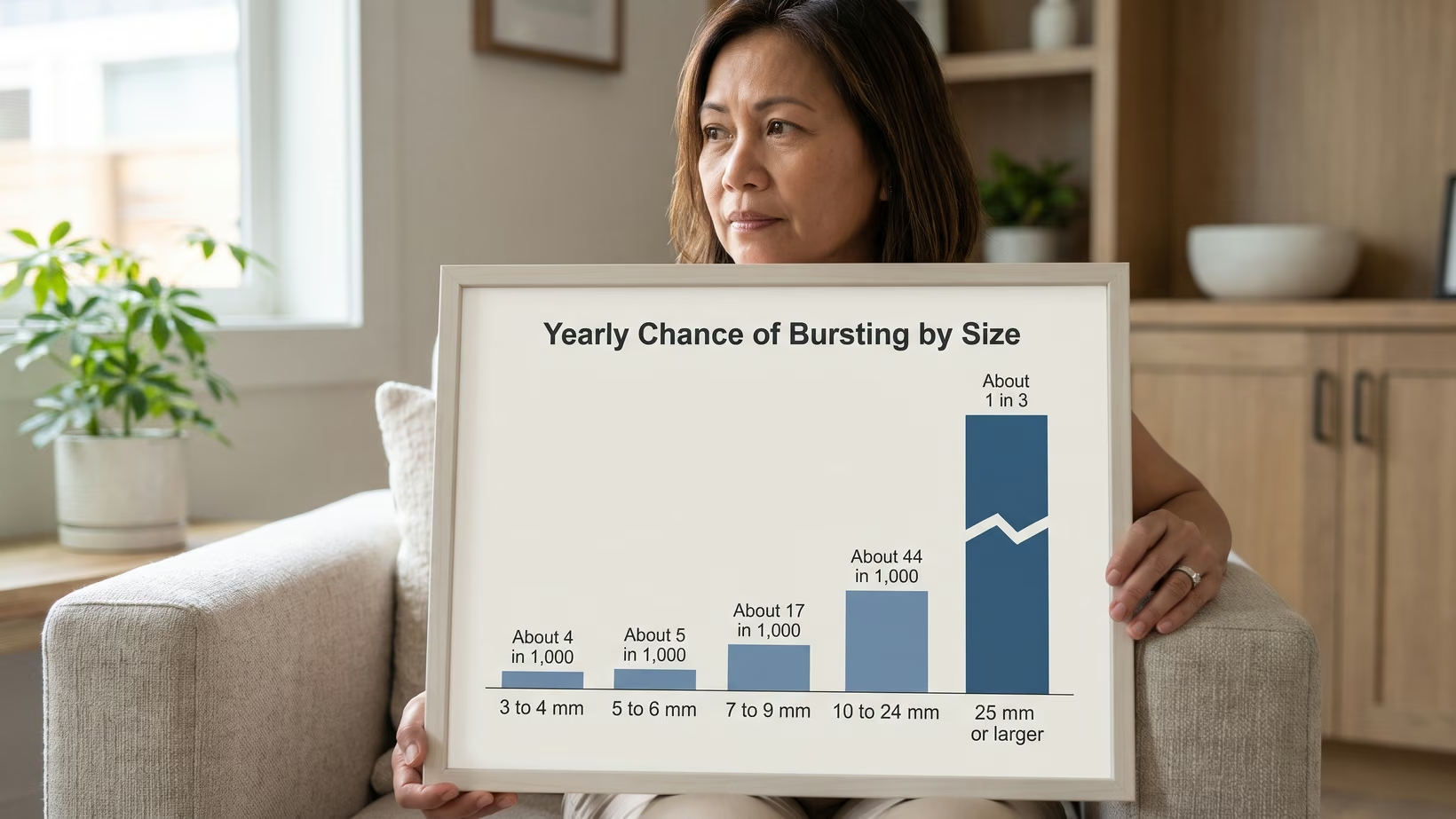
The size of an aneurysm does change its chance of bursting. In the large study in Japan, the chance rose as aneurysms got bigger. The yearly chance for each aneurysm, by its size in millimeters (mm), was:
- About 4 in 1,000 at 3 to 4 mm (0.36 percent)
- About 5 in 1,000 at 5 to 6 mm (0.50 percent)
- About 17 in 1,000 at 7 to 9 mm (1.69 percent)
- About 44 in 1,000 at 10 to 24 mm (4.37 percent)
- About 1 in 3 at 25 mm or larger (33.40 percent)
The chance was clearly higher for every aneurysm of 7 mm or larger. These are the sizes doctors use when they read a brain aneurysm size chart with you.
Seek care now
When is it an emergency? Signs an aneurysm has burst
A burst aneurysm causes a bleed on the brain called a subarachnoid hemorrhage. Its main symptom is a sudden, severe headache, sometimes called a thunderclap headache.
Go to the nearest hospital emergency room now, with someone else driving, if you or someone else suddenly gets:
- A headache that is extremely painful
- Weakness in the face: one side may droop, and it may be hard to smile
- Weakness or numbness in one arm or down one side of the body, so you may not be able to lift both arms and keep them up
- Speech problems: slurred words, sounding confused, or trouble speaking or finding the right words
- Blurred vision or loss of sight in one or both eyes
- Neck pain or stiffness, discomfort from light, nausea and vomiting, a seizure, or being less awake than normal
Ask for an urgent appointment with a doctor if:
- You keep getting headaches, or they do not go away, or they are getting worse
- You have pain above or around your eye
- You have any other symptom of a brain aneurysm that does not go away
Doctors also treat these as signs of a possible bleed: neck pain or stiffness, discomfort from light, nausea and vomiting, a seizure, or reduced consciousness, meaning being less awake than normal. A sudden severe headache with vomiting is one of these signs. A possible bleed needs the nearest hospital emergency room now.
A larger aneurysm that has not burst may cause symptoms: a headache, pain above or around the eye, changes in vision such as double vision, dizziness and balance problems, numbness or weakness on one side of the face, trouble concentrating and speaking, and problems with short-term memory.
If one of these symptoms does not go away, ask for an urgent appointment with a doctor. If face weakness, speech problems or loss of sight come on suddenly, go to the nearest hospital emergency room now, with someone else driving.
Does an aneurysm’s location change its chance of bursting?
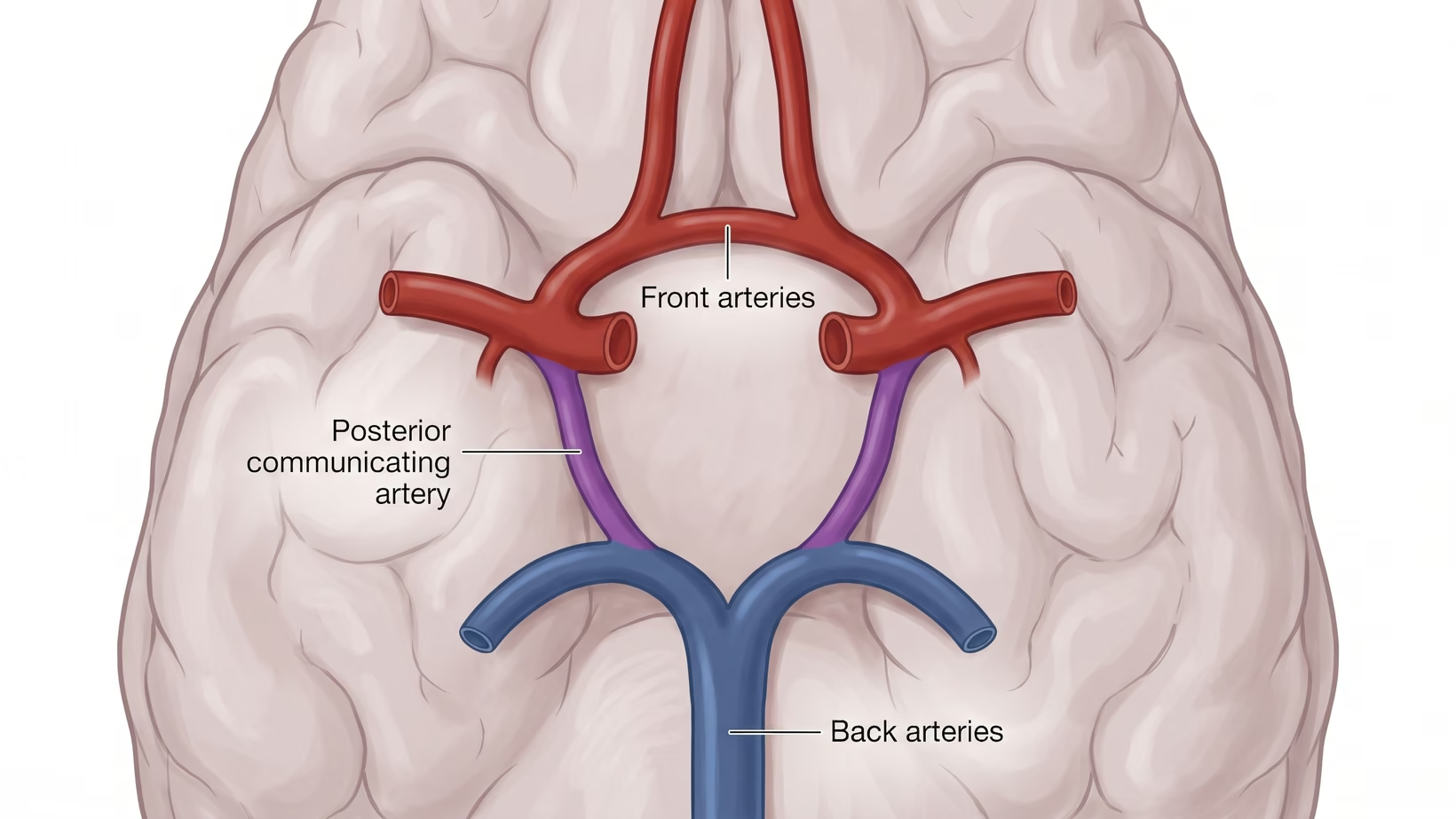
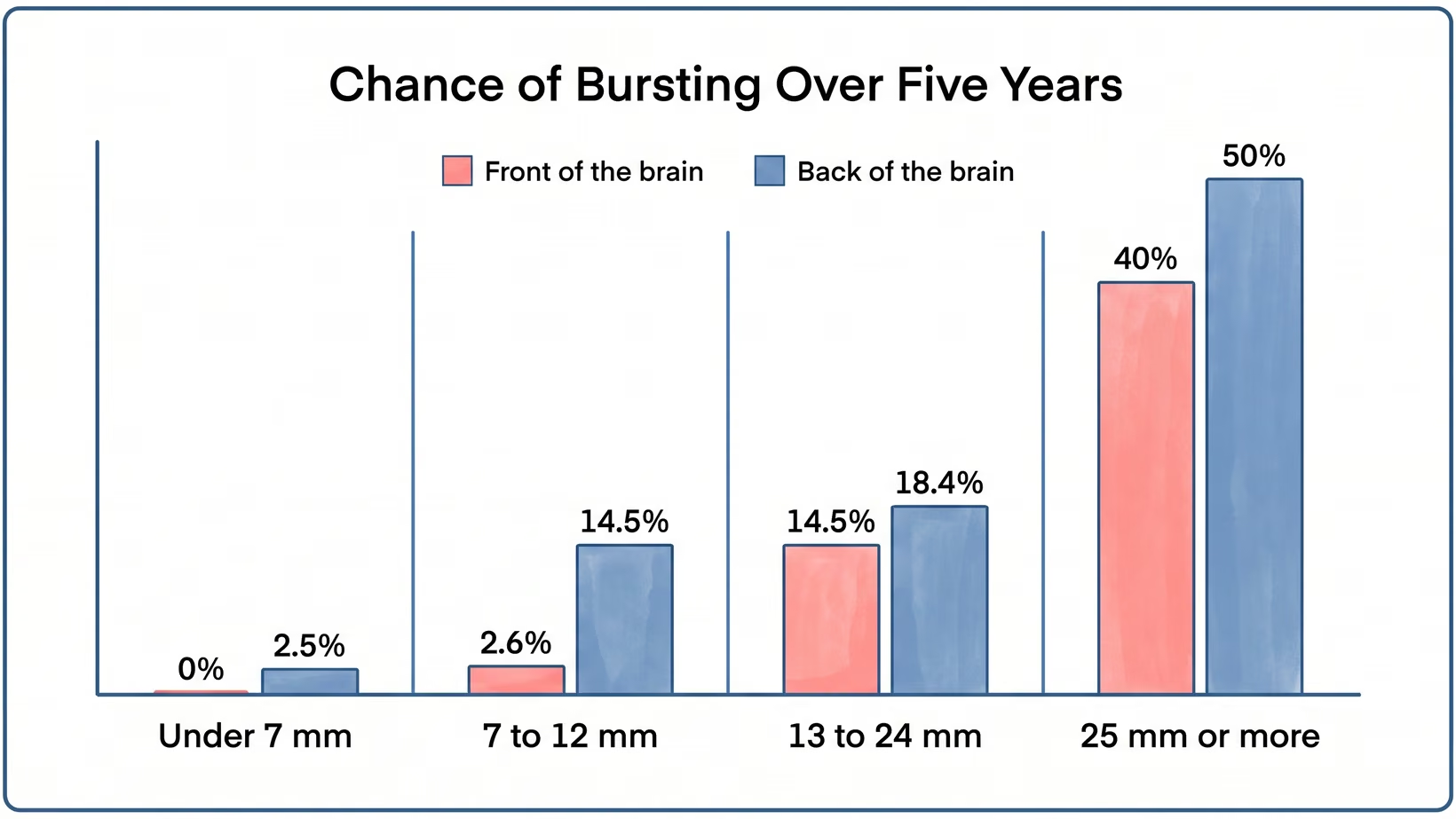
The location of an aneurysm does change its chance of bursting. In the ISUIA study, aneurysms on the arteries at the back of the brain and on the posterior communicating artery burst more often than those at the front, at every size. The study measured this difference, but it did not explain why it happens.
ISUIA followed 4,060 patients at centers in the USA, Canada and Europe. Its front group was aneurysms on the internal carotid artery, the anterior communicating or anterior cerebral artery, and the middle cerebral artery. Its back group was the arteries at the back of the brain together with the posterior communicating artery.
In people who had never had a bleed from an aneurysm, the chance of a burst over five years was:
- Under 7 mm: none at the front, and about 25 in 1,000 at the back (2.5 percent)
- 7 to 12 mm: about 26 in 1,000 at the front (2.6 percent), and about 15 in 100 at the back (14.5 percent)
- 13 to 24 mm: about 15 in 100 at the front (14.5 percent), and about 18 in 100 at the back (18.4 percent)
- 25 mm or more: 40 in 100 at the front, and 50 in 100 at the back
These are chances over five years. The Japanese figures earlier in this post are chances per year, so the two sets cannot be compared directly. As a yearly rate, ISUIA put the chance at about 1 in 1,000 for aneurysms under 7 mm in people who had never bled.
The large study in Japan also looked at location. Aneurysms on the anterior and posterior communicating arteries were more likely to burst than those on the middle cerebral artery. Aneurysms with a daughter sac, an irregular bulge on the wall of the aneurysm, were also more likely to burst.
What is the PHASES score for rupture risk?
The PHASES score is a tool that estimates the chance of an unruptured brain aneurysm bursting over the next five years. It was built from the records of 8,382 people in six studies that followed people forward in time. Its makers called it an easy aid for predicting rupture.
A doctor enters your own details into the score to get a five-year estimate. In people from North America and Europe outside Finland, the estimate ranged from about 1 in 400 (0.25 percent) to more than 15 in 100.
The lowest chance was in people younger than 70 with no risk factors for blood vessel disease. Their aneurysm was small, under 7 mm, on the internal carotid artery, a large artery that carries blood to the brain.
The highest chance was in people aged 70 or older with high blood pressure and an earlier bleed from an aneurysm. Their aneurysm was giant, over 20 mm, on the arteries at the back of the brain.
The factors in the score are linked to bursting. The study did not show that they cause it.
What does the PHASES score count?
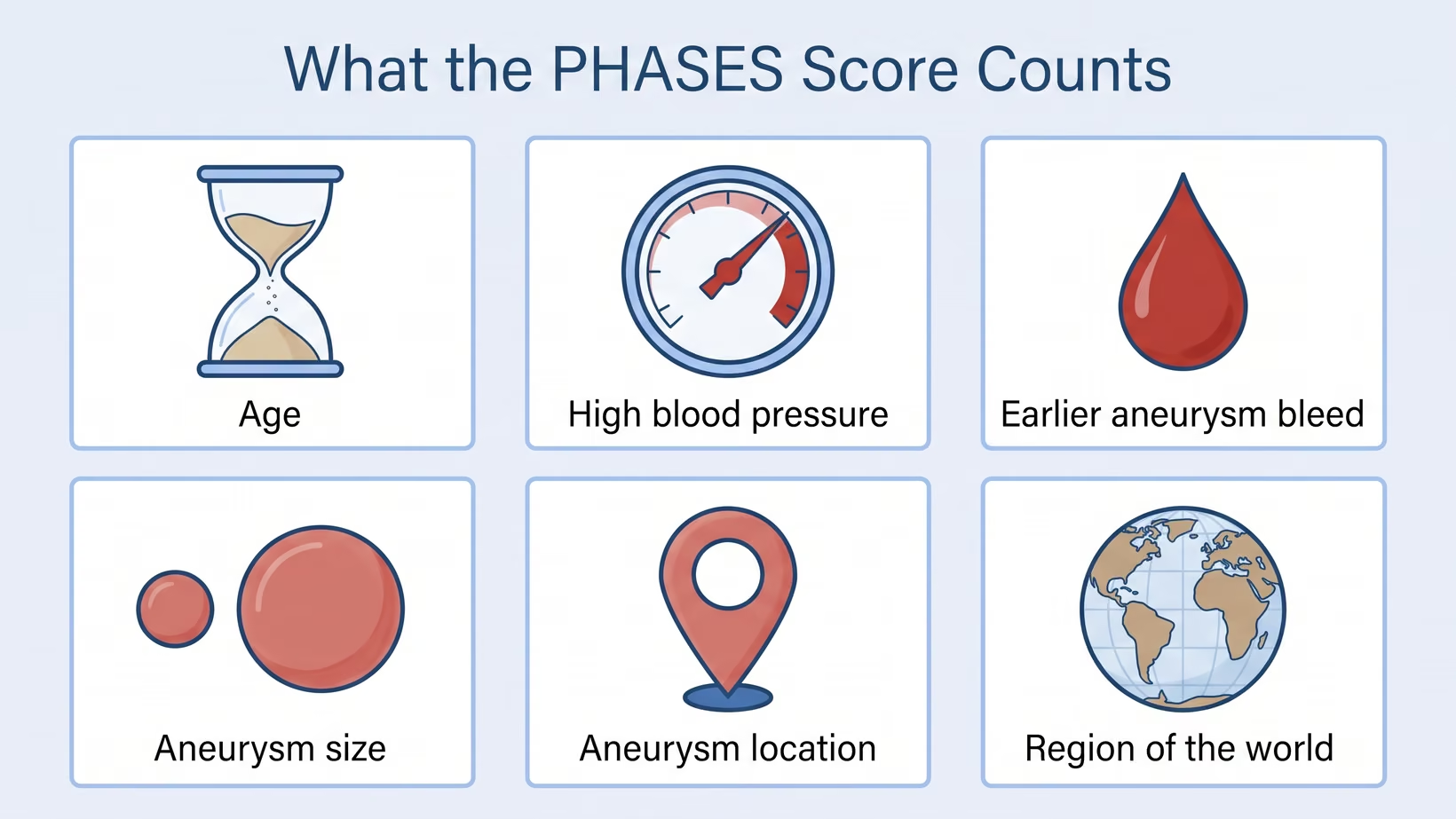
The PHASES score counts six things. These are your age, high blood pressure, an earlier bleed from an aneurysm, the size of the aneurysm, its location, and the region of the world you come from.
Region is in the score because the chance differed between groups of people. Finnish and Japanese people had a higher chance of rupture than people from North America and the rest of Europe.
Why are two people with the same aneurysm advised differently?
Two people with the same aneurysm can be advised differently because the decision weighs the chance of a burst against the risk of the repair, for each person. The ISUIA authors said both should be compared for each patient. Age, for example, strongly predicted how people did after open surgery.
The European guideline suggests a planned repair when the estimated five-year chance of a burst is higher than the risk of the treatment. In an early report from one trial that the guideline quotes, about 4 in 100 people (3.6 to 4.2 percent) were left needing help in daily life, or worse, one year after repair, whether by clipping or by coiling. That risk changes with the shape of the aneurysm, calcium in its wall, its location, the devices used, and other illnesses.
The guideline says all of its advice rests on very low-quality evidence, so it is written as a suggestion, not a rule. It suggests that a team checks each patient: specialists in neurosurgery, neuroradiology (brain scans) and neurology. The decision is shared. The team’s advice and what you want both count.
Some teams use a scoring tool called UIATS, built by agreement among experts from many fields. It adds up points in favor of repair and points in favor of watching. A difference of 3 points or more favors one choice. A difference of 2 points or fewer means either choice can be supported.
Clipping closes the aneurysm from outside the artery. Coiling fills it from inside the artery. The guideline has no general preference between clipping and coiling. Your age, sex, any blood thinner (anticoagulant) you take, and the site and shape of the aneurysm guide the choice.
I perform clipping, the open operation. Where coiling suits an aneurysm better, an endovascular specialist does it.
What happens if the aneurysm grows?
An aneurysm that grows has a higher chance of bursting. The European guideline calls growth of 1 mm or more in any direction a strong risk factor. In growing aneurysms that were not repaired, about 3 in 100 burst within six months, about 4 in 100 within a year, and about 6 in 100 within two years.
The guideline suggests follow-up scans for people who are being watched, to find growth. If a scan shows the aneurysm is larger than before, the decision whether to treat it is made again.
Do rupture risk figures from other countries apply to Filipinos?
The rupture figures in this post come from people in North America, Europe, Finland and Japan. The European guideline says the chance of rupture likely differs by where people live. I could not find a study that measured the chance of an aneurysm bursting in Filipino patients.
In the PHASES data, Finnish and Japanese people had a higher chance than people in North America and the rest of Europe. So a figure from one country may not fit another.
How often aneurysm bleeds happen in a whole population also differs by region. A worldwide review counted about 28 bleeds per 100,000 people a year in Japan and about 17 in Finland. It counted about 6 per 100,000 in Europe and about 7 in North America.
In Asia outside Japan, the review counted about 4 bleeds per 100,000 people a year. That figure was very uncertain, anywhere from 0.1 to 13.3. These are bleeds in a whole population. They are not the chance that a known aneurysm bursts.
Until the chance is measured in Filipino patients, these figures are a guide. Your doctor reads them together with your own scan and your health.
Can you lower the chance of it bursting?
You may be able to lower the chance of an aneurysm bursting by stopping smoking and treating high blood pressure. The European guideline names both as risk factors for aneurysms forming, growing and bursting. It suggests both for people being watched. The evidence for them is very low.
The guideline does not suggest starting aspirin or a statin, a cholesterol medicine, to lower the chance of a burst. If you already take aspirin for heart disease or to prevent another stroke, it does not suggest stopping it. Do not start or stop any medicine on your own. Ask the doctor who prescribed it.
Heavy physical exercise, straining and sex raise the chance of a burst for a short time afterward. The guideline says the actual chance after these activities is still very low.
What to do now
What to do next: who to see and how soon
Who to see, and how soon:
- A sudden, extremely painful headache, face or one-side weakness, speech problems, loss of sight, neck pain or stiffness, vomiting, a seizure, or being less awake than normal: the nearest hospital emergency room now, with someone else driving
- Headaches that keep coming, pain above or around the eye, or another aneurysm symptom that does not go away: an urgent appointment with a doctor
- An aneurysm found on a scan, with no symptoms: a consultation with a neurosurgeon, to talk through your chance of a burst and your choices
What to bring:
- The scan images on a disc or file, and the written report
- Any earlier scans, so the size can be compared
- A list of your medicines
- Your blood pressure readings
- Whether anyone in your family had an aneurysm or a brain bleed
If you are near Quezon City, you may see me at my clinic at the Lung Center of the Philippines, Tuesday and Thursday from 2 PM. If travel is not practical, you can book an online consult on the consultation page. Your own doctor can also refer you.
For referring doctors: estimating rupture risk and when to refer
For an incidental unruptured aneurysm, PHASES gives a five-year rupture estimate. It uses age, hypertension (high blood pressure), earlier subarachnoid hemorrhage, size, location and geographical region. The ESO 2022 guideline suggests preventive occlusion, which blocks blood from entering the aneurysm, when that risk exceeds the risk of treatment.
The guideline suggests that neurosurgery, neuroradiology and neurology check the patient together, with shared decision-making. UIATS weighs patient, aneurysm and treatment features, and each aneurysm in a patient with several is scored separately. For observed patients, it suggests imaging follow-up, smoking cessation and hypertension treatment, but not aspirin or statins to reduce rupture risk.
A thunderclap headache, a sudden severe headache typically peaking within 1 to 5 minutes, is a red flag for subarachnoid hemorrhage. Other signs include neck pain or stiffness, photophobia (discomfort from light), nausea and vomiting, and new altered brain function such as reduced consciousness, seizure, or a focal deficit like new weakness or numbness. Limited or painful neck flexion on examination is another.
Refer a patient with suspected subarachnoid hemorrhage seen outside an acute hospital to an emergency department immediately. CT is most accurate within 6 hours of symptom onset. For an unruptured aneurysm, send the CTA, MRA or angiogram images with reports, the medicine list and blood pressure history, through the consultation page.
Frequently asked questions
Can heavy lifting, exercise or sex make an aneurysm burst?
The European guideline says heavy physical exercise, straining and sex can raise the chance of an aneurysm bursting for a short time afterward. It also says the actual chance after these activities is still very low. If a sudden, extremely painful headache starts during or after any activity, go to the nearest hospital emergency room now, with someone else driving.
If I have more than one aneurysm, is my chance higher?
Your overall chance is the chances of all your aneurysms added together. In the large study in Japan, each aneurysm was not more likely to burst when a person had more than one. The experts who built the UIATS tool also say each aneurysm should be checked separately.
Is a 5 mm aneurysm more likely to burst than a 3 mm one?
A 5 mm aneurysm was not clearly more likely to burst than a 3 mm one in the large study in Japan. Aneurysms of 5 to 6 mm burst at about 5 in 1,000 a year, and those of 3 to 4 mm at about 4 in 1,000. The chance rose clearly from 7 mm.
Should I take aspirin to protect my aneurysm?
The European guideline does not suggest taking aspirin to lower the chance of an aneurysm bursting. If you already take aspirin for heart disease or to prevent another stroke, it does not suggest stopping it. Do not start or stop aspirin on your own. Ask the doctor who prescribed it and your neurosurgeon.
See sources
- Greving JP et al. Development of the PHASES score for prediction of risk of rupture of intracranial aneurysms: a pooled analysis of six prospective cohort studies. The Lancet. Neurology. 2014. PMID 24290159. doi:10.1016/s1474-4422(13)70263-1
- UCAS Japan Investigators et al. The natural course of unruptured cerebral aneurysms in a Japanese cohort. The New England journal of medicine. 2012. PMID 22738097. doi:10.1056/nejmoa1113260
- Wiebers DO et al. Unruptured intracranial aneurysms: natural history, clinical outcome, and risks of surgical and endovascular treatment. Lancet (London, England). 2003. PMID 12867109. doi:10.1016/s0140-6736(03)13860-3
- Etminan N et al. European Stroke Organisation (ESO) guidelines on management of unruptured intracranial aneurysms. European stroke journal. 2022. PMID 36082246. doi:10.1177/23969873221099736
- Etminan N et al. The unruptured intracranial aneurysm treatment score: a multidisciplinary consensus. Neurology. 2015. PMID 26276380. doi:10.1212/wnl.0000000000001891
- Etminan N et al. Worldwide Incidence of Aneurysmal Subarachnoid Hemorrhage According to Region, Time Period, Blood Pressure, and Smoking Prevalence in the Population: A Systematic Review and Meta-analysis. JAMA neurology. 2019. PMID 30659573. doi:10.1001/jamaneurol.2019.0006
- NHS website (nhs.uk). Brain aneurysm. NHS website (nhs.uk). 2025. https://www.nhs.uk/conditions/brain-aneurysm/
- National Institute for Health and Care Excellence. Subarachnoid haemorrhage caused by a ruptured aneurysm: diagnosis and management (NICE guideline NG228). National Institute for Health and Care Excellence. 2022. https://www.nice.org.uk/guidance/ng228/chapter/Recommendations