
Most pituitary tumors are benign, meaning not cancer. Only in rare cases does a pituitary tumor spread to other parts of the body. A benign tumor can still cause harm by pressing on the nerves for sight or by changing your hormone levels. A sudden headache with vomiting, sudden vision changes or drowsiness needs the nearest emergency room now.
What does “pituitary adenoma” mean?
A pituitary adenoma is a tumor of the pituitary gland. It grows from the hormone-making cells in the front part of the gland. For many years, scan and biopsy reports used this name. Since 2022, the World Health Organization (WHO) calls the same tumor a PitNET, so newer reports may use that word instead.
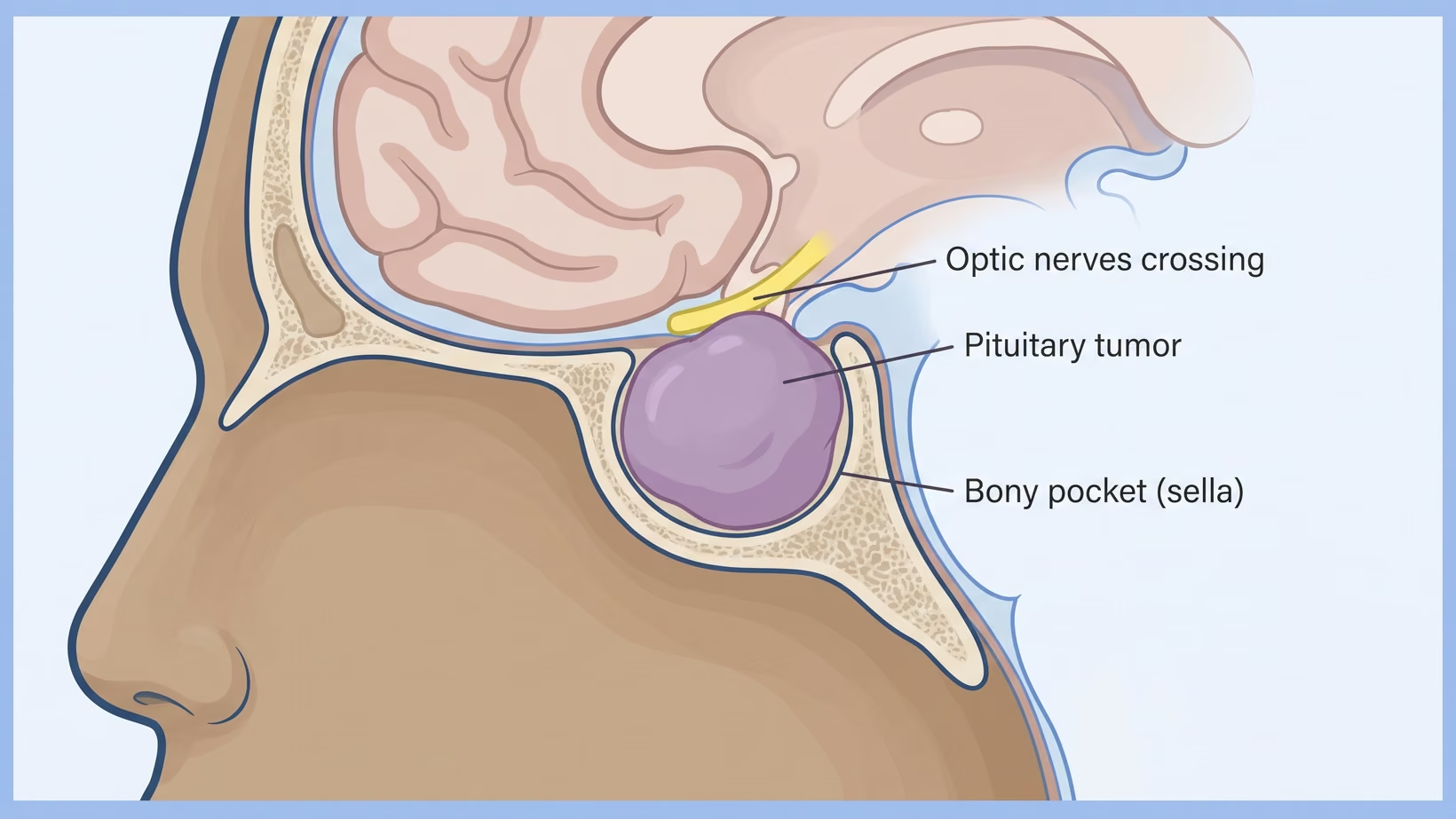
Some pituitary tumors make too much of one hormone, such as growth hormone, prolactin or cortisol. A larger tumor can press on what lies around it. That pressure can cause vision changes, headache, lack of energy, and nausea and vomiting.
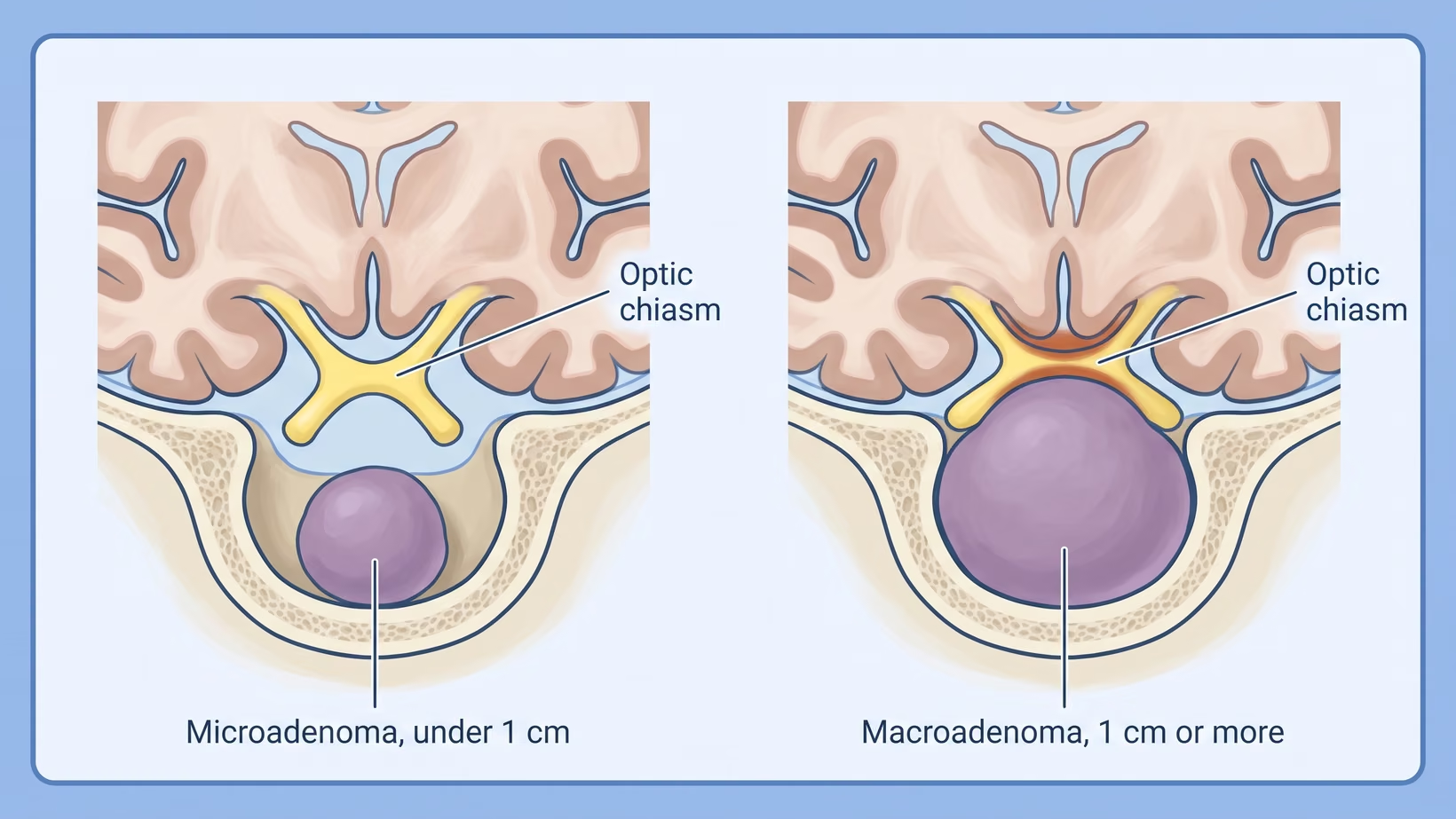
The nerves for sight are the optic nerves, and they meet at the optic chiasm. A tumor that touches them can change your side vision. This is why doctors test your side vision (visual field) when a tumor is close to these nerves.
Why newer reports say “PitNET”
Newer reports say PitNET because the 2022 WHO classification renamed pituitary adenomas as pituitary neuroendocrine tumors, or PitNETs. A report that says PitNET and an older report that says pituitary adenoma are naming the same kind of tumor. The new system also sorts each PitNET by the family of cells it comes from.
Is a pituitary tumor cancer or benign?
Most pituitary tumors are benign, which means they are not cancer. The European Society of Endocrinology’s 2025 guideline says most are well controlled with surgery or medicine. A small group keeps growing or coming back despite treatment. Spread of a pituitary tumor to distant parts of the body is rare.
Benign does not mean harmless. A benign pituitary tumor can still press on the nerves for sight. It can make too much of one hormone. The tumor, or its removal, may also cause lifelong hormone imbalances.
Doctors use three words for these tumors. Benign describes most of them. Aggressive describes the small group that keeps coming back or growing despite a combination of surgery, medicine or radiation treatment (radiotherapy). Metastatic describes a tumor that has spread to other parts of the body, which is rare.
The 2025 guideline links aggressive tumors to more illness and more deaths, even when they have not spread. It says that finding them early is hard but important. That is one reason your doctors repeat your scans and blood tests over time.
Pituitary carcinoma, now called metastatic PitNET
Pituitary carcinoma is the old name for a pituitary tumor that has spread to distant parts of the body. The 2022 WHO classification now calls it a metastatic PitNET. The WHO chose the new name so that it is not confused with neuroendocrine carcinoma, which is a different tumor. The 2025 European guideline calls this kind of spread rare.
What is an atypical pituitary adenoma?
Atypical pituitary adenoma is an older label that pathologists, the doctors who study tissue under a microscope, used for some pituitary tumors. The WHO stopped recommending the term in its 2017 classification. You may still see the word on an older report, or hear it from a doctor who trained with it.
In its place, the 2017 WHO system asks pathologists to measure how actively the tumor cells divide. Two measures do this: the mitotic count and the Ki-67 index. These are read together with clinical signs, such as whether the tumor has grown into nearby tissue (invasion). Together they help doctors recognize a tumor that may behave aggressively.
The 2022 WHO classification goes further. It sorts each tumor by its cell family and cell type. It also marks certain types that carry a higher risk of aggressive behavior.
If your report says atypical, ask your doctor what the cell measures and your latest scan show. Ask too which cell family the tumor belongs to.
Types of pituitary tumors: by what they do
Doctors sort pituitary tumors into two groups by what they do. A functioning tumor makes too much of one hormone, and the extra hormone causes the symptoms. A non-functioning tumor makes no extra hormone. It causes problems through its size, by pressing on the parts around it.
A functioning tumor causes different effects depending on the hormone it makes:
- Too much prolactin: milk-like discharge from the nipple and irregular or absent periods in women, and lower sexual function in men
- Too much growth hormone: gigantism, which is abnormal growth in a child, or acromegaly in an adult
- Too much cortisol: Cushing syndrome, where the body has a higher than normal level of cortisol
- Too much thyroid hormone (hyperthyroidism): an extremely rare effect of a pituitary tumor
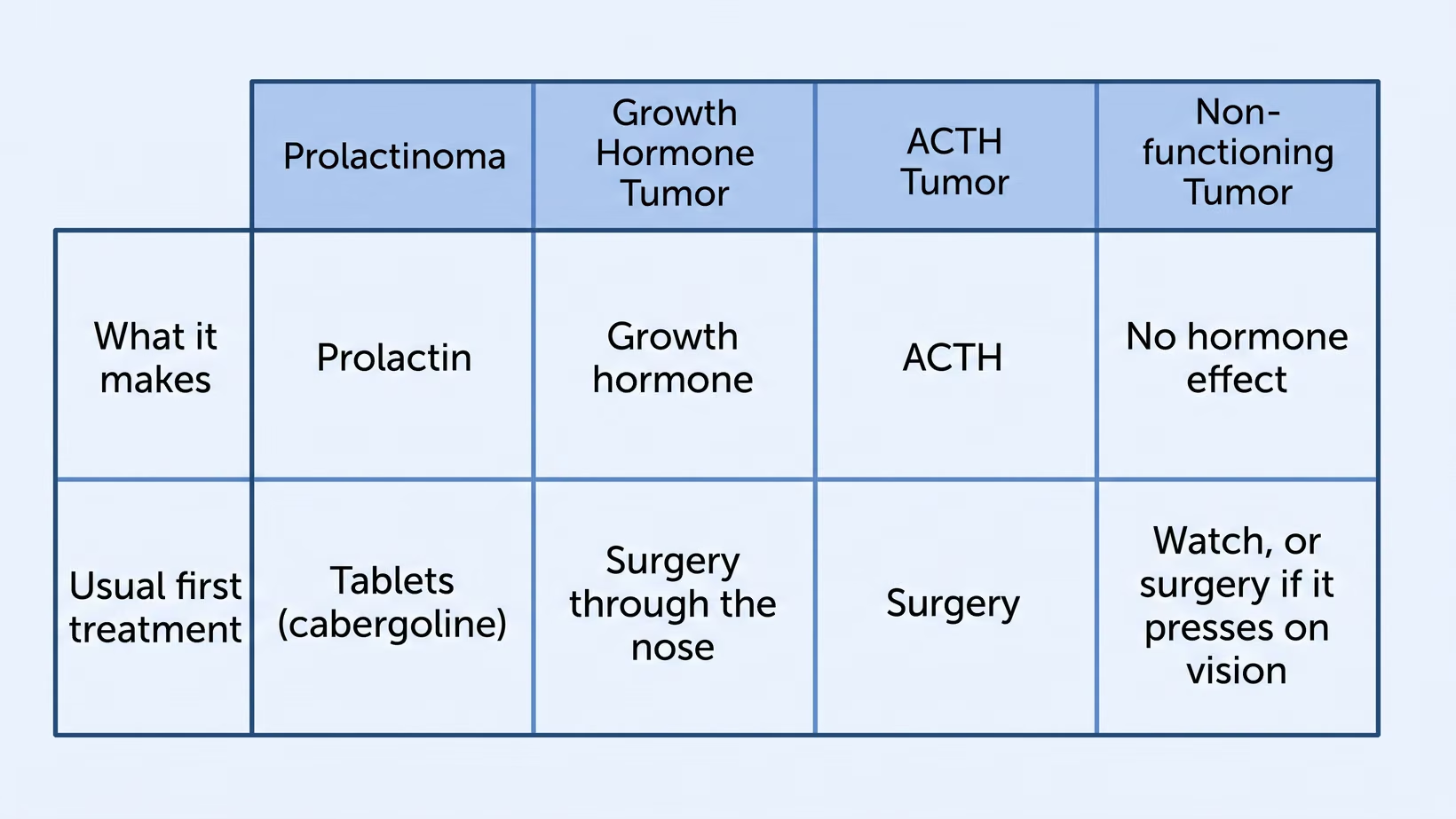
A tumor that makes prolactin is called a prolactinoma. Doctors treat prolactinoma, the pituitary tumor treated with tablets, with medicine first. A 2011 Endocrine Society guideline recommends medicine taken by mouth to lower prolactin, shrink the tumor and restore sexual and reproductive function.
A non-functioning tumor causes symptoms by pressure as it grows. The signs include double vision, loss of side vision, drooping eyelids and changes in color vision. Headache, lack of energy, nausea and vomiting can also appear.
Doctors also sort pituitary tumors by size. By convention, a tumor under 1 cm is a microadenoma. A tumor 1 cm or larger is a macroadenoma.
Seek care now
When should you see a doctor about a pituitary tumor?
Contact your doctor soon if you notice any symptom of a pituitary tumor, such as vision changes, headache or changes in your periods. A few signs cannot wait. They can mean pituitary apoplexy, which is bleeding into the gland or loss of its blood supply. Go to the nearest emergency room now for:
- A sudden headache, which can be severe
- Vomiting with the headache
- Sudden vision changes: loss of sight, double vision, loss of side vision or a drooping eyelid
- Drowsiness or confusion, or being hard to wake
The 2011 UK guideline calls pituitary apoplexy a medical emergency. Bleeding into a pituitary tumor is treated by a team that includes a neurosurgeon and an endocrinologist, a doctor for hormone problems.
What to do now
What to do next, and who to see
For the emergency signs, go to the nearest emergency room now. For slower symptoms:
- See your doctor soon when you notice a symptom, and ask for a referral to an endocrinologist and a neurosurgeon.
- Bring the disc with your MRI or CT scan pictures and its written report, your hormone blood results, your eye test results and a list of your medicines.
- Adults can book with me at the Lung Center of the Philippines, Room 1101, Quezon Avenue, Quezon City, on Tuesday and Thursday from 2 PM.
- I see children at the Philippine Children’s Medical Center, Room 22, Quezon Avenue corner Agham Road, Quezon City, on Wednesday from 2 PM.
- If travel is not practical, book an online consult on the consultation page.
- Your doctor can also refer you to me.
Pituitary adenoma life expectancy: does it shorten life?
Life expectancy with a pituitary adenoma depends on the type of tumor and how well it is controlled. If the tumor can be removed by surgery, the outlook is fair to good. That depends on whether the whole tumor is removed. The studies below compare death rates with those of the general population.
For non-functioning adenomas, a 2024 review found 11 studies, and five of them reported death rates. Across those five, people with the tumor had a higher death rate than the general population. This was seen whether their pituitary hormones were normal or low.
The same review reported a trend toward a larger difference in women and in people diagnosed at age 40 or younger. These studies show a link. They do not show that the tumor itself caused the deaths.
For acromegaly, a 2018 review of 26 studies found that death rates were not raised in people whose hormone levels were brought under control. Death rates were higher in people whose disease stayed active. In the nine studies published after 2008, death rates did not differ from the general population.
The small group of aggressive tumors is linked to more illness and more deaths, even without spread. For most people, the outlook depends on control of the tumor and its hormones.
What happens if a pituitary tumor goes untreated?
An untreated pituitary tumor may grow and press on the nerves for sight, or it may stay the same size. The most serious complication is blindness, which can happen if the optic nerve is badly damaged. When watched without treatment, small tumors grew less often than large ones.
A 2011 Endocrine Society guideline pooled studies of tumors found by chance and watched without surgery. Of 353 people, 85 had a tumor that grew, about one in four. About eight in 100 developed problems with side vision over time.
About two in 100 had pituitary apoplexy. Most of them were left with permanently low pituitary hormones, and one had lasting vision loss.
Small tumors grew in 17 of 160 people, about one in ten, over 2.3 to seven years of follow-up. None of them developed new side-vision problems that needed surgery. Because of this, the guideline recommended less frequent scan checks for small tumors.
A 2011 review of 11 studies of non-functioning tumors, followed for three to 15 years, found the same pattern. Large tumors grew more often than small ones, and solid tumors more often than fluid-filled (cystic) ones. The review rated the quality of its evidence as very low.
These studies were in adults. For a small pituitary tumor found with no symptoms, watching it with repeat scans is one choice your doctor may discuss.
How common are pituitary tumors in Filipinos?
A 2024 Philippine review found no population study of how common pituitary adenoma is in the Philippines. It found only reports from single hospitals. So the figures for Filipinos come from hospital patients, and the figures for whole populations come from other countries.
In one Philippine hospital series from 2003, 120 patients had a pituitary adenoma. About six in ten were women, and their ages ranged from 15 to 75. The most common first symptoms were headache, in about half, and vision problems, in about four in ten. Nine in ten tumors were already 1 cm or larger at diagnosis.
That series counted one hospital’s patients more than 20 years ago. It is not a count for the whole country.
In Europe, diagnosed pituitary tumors were found in about one in 1,000 people in a Belgian population. Small tumors found by chance are far more frequent: about one in ten adults at autopsy had one.
What happens after a pituitary tumor diagnosis?
After a pituitary tumor diagnosis, doctors check your hormones, your scan and your vision, then decide on a plan with you. The plan may be watching the tumor with repeat scans, medicine, or surgery. The choice depends on the type of tumor, its size and whether it presses on the nerves for sight.
A 2011 Endocrine Society guideline for adults recommends these checks for a tumor found on a scan done for another reason:
- Blood tests for too much hormone, including prolactin, even without symptoms
- Blood tests for low pituitary hormones
- A formal test of side vision if the tumor touches or presses on the optic nerves or chiasm
- An MRI of the pituitary if the tumor was first seen only on a CT scan
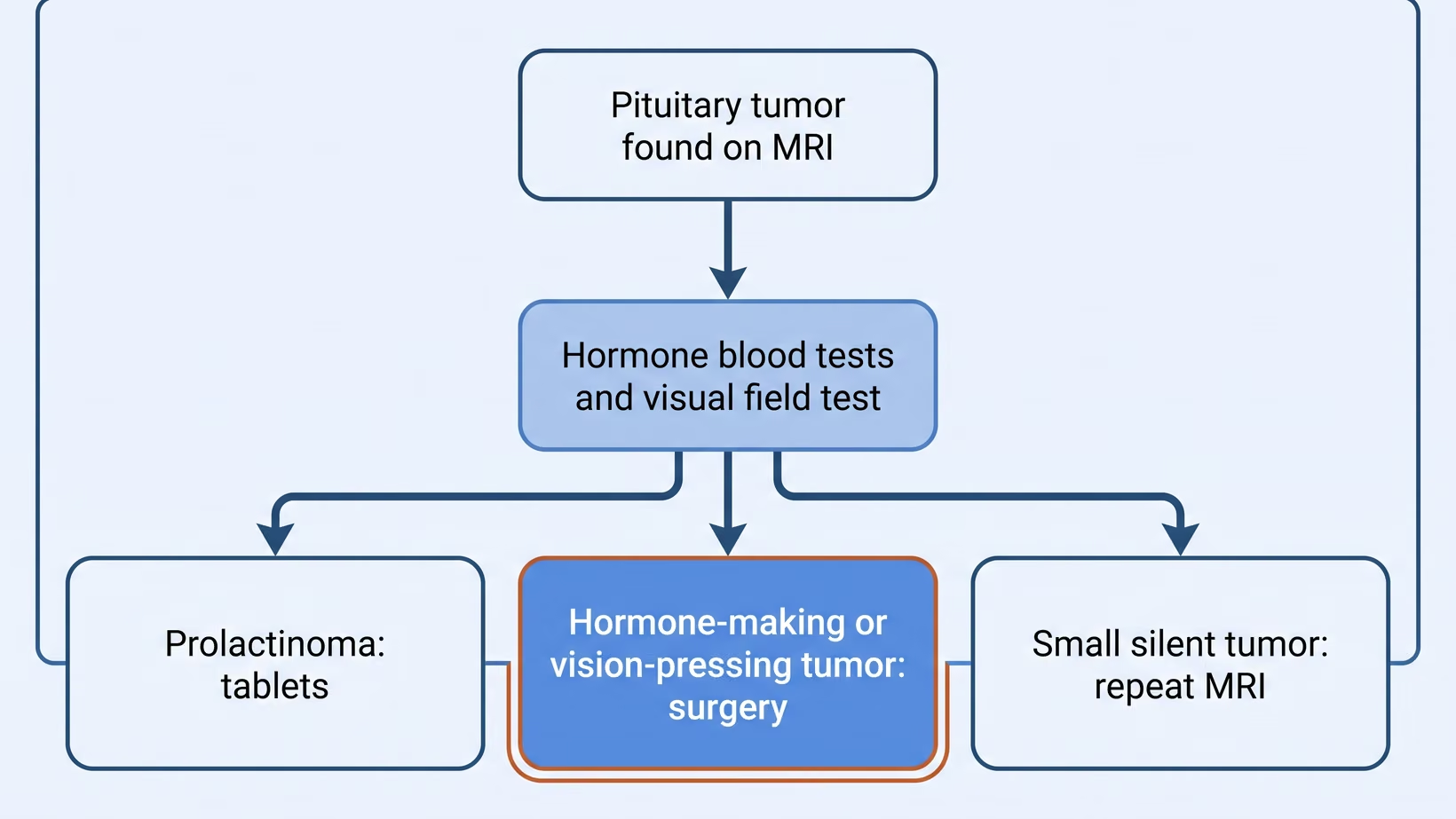
In the Philippines, a 2024 review describes the usual route. Patients usually first see a neurologist or an eye doctor (ophthalmologist) for headache or blurred vision. They are referred to an endocrinologist to check the gland’s hormones. Most are seen together with a neurosurgeon for possible surgery.
Treatment depends on the type. A prolactinoma is treated with tablets first. A tumor that makes growth hormone is treated first with surgery. The 2011 guideline says growth-hormone microadenomas, the smaller tumors, can be cured surgically in almost all cases. This is a result from studies, not a promise for any one person.
When surgery is the plan for an adult, I operate at the National Kidney and Transplant Institute (NKTI), Quezon City. I use pituitary surgery through the nose, called transsphenoidal surgery.
The 2011 guideline’s advice is for adults only, because data on children were not available. I treat pituitary tumors in children at the Philippine Children’s Medical Center (PCMC), Quezon City.
For doctors: when to refer a pituitary tumor, what to send
Send to the emergency room now any patient with a sudden headache, vomiting, sudden vision changes or drowsiness, which suggest pituitary apoplexy. Refer to a neurosurgeon a tumor with a visual field deficit (loss of side vision), one abutting the optic nerves or chiasm, or a hypersecreting tumor other than a prolactinoma.
The 2011 UK guideline calls classical apoplexy a medical emergency in which rapid hydrocortisone replacement may be life saving. It advises referral to a multidisciplinary team that includes a neurosurgeon and an endocrinologist. Surgery is indicated for worsening neurological symptoms; for most other patients, the better choice is unclear.
The 2011 Endocrine Society incidentaloma guideline, written for adults, recommends screening every patient for hypersecretion, with serum prolactin the best supported. In large macroadenomas, prolactin should be measured in diluted serum, so the hook effect does not give a falsely low value.
Screen for hypopituitarism too. Some panel members advised free T4, morning cortisol and testosterone; others added TSH, LH, FSH and IGF-I. The MRI should be a pituitary protocol, with fine cuts through the sella, with and without gadolinium.
Its surgical referral criteria also included ophthalmoplegia or other compressive neurological compromise, and apoplexy with visual disturbance. For a symptomatic prolactinoma, the 2011 hyperprolactinemia guideline recommends a dopamine agonist first.
On pathology, the 2017 WHO listed these as high-risk adenomas: sparsely granulated somatotroph, lactotroph in men, Crooke’s cell, silent corticotroph and plurihormonal Pit-1-positive. The 2022 classification subtypes PitNETs by PIT1, TPIT and SF1 lineage.
A 2025 Pituitary Society consensus advises considering a multidisciplinary pituitary team when signs are new or worsening, surgery is considered, or the next step is uncertain.
To refer to me, send the MRI on a disc with its report, the hormone and visual field results, and the medicine list. I see adults at the Lung Center of the Philippines on Tuesday and Thursday from 2 PM, and children at PCMC on Wednesday from 2 PM.
Frequently asked questions
Does a pituitary tumor spread to other parts of the body?
A pituitary tumor spreads to other parts of the body only in rare cases. The 2025 European guideline calls this spread rare. A tumor that has spread was called pituitary carcinoma and is now called a metastatic PitNET. Most pituitary tumors are benign, meaning not cancer.
Is a pituitary tumor a brain tumor?
A pituitary tumor starts in the pituitary gland. It grows from the hormone-making cells in the front part of the gland. Because it lies close to the optic nerves, a large one can press on them and change your vision. Most pituitary tumors are benign.
Will I need surgery for a pituitary tumor?
Surgery for a pituitary tumor depends on its type and its effects. A prolactinoma is treated with tablets first. A small tumor found by chance may be watched with scans. A 2011 guideline advised surgery referral for side-vision loss, a tumor touching the optic nerves, or a hormone-making tumor other than a prolactinoma.
Will I need hormone medicine for life?
Some people with a pituitary tumor need hormone medicine for the rest of their lives. The tumor, or its removal, may cause lifelong hormone imbalances. The missing hormones may then need to be replaced. Your doctors check your hormone levels with blood tests to find out.
See sources
- Rajasekaran S, et al. (Society for Endocrinology, UK). UK guidelines for the management of pituitary apoplexy. Clinical Endocrinology. 2011. PMID 21044119; doi:10.1111/j.1365-2265.2010.03913.x
- Asa SL, Mete O, Perry A, Osamura RY. Overview of the 2022 WHO Classification of Pituitary Tumors. Endocrine Pathology. 2022. PMID 35291028; doi:10.1007/s12022-022-09703-7
- Mete O, Lopes MB. Overview of the 2017 WHO Classification of Pituitary Tumors. Endocrine Pathology. 2017. PMID 28766057; doi:10.1007/s12022-017-9498-z
- Raverot G, et al. (European Society of Endocrinology). Revised European Society of Endocrinology Clinical Practice Guideline for the management of aggressive pituitary tumours and pituitary carcinomas. European Journal of Endocrinology. 2025. PMID 40506054; doi:10.1093/ejendo/lvaf100
- MedlinePlus, US National Library of Medicine. Pituitary tumor: MedlinePlus Medical Encyclopedia. Reviewed 2025. https://medlineplus.gov/ency/article/000704.htm
- Freda PU, et al. (Endocrine Society). Pituitary incidentaloma: an Endocrine Society clinical practice guideline. Journal of Clinical Endocrinology and Metabolism. 2011. PMID 21474686; doi:10.1210/jc.2010-1048
- Fernández-Balsells MM, et al. Natural history of nonfunctioning pituitary adenomas and incidentalomas: a systematic review and metaanalysis. Journal of Clinical Endocrinology and Metabolism. 2011. PMID 21474687; doi:10.1210/jc.2010-1054
- Fleseriu M, et al. (Pituitary Society). Pituitary incidentaloma: a Pituitary Society international consensus guideline statement. Nature Reviews Endocrinology. 2025. PMID 40555795; doi:10.1038/s41574-025-01134-8
- Melmed S, et al. (Endocrine Society). Diagnosis and treatment of hyperprolactinemia: an Endocrine Society clinical practice guideline. Journal of Clinical Endocrinology and Metabolism. 2011. PMID 21296991; doi:10.1210/jc.2010-1692
- Bioletto F, et al. Excess mortality in patients with non-functioning pituitary adenoma: a systematic review and meta-analysis. Journal of Endocrinological Investigation. 2024. PMID 38503992; doi:10.1007/s40618-024-02356-9
- Bolfi F, Neves AF, Boguszewski CL, Nunes-Nogueira VS. Mortality in acromegaly decreased in the last decade: a systematic review and meta-analysis. European Journal of Endocrinology. 2018. PMID 29764907; doi:10.1530/EJE-18-0255
- Tabuzo MMB, et al. Pituitary Adenoma in the Philippines: A Scoping Review on the Treatment Gaps, Challenges, and Current State of Care. Medical Sciences (Basel). 2024. PMID 38535157; doi:10.3390/medsci12010016