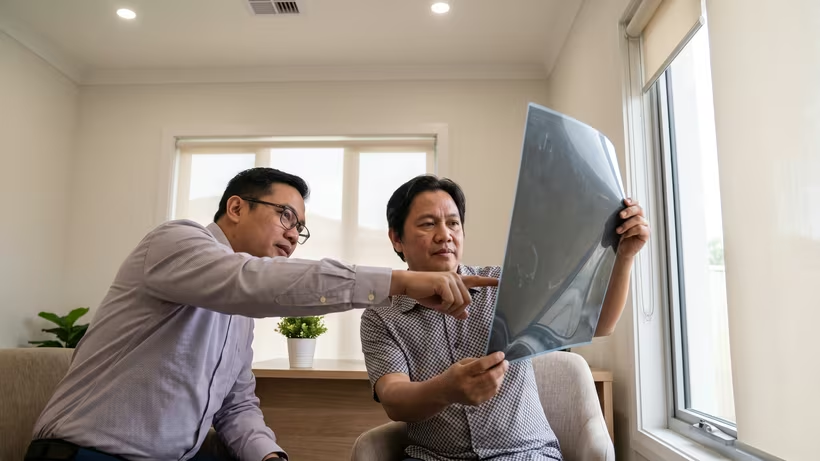

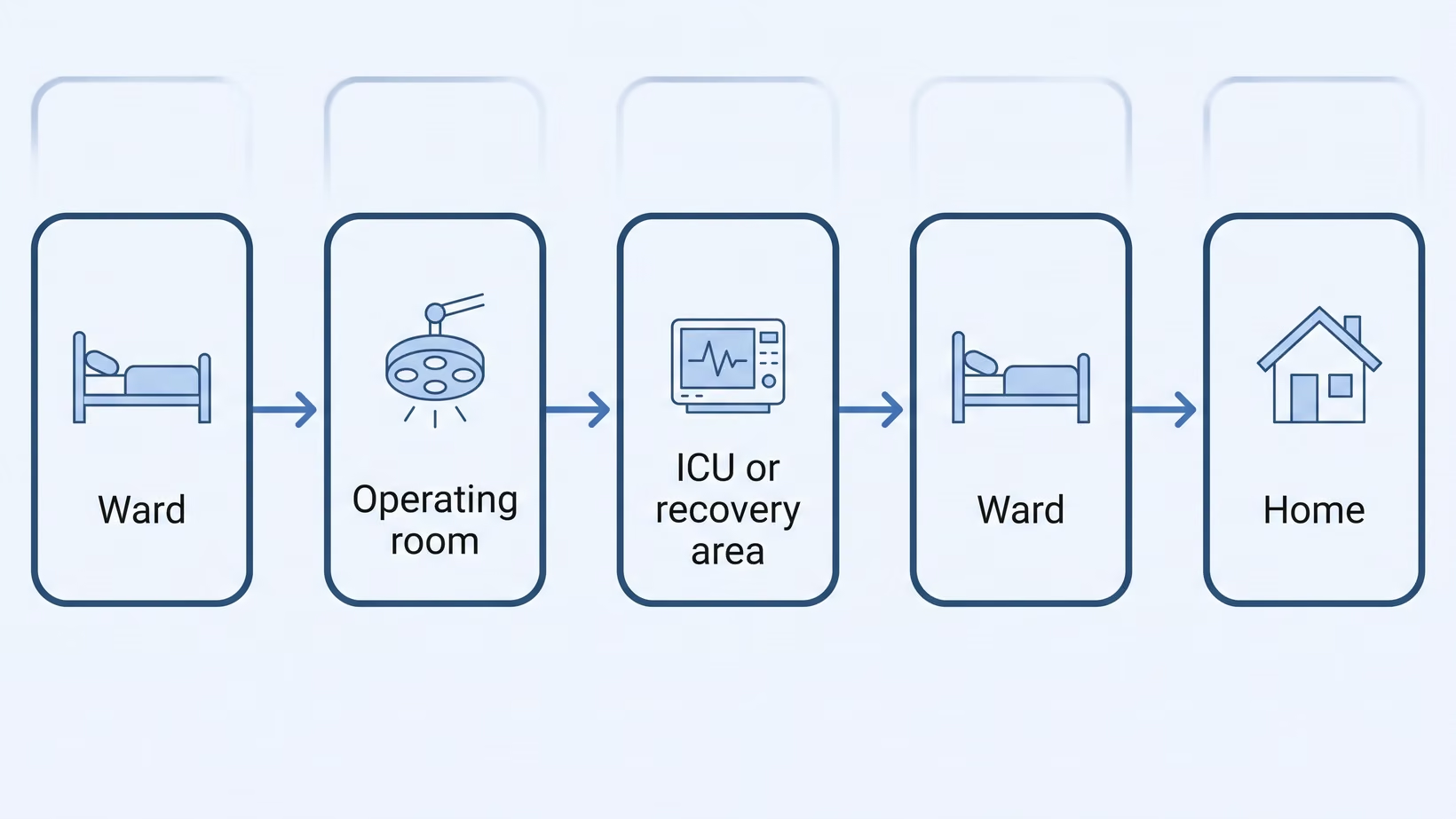
Meningioma surgery removes the tumor through a craniotomy, an operation that opens a window in the skull. The surgeon aims to remove all of the tumor, with the brain covering it grows from, when that is safe. After the operation, you are watched closely in intensive care or a recovery area, then you move to the ward, then home.
How is a craniotomy for meningioma done?
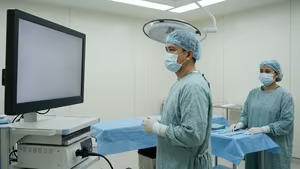
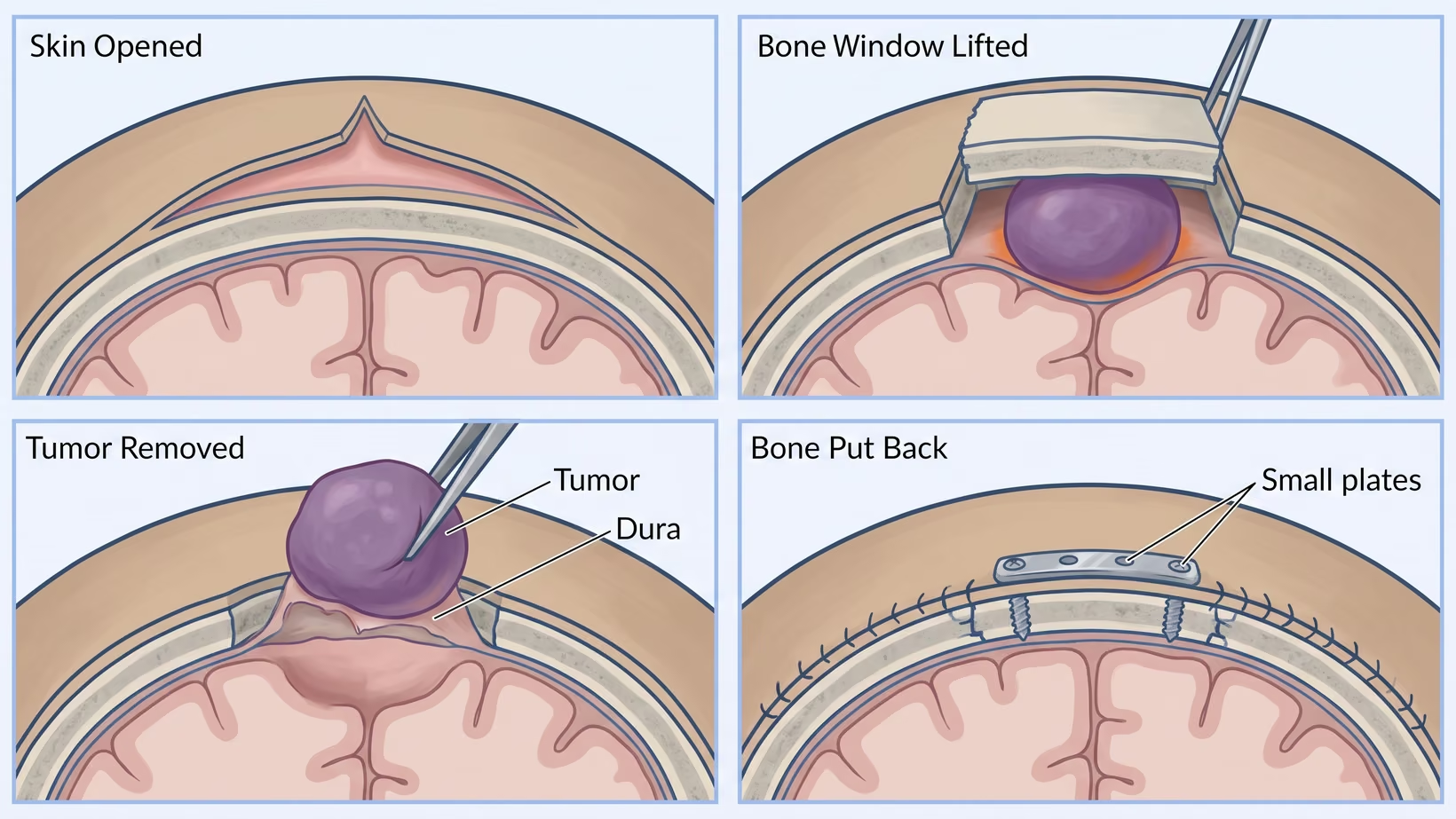
In a craniotomy for meningioma, the surgeon cuts the skin, lifts out a window of skull bone, opens the dura and removes the tumor. The dura is the tough covering of the brain, like a lining. The bone is then put back in place and the skin is closed.
A meningioma is a tumor that grows from the dura. This is why the surgeon also plans to remove the part of the dura it is attached to. For the majority of meningiomas that cause symptoms or are growing, surgery is the main treatment. The guideline reports that no randomized trials have compared surgery with other treatments.
The aim of the operation is to remove as much tumor as is safe while protecting how the brain works. A European guideline recommends image guidance as a routine part of the operation. Image guidance is a navigation system that uses your scans to plan and guide the surgery.
For some tumors, the nerves can be checked during the operation. This is called nerve monitoring, for example of the facial nerve or the brainstem. The guideline says it may help lower the chance of new nerve problems.
You may read about keyhole surgery or endoscopic surgery, meaning surgery done through a thin camera tube. For tumors at the front of the skull base, these methods were not shown to be better. Open craniotomy remains a valid choice for those tumors.
What happens in the days before the operation?
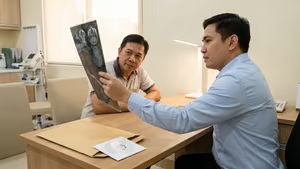
Before meningioma surgery, your surgeon explains the risks and plans the operation around the nerves and blood vessels near the tumor. Some risks depend on where the tumor is. Others are general, such as seizures and hydrocephalus, a build-up of fluid inside the brain.
The guideline also recommends checking memory, attention and planning before the decision to operate. Some teams discuss embolization, which means blocking the tumor’s blood supply before surgery. The guideline does not recommend it routinely, and it has been linked to more heart and blood vessel problems afterwards. One trial found that its only possible benefit was a shorter operation, so the surgical team decides case by case.
How long is the operating time for meningioma surgery?
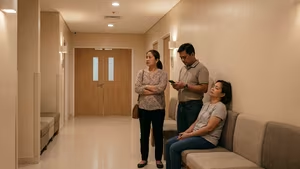
Meningioma surgery has no single operating time. It differs from one tumor to the next, and your surgeon is the one who can estimate it for your case. The time your family waits outside is longer than the surgery itself, because it also includes the anesthesia, the positioning and the waking up.
The studies on this page did not measure operating time, so this page gives no number of hours. Ask your surgeon for an estimate before the day of surgery. Ask also how the family will be updated while you are in the operating room.
Agree on one family member to receive these updates. Keep that person’s phone charged and switched on. The team may need to reach the family during the operation, for example to ask for a signature or for blood.
Will I be awake or asleep during meningioma surgery?
Whether you are awake or asleep during meningioma surgery is decided for your case by your surgeon and your anesthesiologist, the doctor who gives the anesthesia. They explain which method applies to you before the day of surgery.
General anesthesia is a deep sleep brought on by medicine, so you are not aware of the operation. You wake up after the operation is finished.
Awake brain surgery is a different method. The patient is woken during part of the operation, so the team can check speech or movement while they work. Your surgeon will tell you if this applies to your tumor.
Questions to ask the anesthesiologist:
- Will I be fully asleep for the whole operation?
- Which of my usual medicines should I take on the morning of surgery?
- How long before surgery must I stop eating and drinking?
How much of a meningioma is removed?
The aim of meningioma surgery is to remove all of the tumor, together with the dura and any bone it involves. How much can be removed safely depends on the tumor’s location, how firm it is, its size, and how close it is to important nerves and blood vessels.
Complete removal is called Simpson grade I. Your operative report may give a Simpson grade, a number for how much was removed. The guideline says complete removal, including the dura, is often curative, meaning it can often cure the meningioma.
The amount removed matters for the future. The guideline calls it the only modifiable risk factor for the tumor coming back, meaning the only one that treatment can change.
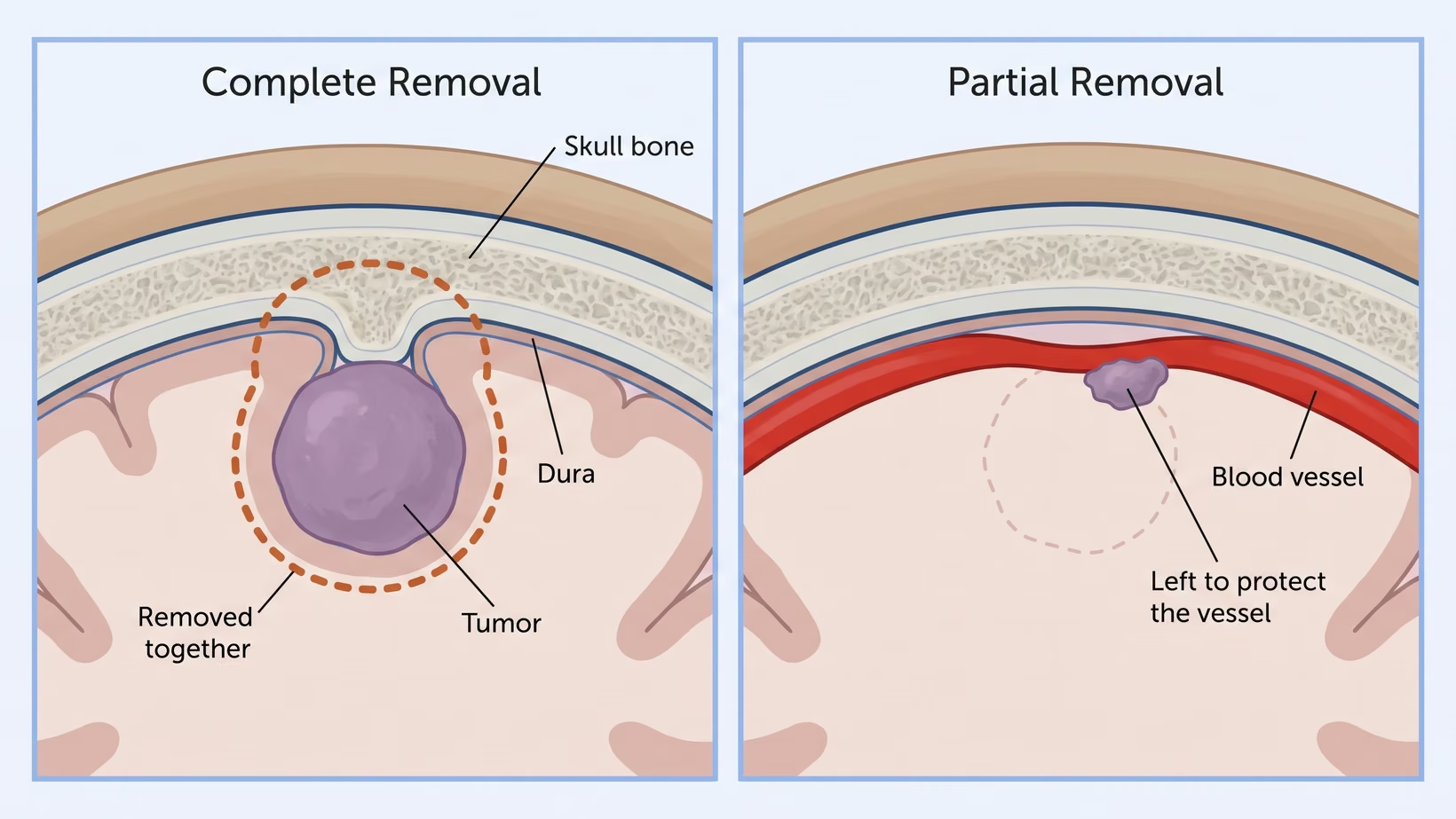
The guideline also says the surgeon should not aim for complete removal at the cost of brain function or thinking. Sometimes a tumor wraps around a blood vessel or sits against a nerve. When complete removal is not possible, the surgeon plans a partial removal to protect brain function.
What is left after a partial removal is then watched with scans or treated with radiation. One option is fractionated radiation, given in several smaller sessions. Another is stereotactic radiosurgery, a focused beam aimed precisely at the tumor. The tumor’s grade helps decide which applies, and the grade is known only from the pathology report after surgery.
Will my hair be shaved, and where is the scar?
Whether hair is removed for meningioma surgery, and how much, is decided by your surgeon. The cut in the skin is planned around where the tumor is. Where possible, it is placed behind the hairline.
Removing hair affects the risk of a wound infection. A large review of surgery of all kinds compared ways of removing hair. Removing hair with clippers may make little difference to wound infection, compared with not removing hair at all.
Shaving with a razor probably raised the number of wound infections. It meant about 17 more infections in every 1,000 people, compared with no hair removal. This review did not study head surgery alone. Do not shave your head yourself before surgery; your surgical team decides whether hair is removed.
Ask your surgeon where the cut will be, how much hair will be removed, and how the skin will be closed.
What happens in the ICU after meningioma surgery?
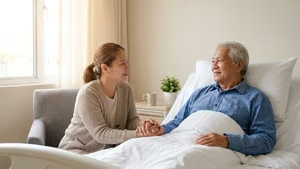
After meningioma surgery, you are watched closely in the ICU or in a close-watch recovery area. Nurses and doctors check often how you wake up, speak and move. The team decides when you are ready to move to the ward.
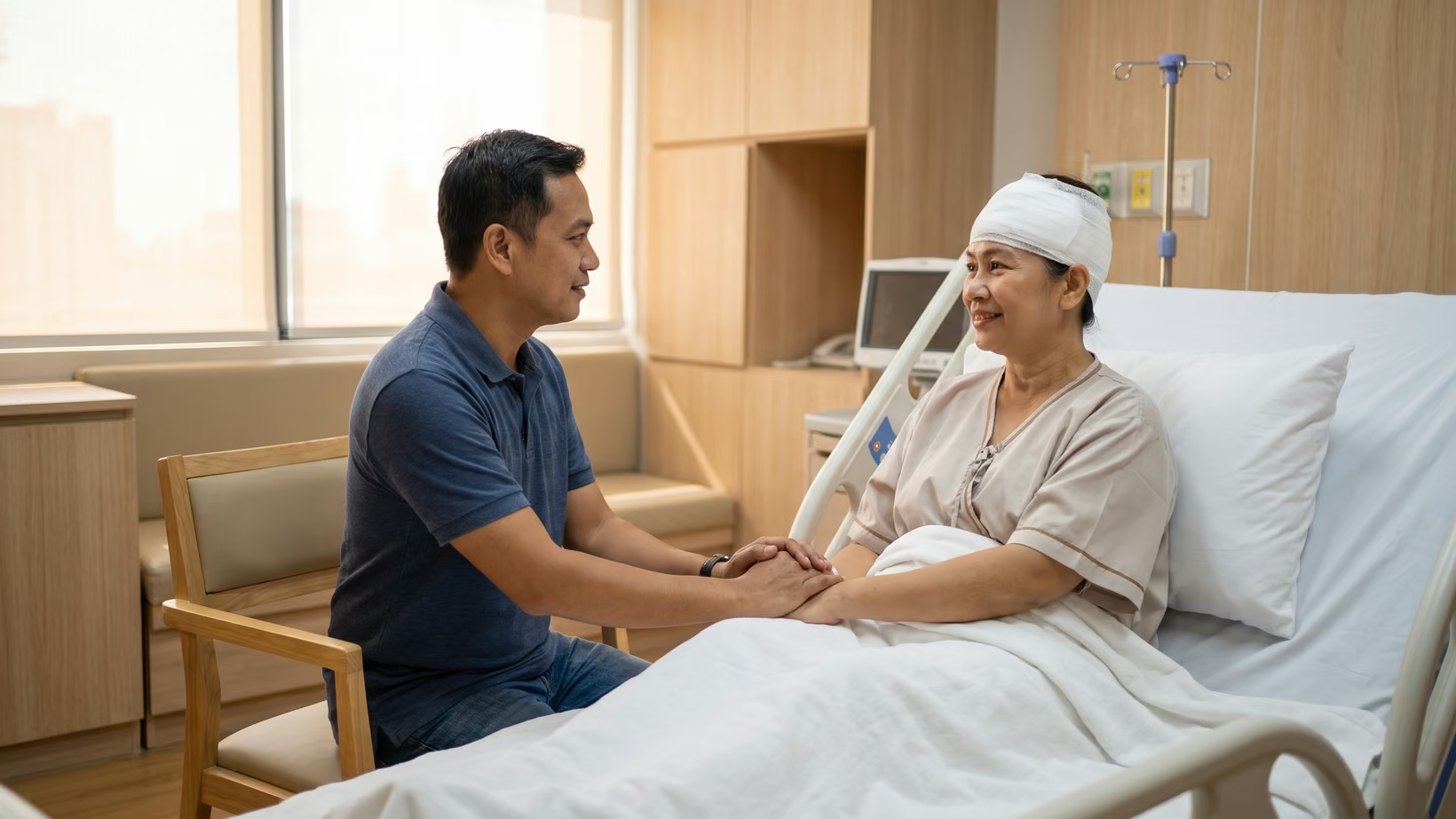
Your family may see monitors with wires on your chest, a drip in your arm and an oxygen tube. Your head may be wrapped in a bandage. The nurses ask you questions, such as your name and where you are. They also ask you to squeeze their hand and move your feet.
These checks are repeated through the night, so your sleep is broken. This is part of the close watch, and it lets the team find a change early. The family may be asked to wait outside the ICU and to visit only at set times. Ask the ICU nurses about the visiting rules of that hospital.
What problems are the nurses watching for?
After meningioma surgery, the nurses watch for seizures, changes in alertness, speech and movement, and the risks linked to where the tumor was. A seizure, also called a fit or convulsion, is a sudden burst of abnormal activity in the brain.
In studies of supratentorial meningiomas, meaning those in the upper part of the brain, about one in eight patients with no seizures before surgery had a new seizure after it. Hydrocephalus is another named risk. Other risks of meningioma surgery depend on where the tumor is, and your surgeon explains them before you sign the consent form.
Problems with memory, attention and thinking may already be present before surgery in a large share of patients. Surgery may relieve them. New problems with thinking after surgery are also a real risk of the operation. Tell the nurse about any change you notice in your relative.
How long is the hospital stay after meningioma surgery?
The hospital stay after meningioma surgery differs from patient to patient. The studies on this page did not measure it, so this page gives no fixed number of days. The surgical team decides when you are ready to go home, based on how you are recovering.
You move from the ICU or recovery area back to a regular room on the ward. There, the team continues to check you, but less often. You are helped to sit up, eat and walk again.
Ask the team what they need to see before you go home. Before you leave, make sure you have these:
- The discharge summary and the operative report
- A written list of your medicines and when to take each one
- The date of your first follow-up visit
- The phone number of the surgical team
Ask also about recovery at home, week by week: bathing, caring for the wound, activity and the return to work.
Will I go home on seizure medicine?
Whether you go home on seizure medicine after meningioma surgery depends on your own case, and your surgeon decides. In studies of meningiomas in the upper brain, about three in 10 patients had seizures before surgery. After surgery, about seven in 10 of them became seizure-free.
For people with no seizures before surgery, new seizures were no less common with preventive seizure medicine in those studies. A review of 10 trials, with 1,815 people having a craniotomy, could not show whether preventive seizure medicine works or not. The evidence was of low certainty. Your surgeon decides how long seizure medicine is taken after surgery.
If you were sent home on seizure medicine, do not stop it or change the dose on your own. Ask your surgeon before any change.
What does the bantay do, and what is the family asked?
The bantay is the family member who stays with the patient in the hospital. During meningioma surgery, the bantay and the family may be asked to sign forms, buy medicines and supplies, and stay reachable by phone. Some hospitals may also ask the family to find blood donors.
The family is also asked for information. This includes the patient’s medical history, allergies, and a list of every medicine taken at home. Bring the medicine bottles or packets if you can.
Choose one family member to speak with the doctors. This keeps the information clear and avoids mixed messages. That person can then update the rest of the family.
The bantay is at the bedside and may notice small changes first. Tell the nurse at once about any change in how the patient talks, moves or wakes. Write your questions down before the doctors’ rounds, so none are forgotten.
What should the family ask about cost and PhilHealth?
Ask the hospital billing office for an itemized estimate of meningioma surgery before admission. Ask what the surgeon’s and the anesthesiologist’s professional fees are, and whether the ICU is included. Ask what PhilHealth and your HMO will cover. The hospital’s social service office can explain any help with the bill.
Seek care now
Warning signs after meningioma surgery: who to call
After meningioma surgery, a seizure at home means going to the nearest emergency room now. After surgery on the skull or brain, seizures are most likely in the first month. For any other new symptom, the lists below say how soon to act.
Go to the nearest emergency room now for:
- A seizure, fit or convulsion
- Being hard to wake, or new confusion
- New weakness, or new trouble moving or speaking
- A sudden, severe headache
- A new symptom that is getting worse quickly, or that frightens you
Call the surgical team today for:
- Any other new symptom, or a symptom that is slowly getting worse
- Redness, swelling, pus or an opening along the wound, or a fever
- A headache that the medicine you were given does not help
- Any question about your medicines
If you cannot reach the team the same day, go to the nearest emergency room.
What to do now
Who to call and what to bring
Your surgical team is your first call after you go home. For a seizure, go to the nearest emergency room now, and call the team on the way.
Bring these to every follow-up visit:
- The discharge summary
- The operative report and the pathology report
- Your scans on a disc, with their reports
- The list of your medicines
If you have a meningioma and have not yet seen a neurosurgeon, you can book a consultation. Your own doctor can also refer you.
You are welcome to see me at my clinic at the Lung Center of the Philippines, Quezon City, on Tuesday and Thursday from 2 PM. If the trip is too far for you, we can talk in an online consult, booked on the consultation page.
For referring doctors: when to refer for meningioma surgery
Refer a patient with a meningioma that causes symptoms or is growing, because surgery is the first treatment option for that group. The EANO guideline, from the European Association of Neuro-Oncology, recommends observation first for patients without symptoms, with a newly diagnosed or slow-growing tumor.
The guideline gives four reasons for surgery first. Removing all of the tumor, called a Simpson grade I resection, can often cure the patient. Symptoms from the brain, including problems with thinking (cognitive symptoms), may be reversed. Surgery gives a diagnosis from tissue, and tissue for molecular testing.
Radiosurgery may be an alternative for small tumors without mass effect, meaning pressure on the brain, in patients who cannot have surgery.
For elderly patients, the majority of data supports aiming for complete removal. The guideline also says that a large share of meningiomas, notably in patients who are elderly or without symptoms, may be managed by watching with scans. Discuss these patients with us before a decision is made.
A provisional diagnosis is made by MRI; the definitive diagnosis and the WHO grade come from the tissue. CT with a bone window is useful to check thickening of the nearby bone, called hyperostosis, and tumor growth into the bone. The guideline also recommends checking memory, attention and executive function, the skills used to plan and organize.
Please send:
- The MRI with contrast and any CT, on a disc, with the reports
- The list of medicines, including any blood thinner or antiplatelet medicine
- Any history of seizures
- Other illnesses and any earlier treatment of the tumor
What comes back to you includes the operative report with the Simpson grade, and the pathology report with the WHO grade. The follow-up scan plan depends on that grade. You can send the patient through Refer a Patient, or with a referral letter.
Frequently asked questions
Is meningioma surgery a cure?
The European guideline says meningioma surgery can often cure the tumor when all of it, with its dura, is removed. It does not cure every patient.
Will I need radiation after meningioma surgery?
Radiation after meningioma surgery depends on the tumor’s grade and how much was removed. A grade 1 tumor that was partly removed may not need radiation right away, notably if no symptoms remain. For a grade 2 tumor that could not be removed fully, the guideline recommends radiation. For grade 3, it recommends radiation after surgery.
Can older adults have meningioma surgery?
Older adults can have meningioma surgery, and the majority of data supports aiming for complete removal even in elderly patients. A meningioma that causes no symptoms, notably in an older person, may instead be watched with regular scans. The guideline gives no age limit. Your surgeon weighs your health and the tumor.
How often are scans needed after meningioma surgery?
After surgery for a grade 1 meningioma, the guideline recommends an MRI every year for five years. After that, scans can be spaced further apart, depending on age and health. For grade 2, it recommends an MRI every six months for five years, then every year. Your surgeon may set a different schedule.
See sources
- Goldbrunner R, Stavrinou P, Jenkinson MD, Sahm F, et al (European Association of Neuro-Oncology). EANO guideline on the diagnosis and management of meningiomas. Neuro-Oncology. 2021. PMID 34181733; doi:10.1093/neuonc/noab150
- Englot DJ, Magill ST, Han SJ, Chang EF, et al. Seizures in supratentorial meningioma: a systematic review and meta-analysis. Journal of Neurosurgery. 2016. PMID 26636386; doi:10.3171/2015.4.JNS142742
- Greenhalgh J, Weston J, Dundar Y, Nevitt SJ, Marson AG. Antiepileptic drugs as prophylaxis for postcraniotomy seizures. Cochrane Database of Systematic Reviews. 2020. PMID 32343399; doi:10.1002/14651858.CD007286.pub5
- Tanner J, Melen K. Preoperative hair removal to reduce surgical site infection. Cochrane Database of Systematic Reviews. 2021. PMID 34437723; doi:10.1002/14651858.CD004122.pub5