
Not every brain bleed needs surgery. For bleeding inside the brain, also called a hemorrhagic stroke, the neurosurgeon looks at where the bleed is, how big it is and how awake the patient is. Some patients have an operation. Others get medical care and close watching.
Brain bleed: when neurosurgeons operate and when they do not
Surgery is chosen for some brain bleeds, not for all of them. The European stroke guideline suggests an operation to remove the clot for some bleeds in the upper brain, meaning the large main part of the brain. The aim is to lower the risk of death or of depending on others. It is a weak suggestion, based on evidence of very low quality.
Before an operation, the guideline asks the team to weigh several things together: where the bleed is, how big it is, how awake and strong the patient is, how soon after the bleed it is, which operation would be used, and the surgeon’s own rate of complications.
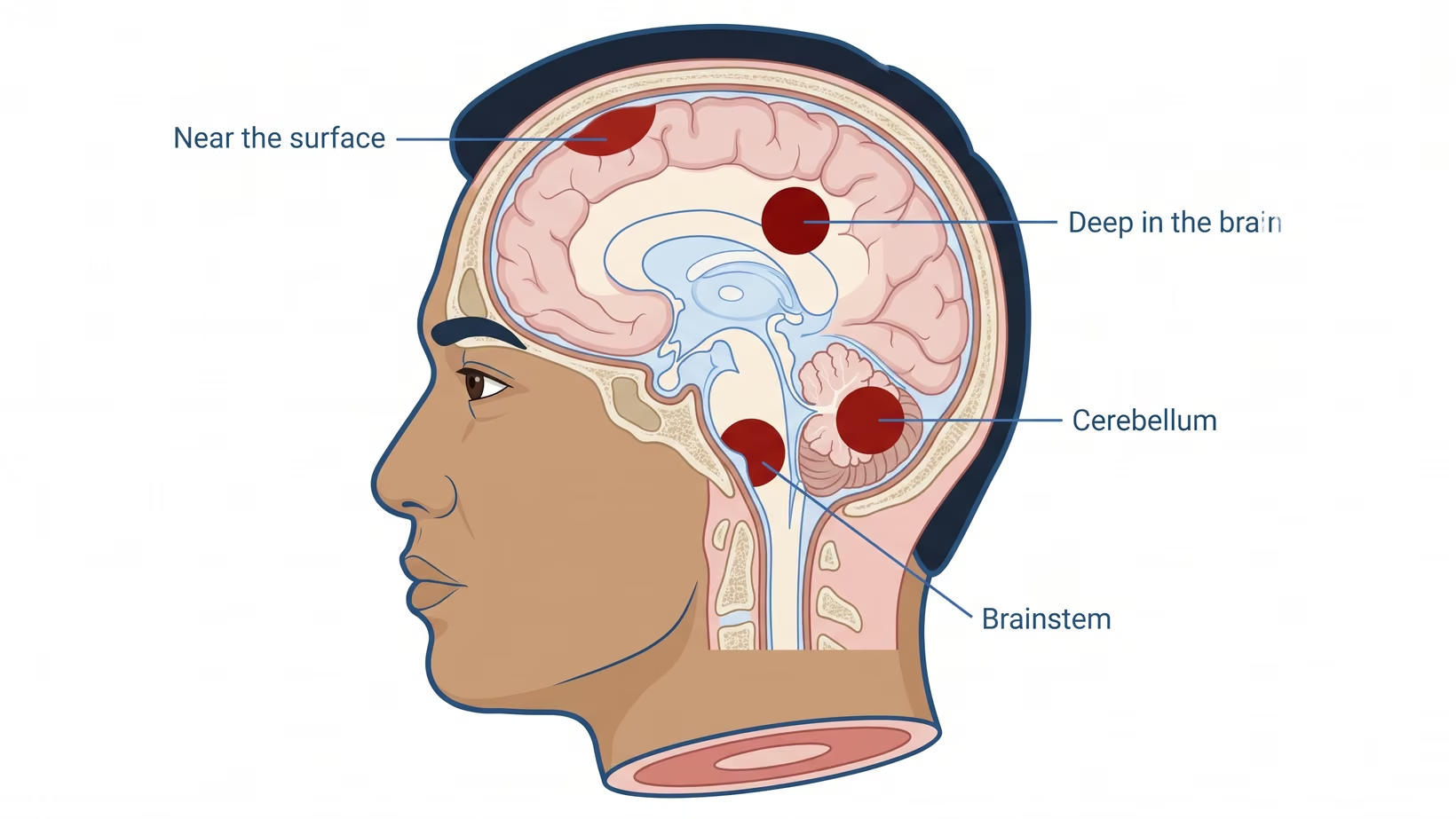
For bleeds in the upper brain, the guideline calls the volume of the bleed, meaning its size, an important predictor of death and of how well a patient recovers.
Across 17 trials with 3,927 patients, any operation to remove the clot in the upper brain was linked with fewer deaths at 3 to 12 months. The certainty of this evidence was low. The trials used many different operations, so the result does not speak for any single one.
For some bleeds, the trials found no clear gain from surgery. In one trial, removing bleeds in the deep centers of the brain through a small opening showed no clear benefit.
Which kind of brain bleed does this page cover?
This page is about bleeding inside the brain tissue that starts on its own, without an injury. Doctors call it a spontaneous intracerebral hemorrhage, meaning bleeding within the brain itself. It is one type of hemorrhagic stroke, a stroke caused by bleeding.
Two other bleeds are not covered here. Bleeding around the brain from a burst aneurysm, a ballooned weak spot on an artery, is a subarachnoid hemorrhage. Blood that collects under the skull after a head injury may be an acute subdural hematoma. The guideline on this page is for adults.
Seek care now
Warning signs that a brain bleed is getting worse and cannot wait
A brain bleed cannot wait when the patient is getting worse. The patient may need an emergency drain or an operation. Act on these signs at once.
In hospital, tell the nurse or doctor at once if the patient:
- Becomes drowsier or harder to wake
- Becomes weaker in an arm or a leg
- Talks, moves or responds less well than before
At home or anywhere outside a hospital, go to the nearest emergency room now for:
- New signs of a stroke in the face, arms or speech
- Drowsiness or new weakness in someone who went home after a brain bleed
- A sudden, very severe headache, repeated vomiting, a seizure, or new confusion
A bleed can keep growing after the first scan. In pooled data on 218 patients scanned within three hours, about 73 in 100 had some growth of the bleed by 24 hours. Some of that growth was very small. Growth was linked with more deaths and poorer recovery.
Blood can also spread into the ventricles, the fluid spaces inside the brain. There it can block the fluid and cause hydrocephalus, a build-up of fluid. When a patient with hydrocephalus becomes less awake, a drain is placed as an emergency. Doctors regard this drain as life-saving.
What does watching and waiting mean for a brain bleed?
Watching and waiting means the patient receives medical treatment without an operation for now, and the team watches closely for any change. In the first large surgery trial, STICH, this was called initial conservative treatment, meaning care without an operation at first. The clot could still be removed later if it became necessary.
Medical treatment continues the whole time, and part of it is lowering high blood pressure. High blood pressure is common after a brain bleed. It is linked with a growing bleed, with death and with dependence on others.
Doctors lower blood pressure early to try to stop the bleed from growing and to keep the patient from getting worse.
During this time, nurses and doctors check how awake the patient is, how strong the arms and legs are and how the patient speaks. A change is reported to the neurosurgeon. If the patient gets worse, the team looks again at whether an operation could help.
Brain bleed treatment: the operations a neurosurgeon may use
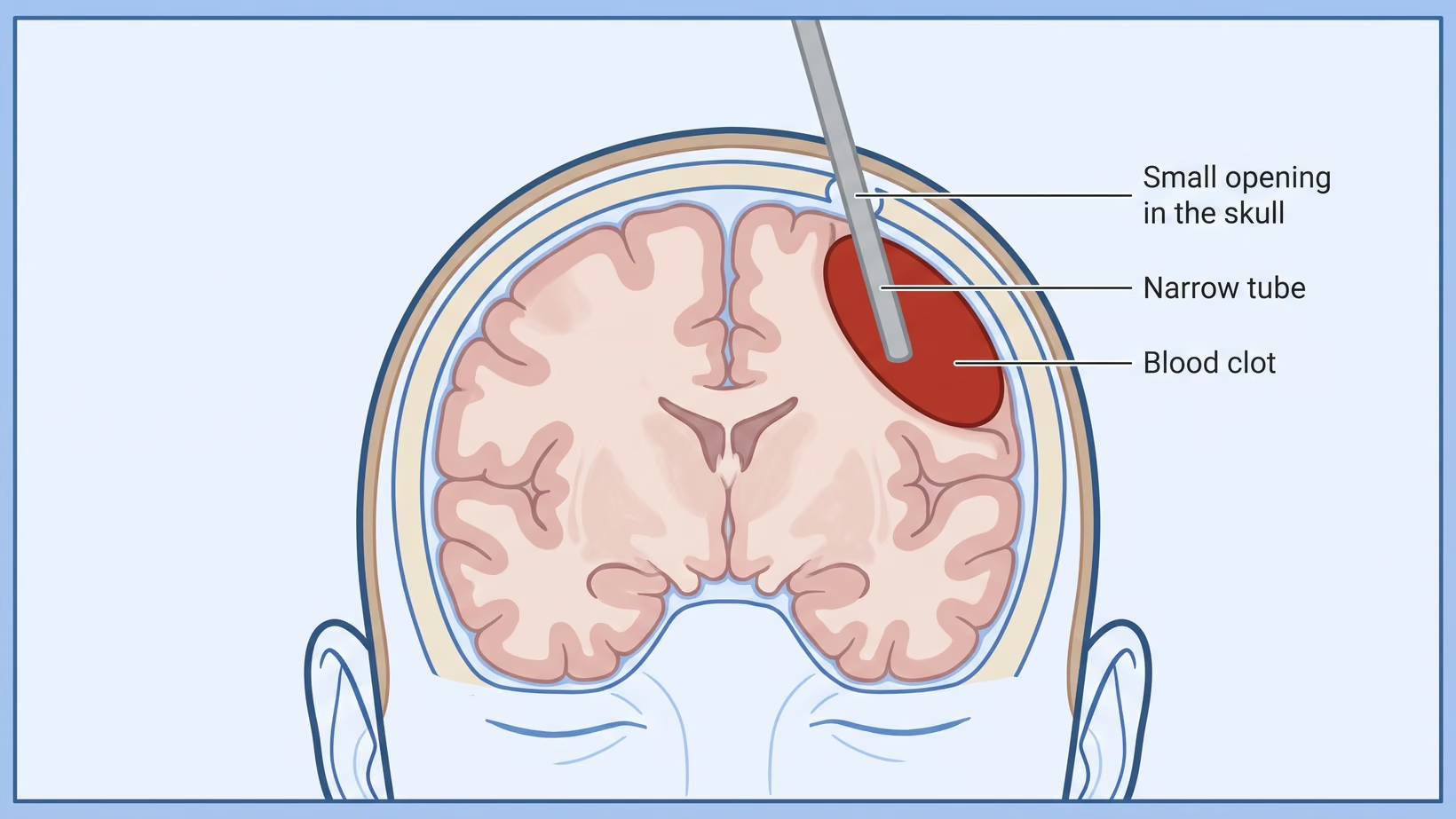
A neurosurgeon may use one of four operations for a brain bleed. The clot can be removed through an opening in the skull or through a narrow tube. A drain can let out blocked fluid. Or part of the skull can be left off so the swollen brain has room.
In open surgery, or craniotomy, the surgeon lifts a piece of skull bone, removes the clot and puts the bone back. The guideline suggests considering it early for a lobar bleed, meaning one near the brain surface, in a patient who is not in a coma, where a minimally invasive method is not available. It is a weak suggestion on very low quality evidence.
Minimally invasive removal takes out the clot through a small opening and a narrow tube. The ENRICH trial tested one such method in 300 patients whose bleeds measured 30 to 80 mL on the scan. They were treated within 24 hours of when they were last known to be well.
By 30 days, about 9 in 100 had died with surgery, against 18 in 100 with medical care alone. Function at six months was better with surgery. The gain was seen in lobar bleeds, not in deep ones. About 3 in 100 bled again after the operation and became worse.
An external ventricular drain (EVD) is a thin tube placed into a fluid space of the brain. It lets out fluid that the blood has blocked.
A decompressive craniectomy removes a large piece of skull and leaves it off, so the swollen brain has room. The clot itself is not removed. The SWITCH trial tested it in 201 adults with severe deep bleeds. With it, 44 in 100 died or were left severely disabled at six months, against 58 in 100 without it.
That difference was too small to be certain, and the trial stopped early for lack of funds. The authors called it weak evidence. In both groups, survival was linked with severe disability.
A bleed in the cerebellum, the back part of the brain below the main brain, is weighed differently. For a cerebellar bleed larger than 15 mL, the guideline suggests surgery to improve survival. In pooled data, not a trial, about 75 in 100 survived three months with surgery, against 45 in 100 with medical care.
The chance of a good recovery was no different between the two groups. Surgery may also be considered when the patient is getting worse, the brainstem is pressed, or fluid is blocked.
Hemorrhagic stroke treatment without surgery
Hemorrhagic stroke treatment without surgery is careful medical care in a stroke unit or an intensive care unit (ICU). It includes lowering high blood pressure. It also includes controlling blood sugar and treating fever, as part of a set of care steps used together. In the STICH and ENRICH trials, patients who had an operation received medical treatment as well.
For patients who do not need intensive care, the European guideline recommends an organized stroke unit. This is a ward where a trained stroke team works together. Care there lowers the risk of death or dependence. The recommendation is strong, on evidence of moderate quality.
The INTERACT3 trial tested a bundle of care started within hours of the bleed. The bundle lowered high blood pressure, controlled blood sugar, treated fever and quickly reversed the blood thinner warfarin. Each step was used in patients whose readings were abnormal.
Fewer patients had a poor recovery with the bundle. Serious harmful events were fewer too: about 16 in 100, against 20 in 100 with usual care. The trial tested the bundle as a whole, not each part alone.
The European guideline recommends a care bundle like this. Its recommendation is weak, on evidence of low quality. If the patient takes a blood thinner, tell the doctors at once. Its effect may need to be reversed.
What happens if the family says no to surgery?
If the family says no to surgery, medical treatment for the brain bleed continues. The team still controls blood pressure and gives ward or ICU care, with a drain if one is needed. Saying no to an operation does not mean stopping care.
Some patients do well without an operation. In the MISTIE III trial of bleeds of 30 mL or more, 41 in 100 on medical care alone could walk without help at one year. Some of them still needed help with daily tasks.
With catheter surgery, the figure was 45 in 100. The difference was too small to be sure. These were selected trial patients, so the figures do not predict how one patient will do.
For a large bleed in the cerebellum, the guideline suggests surgery to improve survival. A drain for blocked fluid in a patient who is becoming less awake is regarded as life-saving. Before saying no, ask the team whether this applies to your patient.
Ask the team why they advise surgery and what they expect without it. You may ask more questions, or ask for another neurosurgeon’s opinion.
For the first 24 hours, the European guideline suggests that hospitals avoid general policies that limit treatment. This includes early do-not-resuscitate (DNR) orders, which say the team will not try to restart the heart or breathing if they stop.
Does choosing not to operate mean the doctors are giving up?
Not operating is a medical decision based on trial results. For some bleeds, large trials found that early surgery did not do better than starting with medical care. The patient still receives full treatment, and an operation can still be done later if it becomes necessary.
The STICH trial enrolled 1,033 patients with bleeds in the upper brain, from 27 countries. About 26 in 100 had a good outcome with early surgery, and 24 in 100 with initial medical treatment. The trial found no overall benefit from early surgery. That is a result for the whole group.
STICH II studied awake patients with lobar bleeds and no blood in the fluid spaces. About 59 in 100 had a poor outcome with early surgery, and 62 in 100 without it. The difference was too small to be sure. Early surgery did not raise the rate of death or disability, and it might give a small survival advantage.
In ENRICH, removing deep bleeds at the front of the basal ganglia, the deep centers of the brain, showed no clear benefit. After 175 patients, the trial enrolled only lobar bleeds.
Who decides on surgery for a brain bleed, and how fast?
The neurosurgeon recommends whether to operate, and the patient agrees or declines. When the patient cannot decide, the family does. Ask for the neurosurgery consult early. The trials that tested surgery operated within set time windows.
For lobar bleeds, the guideline suggests minimally invasive removal within 24 hours of the start of the bleed. The 24 hours is the window that was studied. The effect in deep bleeds is uncertain.
A pooled analysis of eight older trials linked better outcomes with surgery within eight hours of the bleed. It also linked better outcomes with a middle level of alertness: a Glasgow Coma Scale (GCS) score of 9 to 12, a score of how awake a person is.
For a severe deep bleed, the guideline suggests considering decompressive surgery within 72 hours, in adults aged 18 to 75.
If your family wants me to see the patient, the treating doctor can call me for a consult.
For an adult who needs an ICU bed quickly, I point families to Manila Central University (MCU) Hospital in Caloocan, or at Capitol Medical Center (CMC), where an ICU bed is often available. The treating doctor arranges any move from one hospital to another. I treat brain bleeds in children at the Philippine Children’s Medical Center (PCMC).
For referring doctors: the trials and when to call
Call the neurosurgeon early for spontaneous intracerebral hemorrhage (ICH) in which surgery could change the plan. The guideline’s surgical suggestions concern lobar clots, cerebellar bleeds over 15 mL, severe deep bleeds, and hydrocephalus with falling consciousness. Trial results depend on location, volume, timing and level of consciousness.
- STICH (2005): 1,033 patients with supratentorial ICH, meaning above the cerebellum. Favorable outcome in 26 in 100 with early surgery and 24 in 100 with initial conservative treatment; no overall benefit.
- STICH II (2013): conscious patients, superficial lobar ICH of 10 to 100 mL, no intraventricular blood, within 48 hours. Unfavorable outcome in 59 versus 62 in 100 (p = 0.367).
- MISTIE III (2019): ICH of 30 mL or more, catheter with clot-dissolving medicine. An mRS score, a 0 to 6 scale of disability, of 0 to 3, walking without help, at one year: 45 versus 41 in 100, not significant.
- ENRICH (2024): 300 patients, 30 to 80 mL, within 24 hours of last known well. The benefit came from lobar bleeds; death by 30 days was 9 versus 18 in 100.
- SWITCH (2024): 201 adults with severe deep ICH. Craniectomy without clot removal: mRS 5 to 6, meaning bedbound or dead, at 180 days in 44 versus 58 in 100. The difference was not significant, and the trial stopped early.
The ESO and EANS guideline (2025) suggests considering decompressive surgery within 72 hours for severe deep ICH. Its criteria are age 18 to 75, GCS 8 to 13, NIHSS (a stroke severity score) 10 to 30, and a stable volume of 30 to 100 mL. For cerebellar ICH over 15 mL it suggests evacuation. These are weak recommendations.
Intraventricular extension, the spread of blood into the ventricles, occurs in 30 to 40 in 100 patients, with hydrocephalus in about half of them. An EVD for overt hydrocephalus with falling consciousness is regarded as life-saving.
The guideline also suggests no general policies that limit treatment or set DNR orders in the first 24 hours. It limits the ICH score to prognostic information, not the sole predictor, because of the risk of a self-fulfilling prophecy.
To call the neurosurgeon about a brain bleed, have these ready:
- The CT images, on a disc or a viewing link
- The time the patient was last known well
- The GCS and how it has changed
- The blood pressure readings
- All medicines, especially blood thinners
What to do now
Your next step: who to see and how soon
Who to see depends on where the patient is now.
- New stroke signs, or drowsiness or weakness after going home: the nearest emergency room now.
- Already admitted with a brain bleed: ask the treating doctor now for a neurosurgery consult.
- Bring the CT scan on a disc or a link, the reports, and a list of all medicines, including blood thinners.
After the emergency, or to talk through the plan, you may book a consultation with me. I see adults at the Lung Center of the Philippines, Room 1101, Quezon Avenue, Quezon City, on Tuesday and Thursday from 2 PM. I see children at PCMC, Room 22, on Wednesday from 2 PM.
If travel is not practical, you can book an online consult on the consultation page. Your doctor can also refer the patient to me.
Frequently asked questions
Can a brain bleed get better without surgery?
A brain bleed can improve without surgery in some patients. In the MISTIE III trial, 41 in 100 patients on medical care alone could walk without help at one year. In STICH, 24 in 100 had a good outcome after starting with medical treatment. For a large bleed in the cerebellum, the guideline suggests surgery to improve survival, so ask the team which applies to your patient.
Can surgery still be done later if the patient gets worse?
Surgery for a brain bleed can still be considered later if the patient gets worse. In the STICH trial, patients who started with medical treatment could have the clot removed later if it became necessary. The neurosurgeon looks again at each change.
Is minimally invasive surgery an option for a brain bleed?
Minimally invasive surgery is an option for some brain bleeds near the brain surface. In the ENRICH trial, removing the clot through a small opening within 24 hours gave better function at six months for these bleeds. It showed no clear benefit for deep bleeds.
Does a deep brain bleed need surgery?
For a deep brain bleed, the trials on this page found no clear gain from removing the clot. In ENRICH, removing deep bleeds showed no clear benefit. For a severe deep bleed, the SWITCH trial gave weak evidence that leaving part of the skull off might help.
See sources
- Steiner T, Purrucker JC, Aguiar de Sousa D, et al. European Stroke Organisation (ESO) and European Association of Neurosurgical Societies (EANS) guideline on stroke due to spontaneous intracerebral haemorrhage. European Stroke Journal. 2025. PMID 40401775. doi:10.1177/23969873251340815
- Davis SM, Broderick J, Hennerici M, et al. Hematoma growth is a determinant of mortality and poor outcome after intracerebral hemorrhage. Neurology. 2006. PMID 16636233. doi:10.1212/01.wnl.0000208408.98482.99
- Mendelow AD, Gregson BA, Fernandes HM, et al (STICH investigators). Early surgery versus initial conservative treatment in patients with spontaneous supratentorial intracerebral haematomas in the International Surgical Trial in Intracerebral Haemorrhage (STICH): a randomised trial. Lancet. 2005. PMID 15680453. doi:10.1016/S0140-6736(05)17826-X
- Mendelow AD, Gregson BA, et al (STICH II investigators). Early surgery versus initial conservative treatment in patients with spontaneous supratentorial lobar intracerebral haematomas (STICH II): a randomised trial. Lancet. 2013. PMID 23726393. doi:10.1016/S0140-6736(13)60986-1
- Hanley DF, Thompson RE, et al (MISTIE III investigators). Efficacy and safety of minimally invasive surgery with thrombolysis in intracerebral haemorrhage evacuation (MISTIE III): a randomised, controlled, open-label, blinded endpoint phase 3 trial. Lancet. 2019. PMID 30739747. doi:10.1016/S0140-6736(19)30195-3
- Ma L, Hu X, et al (INTERACT3 investigators). The third Intensive Care Bundle with Blood Pressure Reduction in Acute Cerebral Haemorrhage Trial (INTERACT3): an international, stepped wedge cluster randomised controlled trial. Lancet. 2023. PMID 37245517. doi:10.1016/S0140-6736(23)00806-1
- Pradilla G, et al (ENRICH investigators). Trial of Early Minimally Invasive Removal of Intracerebral Hemorrhage. New England Journal of Medicine. 2024. PMID 38598795. doi:10.1056/NEJMoa2308440
- Beck J, et al (SWITCH investigators). Decompressive craniectomy plus best medical treatment versus best medical treatment alone for spontaneous severe deep supratentorial intracerebral haemorrhage: a randomised controlled clinical trial. Lancet. 2024. PMID 38761811. doi:10.1016/S0140-6736(24)00702-5