
Bleeding in the brain gets bigger in about 20 in 100 adults not on an anticoagulant blood thinner. It happens early, so the first day is spent keeping blood pressure steady, checking the brain often and scanning again. For new weakness, confusion, severe headache or vomiting, tell the nurse at once; at home, go to the nearest emergency room now.
What happens in the first twenty-four hours after a brain bleed?
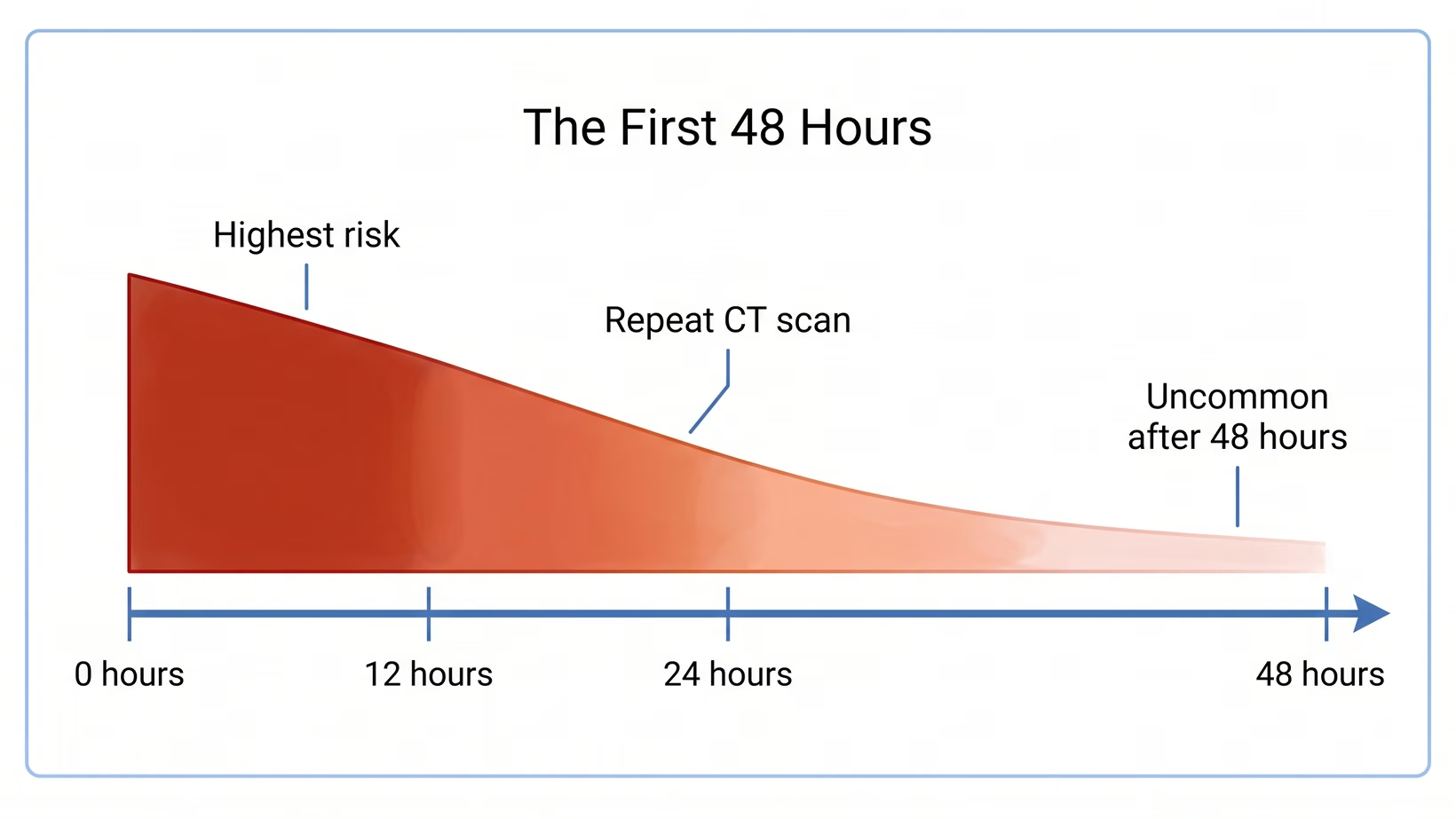
In the first 24 hours, the team watches closely for growth of the bleed. Growth happens early, and it is linked to getting worse, to death and to a poorer recovery. So the first day is spent keeping the blood pressure steady, checking the brain often and scanning again.
Doctors call a bleed inside the brain an intracerebral hemorrhage. Here it means a bleed in an adult that was not caused by an injury.
How often does the bleed grow? A large review pooled 5,076 adults who were not taking an anticoagulant. In 1,009 of them, about 20 in 100, the bleed grew by more than 6 mL (milliliters) on the repeat scan.
The timing matters. In that review, the chance of growth was higher when the first scan was done soon after symptoms began. It fell most steeply between half an hour and three hours after the start.
One study in the American guideline followed 103 patients first scanned within three hours. The bleed grew a lot in about 26 in 100 by the scan one hour later. In about 12 in 100 more, it grew by the scan 20 hours later.
The guideline also says the risk of getting worse is highest in the first 12 hours. Getting worse becomes uncommon after 48 hours. The first day of care includes these steps:
- Brings the blood pressure down and keeps it steady.
- Checks the brain often by examining the patient at the bedside.
- Repeats the CT scan to see if the bleed has grown.
- Reverses an anticoagulant blood thinner quickly, if the patient was taking one.
Seek care now
When to tell the nurse at once, or go to the ER
A new stroke sign, or one that gets worse, cannot wait. In hospital, tell the nurse or doctor at once about any change you notice in your relative. At home, after discharge or in another family member, go to the nearest hospital emergency room now, with someone else driving. Do this even if the sign has already stopped.
These are the signs of a stroke, from the National Health Service (NHS) of the United Kingdom:
- Face weakness: one side of the face may droop, and it may be hard to smile.
- Arm weakness: they may not be able to fully lift both arms and keep them there, because of weakness or numbness in one arm.
- Speech problems: they may slur their words or sound confused.
- Weakness or numbness down one side of the body.
- Blurred vision or loss of sight in one or both eyes.
- Finding it hard to speak or to think of words.
- Confusion and memory loss.
- Feeling dizzy or falling over.
- A severe headache.
- Feeling or being sick (nausea or vomiting).
The US National Library of Medicine (MedlinePlus) also lists this sign of a stroke:
- A change in alertness, such as becoming sleepier or unconscious.
What to do:
- In hospital: tell the nurse or doctor at once if any sign appears or gets worse.
- At home: go to the nearest hospital emergency room now, with someone else driving, even if the sign has stopped.
Why do they check the blood pressure so often?
The blood pressure is checked often because the team is trying to keep it in a narrow range. Steady control, without high peaks or big swings, can help recovery. Lowering it early can help lower the chance that the bleed grows. Bringing it down too far may be harmful.
The American guideline says that when blood pressure must be lowered, smooth and steady control can be good for recovery. It also says peaks and large swings in the top number should be avoided. The top number of the reading is called the systolic pressure.
Timing also counts. The same guideline says that starting treatment within two hours of the bleed, and reaching the target within one hour, can lower the risk of growth. After a mild to moderate bleed, steady control appears to reduce growth and to give a better recovery.
How low? In hospital, for a mild to moderate bleed with a top number between 150 and 220, the guideline says aiming for a top number of 140 may be reasonable. The aim is to keep it between 130 and 150. Lowering it below 130 is potentially harmful. These targets are not for blood pressure medicine at home.
For minor or moderate bleeds, smaller than 30 mL, the European guideline suggests bringing the top number below 140 within six hours of the first symptoms, to reduce growth. It also suggests avoiding a drop of more than 70 from the starting pressure, and avoiding lowering it below 110 on purpose.
Two large trials tested how low to aim. In INTERACT2, 2,839 patients with high pressure joined within six hours of their bleed. About 52 in 100 aiming for a top number under 140 died or had major disability, against about 56 in 100 aiming for under 180.
That difference was not large enough to be sure it was real. A second analysis of the full range of disability favored the lower target. Deaths were about 12 in 100 in both groups.
In ATACH-2, aiming lower, between 110 and 139, was no better than aiming for 140 to 179. Death or disability came to about 39 in 100 with the lower target and 38 in 100 with the standard one. Kidney problems within seven days were more common with the lower target, about 9 in 100 against 4 in 100.
Why is a repeat scan done?
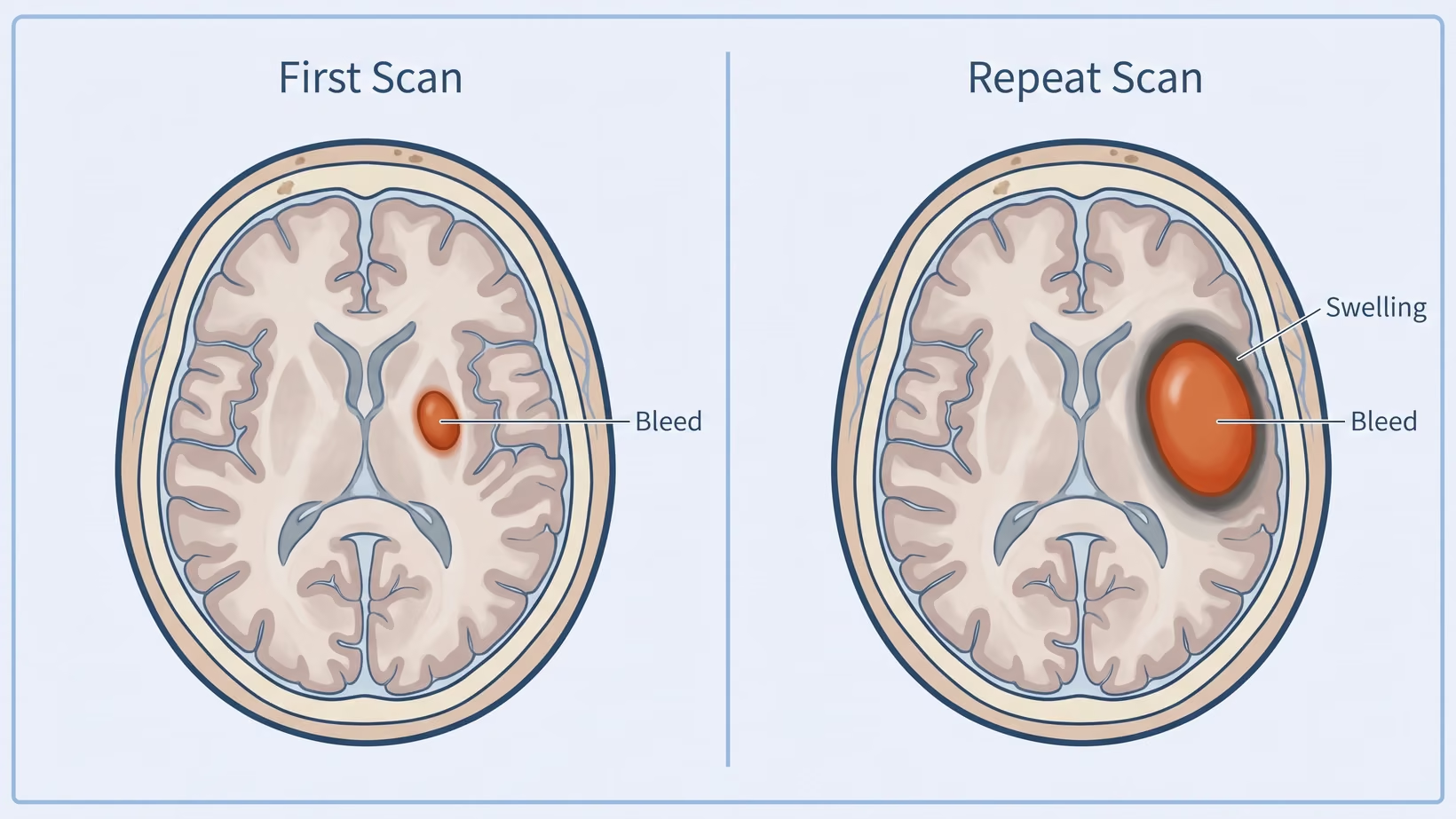
A repeat CT scan is done to see whether the bleed has grown. The American guideline says a repeat head CT can be useful within the first 24 hours for this. After that, more scans depend on how the patient is doing. So the team may order another scan even when your relative seems the same.
When the patient is less awake or getting worse, the repeat scan looks for more than growth. It can show fluid building up in the brain (hydrocephalus), brain swelling, or herniation. Herniation means pressure pushing the brain out of its normal place.
Ask the team when the repeat scan is planned, and what it showed. Knowing what a brain bleed CT scan shows makes it easier to follow what the doctors say about size.
A CT angiogram (CTA) is a CT scan done with contrast dye. The guideline says a CTA in the first few hours may help find the patients at risk of growth. Not every patient has one.
Why did he get worse on day two?
Getting worse after a brain bleed has more than one possible cause. When a patient gets worse, the American guideline says a repeat CT can look for growth of the bleed, fluid build-up (hydrocephalus), or swelling around the bleed. A seizure is another possible cause.
The guideline does not rank these causes, and none of them is tied to a particular day. What it does say is about timing. The risk of getting worse is highest in the first 12 hours, and it becomes uncommon after 48 hours. Day two is still within those first 48 hours.
Blood can also leak into the fluid spaces inside the brain, called the ventricles. Blood in the fluid spaces after a brain bleed is watched with the same repeat scans.
A seizure is also called a fit. The guideline says new seizures after a brain bleed are relatively common. They happen in between about 3 and 28 in 100 patients, across different studies. Most of these seizures happen within the first 24 hours.
The guideline says that trained staff who check the brain often can find these changes in time. Finding a change early can lead to a change in treatment. In the ICU, these checks are typically done every hour for the first 24 hours, or until the bleed is stable.
What makes a bleed expand?
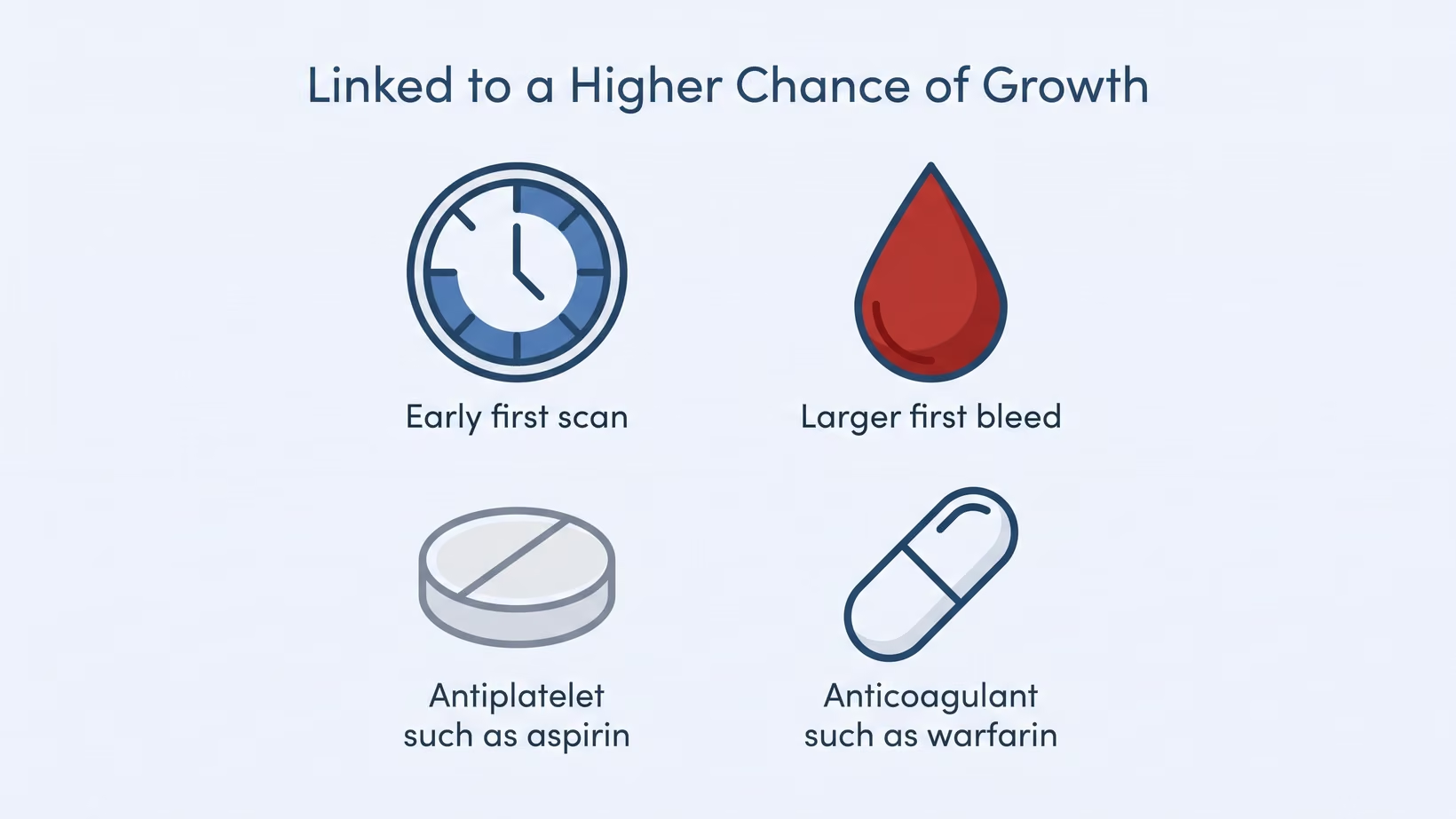
Four things were linked to a higher chance of growth in a large review of adults with a brain bleed. These were an early first scan, a larger bleed on that scan, taking an aspirin-type blood thinner (antiplatelet), and taking an anticoagulant blood thinner. The review calls them predictors: they help tell who is more likely to have growth.
An early scan does not make the bleed grow. A bleed scanned soon after it begins is more likely to be seen growing on the next scan. A larger first bleed was linked to more growth, up to a size of about 75 mL. Above that size, the chance fell.
Blood thinners come in two kinds. Antiplatelets, such as aspirin, are one kind. Anticoagulants, such as warfarin, are the other. Both kinds were linked to growth. If you take a blood thinner yourself, do not stop it on your own; ask the doctor who prescribed it.
In the same review, the bleed grew by more than 6 mL in about 31 in 100 people taking an anticoagulant. In people not taking one, it was about 20 in 100.
Scans can give more clues. A spot sign is a small bright spot of dye inside the bleed on a CT angiogram. Adding it to the other four signs helped predict growth better. The American guideline adds that on a plain CT, uneven brightness inside the bleed or uneven edges may also help find patients at risk.
What lowers the chance of the bleed growing?
Both guidelines say early, steady blood pressure control can lower the chance that the bleed grows. A care bundle, a set of basic steps done together, helped recovery in a large trial. Medicines that help the blood clot have not yet been shown to improve recovery.
The care bundle was tested in a large trial called INTERACT3. It joined four steps: early lowering of the blood pressure, control of the blood sugar, treatment of fever, and quick reversal of warfarin. Each step was used in the patients who needed it.
Fewer patients had a poor recovery in the care bundle group. Serious harmful events were also fewer, about 16 in 100 against 20 in 100. The trial measured recovery, so it did not show whether the bundle reduced growth. The European guideline recommends a care bundle to reduce death or dependence on others.
Medicines that help the blood clot have been studied too. Tranexamic acid (TXA) reduced growth when the studies were pooled, in bleeds not linked to blood thinners. In the TICH-2 trial, it did not change how well patients were doing at 90 days.
In TICH-2, about 9 in 100 died by day seven with TXA, against 11 in 100 without it. By day 90, deaths were about 22 and 21 in 100. For bleeds not linked to blood thinners, the European guideline says the balance of benefit and harm of TXA is uncertain.
It is also uncertain about a clotting factor medicine called rFVIIa in these bleeds, and suggests against its routine use. For a bleed in someone on an antiplatelet, it suggests against a platelet transfusion. In the PATCH trial, about 24 in 100 given platelets died in hospital, against 17 in 100 without them.
The American guideline says the two medicines that help clotting tested in large trials, rFVIIa and TXA, limited growth only a little and did not improve recovery.
Blood thinners: why they are reversed quickly
An anticoagulant is reversed quickly because it raises the risk that the bleed grows. The American guideline says people on an anticoagulant have a higher risk of growth, of getting worse fast, and of a poor outcome. Reversing it is an emergency.
The European guideline matches the reversal medicine to the type of anticoagulant. This is why the team asks early which blood thinner your relative takes. Bring the medicine box or a list. Reversal treatment for a bleed on a blood thinner depends on which medicine it is.
What if the bleed grows anyway?
If the bleed grows, the neurosurgeon decides whether an operation would help. For bleeds in the upper brain, the European guideline suggests surgery to remove the blood, to reduce death and dependence. It weighs the size and place of the bleed, the patient’s condition, the timing, the method and the surgeon’s complication rate.
For a bleed in the cerebellum, at the lower back part of the brain, larger than 15 mL, it suggests surgery to improve survival. A bigger bleed does not by itself decide it. The decision about when a brain bleed needs surgery depends on all of these.
Where should a brain bleed be watched in the first day?
The European guideline recommends an organised stroke unit for a patient with a brain bleed who does not need intensive care. The American guideline recommends quick transfer, when needed, to a hospital with intensive care for the brain and a neurosurgeon.
A stroke unit is a hospital ward organised for the care of stroke patients. A patient who needs intensive care is watched in the intensive care unit (ICU).
In practice, look for a hospital with an ICU or a stroke unit and a neurosurgeon on call. Most of the hospitals where I work are government hospitals, where admission needs time to arrange. When your relative needs an ICU bed quickly, I point stroke patients to Manila Central University (MCU) Hospital in Caloocan, where an ICU bed is usually available. For a new stroke sign, go to the nearest hospital emergency room first.
When your relative needs to be admitted sooner, I point families to Capitol Medical Center in Quezon City.
What to do now
What should the family do next?
What you do next depends on where your relative is now.
If a stroke sign appears at home, even if it has stopped:
- Go to the nearest hospital emergency room now, with someone else driving.
If your relative is in hospital:
- Tell the nurse or doctor at once about any new change.
- Ask the team when the repeat scan is, and what it showed.
- Ask about the blood pressure target.
Bring these to every visit:
- The CT scans on a disc, and the written reports.
- A list of all medicines, especially any blood thinner.
If you want a neurosurgeon’s opinion on the scans, or a check-up after discharge, you may book a visit at my clinic at the Lung Center of the Philippines, Room 1101, on Tuesday and Thursday from 2 PM. When travel is not practical, book an online consult on the consultation page. Your own doctor can also refer you.
Frequently asked questions
Can a brain bleed still grow after the first day?
A brain bleed is most likely to grow early, and getting worse becomes uncommon after 48 hours. Uncommon does not mean never. After the first 24 hours, more scans depend on how the patient is doing. If a stroke sign appears or gets worse, tell the nurse at once, or at home, go to the nearest emergency room now.
Should the blood pressure be brought down as low as possible?
No, the blood pressure should not be brought down as low as possible. For a mild to moderate bleed, the American guideline says lowering the top number below 130 is potentially harmful. In ATACH-2, aiming lower brought no better recovery and more kidney problems.
Is there a medicine that stops the bleeding?
No medicine has yet been shown to stop the bleeding in a way that improves recovery. TXA reduced growth when studies were pooled, but its benefit is uncertain. A platelet transfusion for people on aspirin-type medicines is not suggested. An anticoagulant is reversed as an emergency.
Does a bigger bleed always need surgery?
A bigger bleed does not always need surgery. The neurosurgeon weighs the size and place of the bleed, the patient’s condition and the timing. For a bleed in the cerebellum larger than 15 mL, the European guideline suggests surgery to improve survival.
See sources
- Greenberg SM, et al. 2022 Guideline for the Management of Patients With Spontaneous Intracerebral Hemorrhage: A Guideline From the American Heart Association/American Stroke Association. Stroke. 2022. PMID 35579034. doi:10.1161/STR.0000000000000407
- Steiner T, et al. European Stroke Organisation (ESO) and European Association of Neurosurgical Societies (EANS) guideline on stroke due to spontaneous intracerebral haemorrhage. European Stroke Journal. 2025. PMID 40401775. doi:10.1177/23969873251340815
- Al-Shahi Salman R, et al. Absolute risk and predictors of the growth of acute spontaneous intracerebral haemorrhage: a systematic review and meta-analysis of individual patient data. The Lancet Neurology. 2018. PMID 30120039. doi:10.1016/S1474-4422(18)30253-9
- Anderson CS, et al (INTERACT2 investigators). Rapid blood-pressure lowering in patients with acute intracerebral hemorrhage. New England Journal of Medicine. 2013. PMID 23713578. doi:10.1056/NEJMoa1214609
- Qureshi AI, et al (ATACH-2 trial investigators). Intensive Blood-Pressure Lowering in Patients with Acute Cerebral Hemorrhage. New England Journal of Medicine. 2016. PMID 27276234. doi:10.1056/NEJMoa1603460
- Ma L, et al (INTERACT3 investigators). The third Intensive Care Bundle with Blood Pressure Reduction in Acute Cerebral Haemorrhage Trial (INTERACT3): an international, stepped wedge cluster randomised controlled trial. The Lancet. 2023. PMID 37245517. doi:10.1016/S0140-6736(23)00806-1
- Sprigg N, et al (TICH-2 investigators). Tranexamic acid for hyperacute primary IntraCerebral Haemorrhage (TICH-2): an international randomised, placebo-controlled, phase 3 superiority trial. The Lancet. 2018. PMID 29778325. doi:10.1016/S0140-6736(18)31033-X
- Baharoglu MI, et al (PATCH investigators). Platelet transfusion versus standard care after acute stroke due to spontaneous cerebral haemorrhage associated with antiplatelet therapy (PATCH): a randomised, open-label, phase 3 trial. The Lancet. 2016. PMID 27178479. doi:10.1016/S0140-6736(16)30392-0
- NHS. Symptoms of a stroke. nhs.uk, page last reviewed 12 September 2024. https://www.nhs.uk/conditions/stroke/symptoms/
- MedlinePlus, US National Library of Medicine. Stroke. Medical Encyclopedia, review date 16 April 2025. https://medlineplus.gov/ency/article/000726.htm