
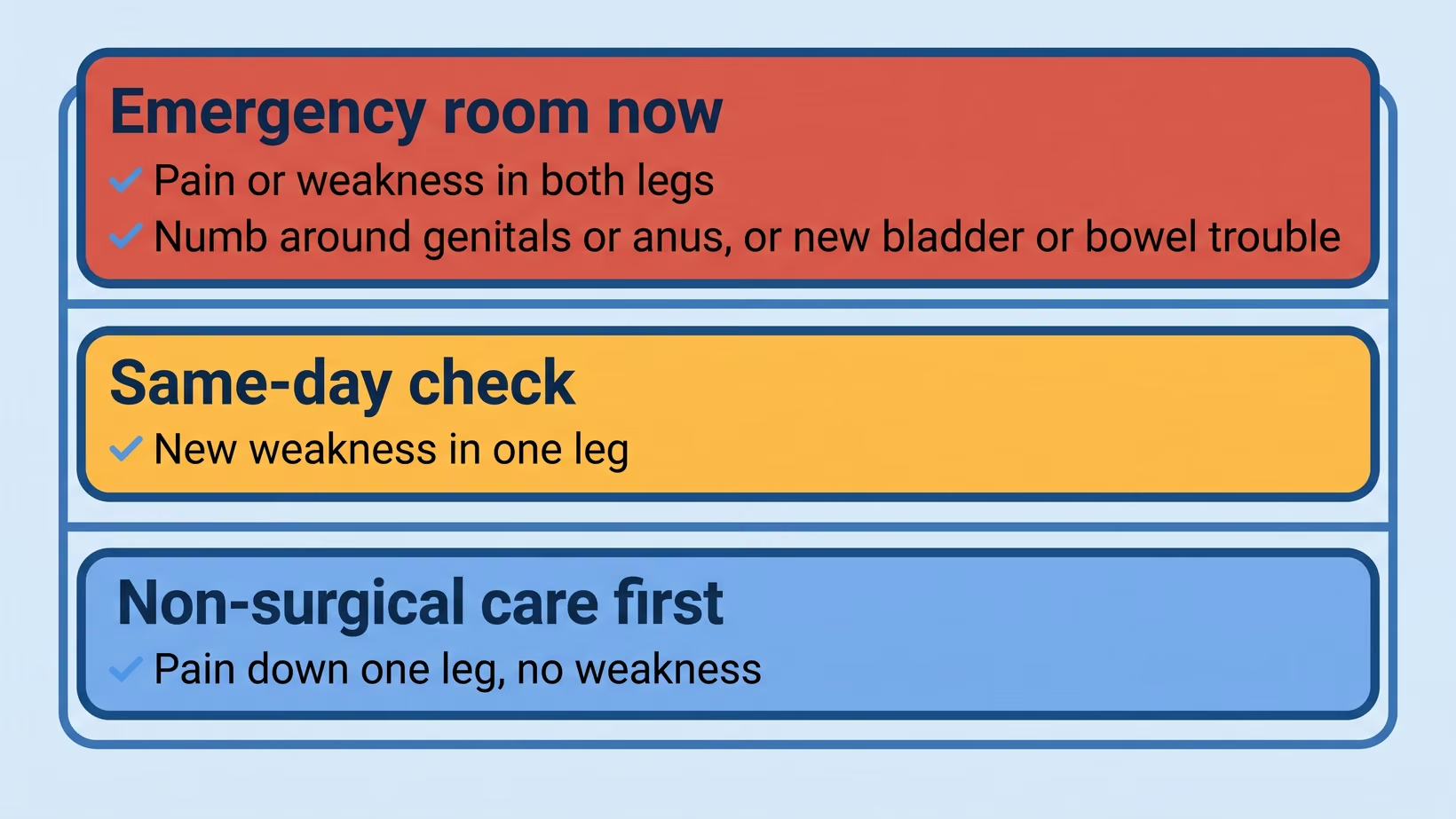
A slipped disc may need urgent surgery when it causes pain down both legs, severe or worsening weakness or numbness in both legs, numbness around the genitals or anus, or new bladder or bowel trouble. Go to the emergency room now. New weakness in one leg needs a same-day check. Pain alone may need surgery if weeks of treatment fail.
Seek care now
Which slipped disc symptoms need surgery right away?
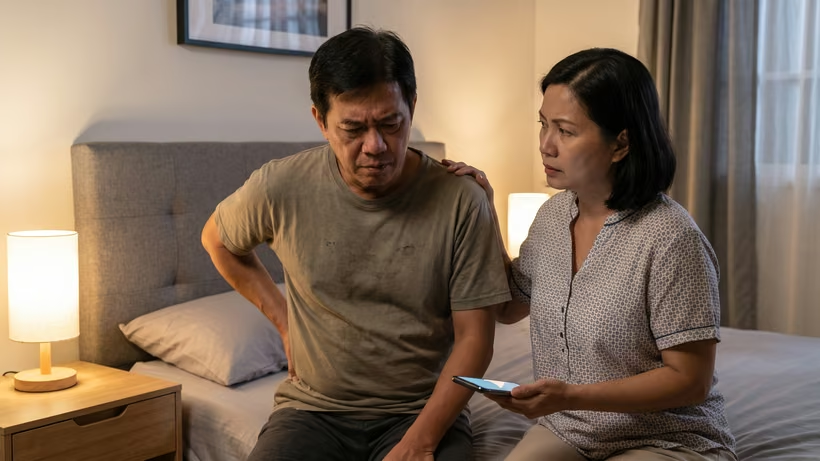
Go to the nearest emergency room now if you have back pain or sciatica with any of these signs. Sciatica is pain that runs from the back down the leg. These signs can mean the disc is pressing on the nerves to the legs, bladder and bowel.
- Sciatica on both sides, with pain down both legs
- Weakness or numbness in both legs that is severe or getting worse
- Numbness around or under the genitals, or around the anus
- Trouble starting to pee, not being able to pee, or not being able to control peeing, when this is not normal for you
- Not noticing when you need to poo, or not being able to control pooing, when this is not normal for you
These signs can point to cauda equina syndrome. The cauda equina is the bundle of nerve roots at the bottom of the spine. A nerve root is the start of a nerve where it leaves the spinal cord. AO Spine, an international group of spine surgeons, advises that people with this syndrome be sent promptly to a surgeon to be checked for an operation.
A new problem with peeing is one of these signs, and trouble peeing with back pain needs the emergency room now. Do not wait for a clinic day.
New weakness in one leg, without the signs above, is also urgent. AO Spine experts advise that leg weakness from a slipped disc be examined and scanned as an emergency. Get it checked the same day, at an emergency room or by a spine surgeon.
Pain down one leg, without weakness, is not on the emergency list. Sciatica usually gets better in a few weeks to a few months, but it can last longer. See a doctor soon if the pain is getting worse. Book a regular visit if it has not improved after a few weeks of home treatment, or if it stops your normal activities.
Is surgery for leg weakness different from surgery for pain?
Surgery for leg weakness from a slipped disc is more time-sensitive than surgery for pain. When the weakness is significant, experts advise an operation within days, for the best chance of full nerve recovery. When there is pain without weakness, the timing depends on how long the pain has lasted, how bad it is and what you prefer.
Doctors grade muscle strength on the Medical Research Council (MRC) scale, from 0 to 5. The lower the grade, the weaker the muscle. At grade 3, you can lift the foot against gravity but not against the doctor’s push. At grade 4, you can push against the doctor’s hand, but with less than full strength.
The 2026 AO Spine recommendations advise surgery within 3 days of the start of weakness for grade 3 or lower. For grade 4 weakness that affects daily function, they advise surgery within 8 days. Both are conditional recommendations. They rest on low- to moderate-quality evidence from two studies at one center.
Mild weakness, grade 4, appears to have a better natural course, meaning how it goes without surgery. It may not need the same speed of surgery. Only a doctor’s examination can tell the grade, so new weakness of any degree still needs a check the same day. The same experts still advise close watching and a prompt recheck if the weakness does not improve.
One trial looked at 150 people with sciatica and leg weakness that had lasted 6 to 12 weeks. About 84 in 100 had grade 4 weakness, and the rest had grade 3. Strength came back faster after early surgery. At one year, strength had fully recovered in about 81 in 100 after early surgery and 80 in 100 after non-surgical care first.
That result applies to people whose sciatica had already lasted 6 to 12 weeks. It does not apply to sudden, severe weakness. In the same trial, severe weakness at the start made lasting weakness more likely. Of the 80 people given non-surgical care first, 32 had surgery later because the pain was too much to bear.
For doctors, AO Spine advises checking whether weakness is true nerve weakness or pain holding the muscle back. Doctors should give enough pain relief before the final strength test.
When there is pain without weakness, AO Spine advises that how long it has lasted, how bad it is and your own preference guide the choice. The benefit of surgery grows the longer the pain has lasted.
What if 6 weeks of non-surgical care has not worked?
When six weeks of non-surgical care has not eased the leg pain, surgery may be offered. NICE, the UK’s guideline body, advises considering surgery when non-surgical treatment has not improved pain or function, and the scan findings match the symptoms. At this point, surgery is a choice you make with your surgeon.
NICE does not give a number of weeks. The six-week mark comes from the trials, which enrolled people after six weeks or more of sciatica.
Pain that lasts for months changes the balance. In one Canadian trial, 128 people with sciatica for 4 to 12 months had either a microdiscectomy (an operation that removes the part of the disc pressing on the nerve root) or six more months of non-surgical care. Leg pain started near 8 out of 10 in both groups. At six months, it averaged 2.8 out of 10 after surgery and 5.2 after non-surgical care.
That was one trial at one center, in people with pain down one leg from a disc at the lowest two levels of the spine. Of the 64 people given non-surgical care, 22 had surgery later.
For doctors, NICE advises that a person’s weight (body mass index), smoking or psychological distress should not influence the decision to refer for a surgical opinion.
What should be tried before surgery?
Before surgery, NICE supports advice to keep up your normal activities. It advises considering a group exercise program. Massage or spinal manipulation may be considered, but only as part of a package that includes exercise. If you have leg weakness or any emergency sign, do not wait for massage or manipulation: get checked first.
For acute and severe sciatica, NICE advises considering an epidural injection of local anesthetic (numbing medicine) and steroid. NICE words most of these sciatica treatments that do not need surgery as options to consider for some people. Your doctor decides which ones fit you.
Does the MRI have to match the symptoms?
Yes. For surgery to be considered, the findings on the MRI, a scan that shows the spine and nerves in pictures, should match the sciatica, according to NICE. A disc bulge on its own is common in people with no pain at all.
A review of 3,110 people without symptoms found disc bulges in about 3 in 10 twenty-year-olds and 8 in 10 eighty-year-olds. Many of these changes are likely part of normal aging. A report that mentions a disc bulge on the MRI must be read with your symptoms and examination.
Outside specialist care, NICE advises against routine scans for back pain or sciatica. This advice does not cover the emergency signs above.
What are discectomy and microdiscectomy?
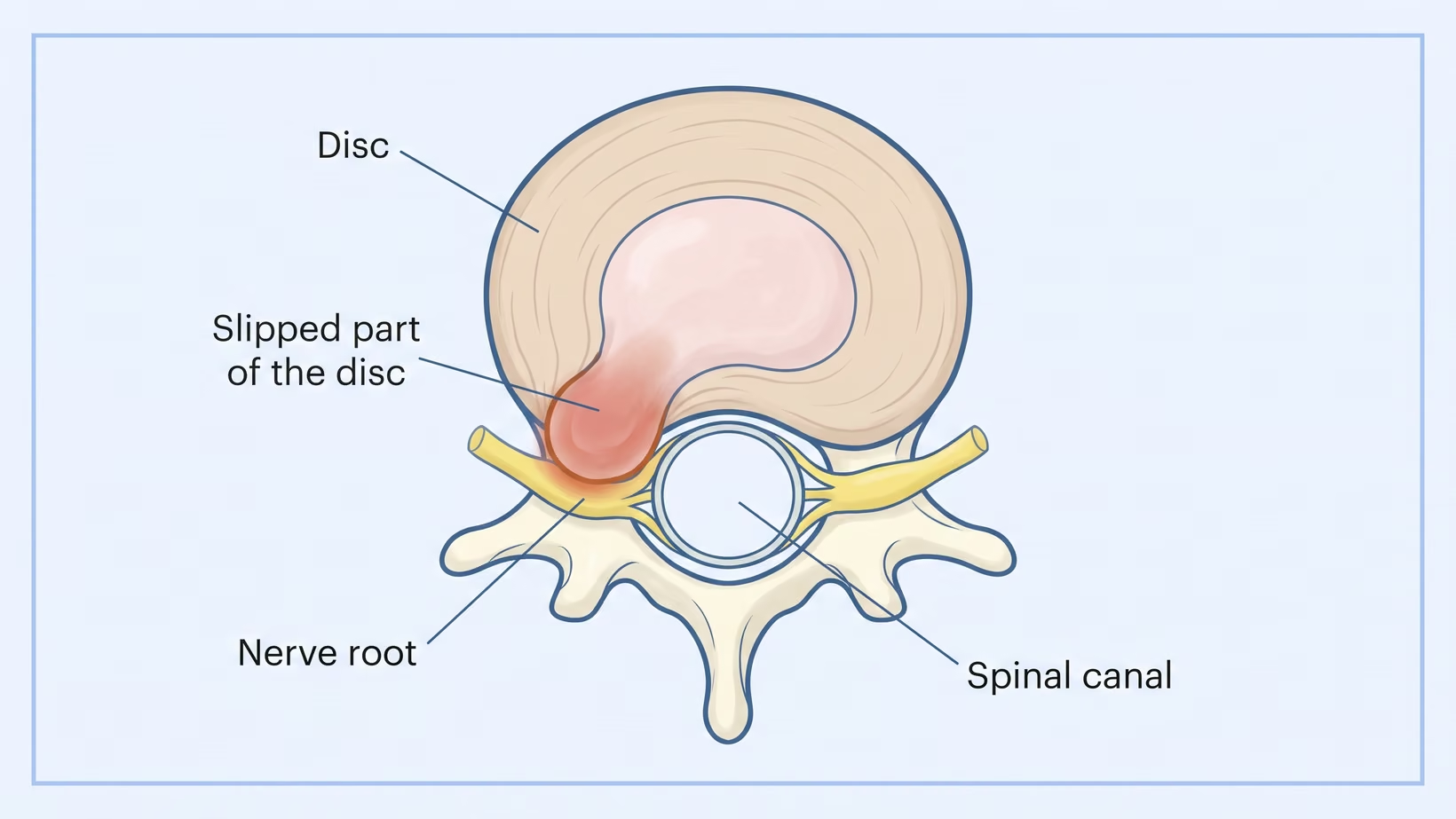
A discectomy is an operation that removes the part of a slipped disc that presses on the nerve root. Microdiscectomy and open discectomy are the standard operations for this, according to a Cochrane review, a report that gathers the trials on one question and combines their results. The surgeon may work with a microscope or with magnifying glasses fitted with a headlight (loupes).
A slipped disc, also called a herniated disc, is a disc pushed out from between the bones of the spine that presses on a nerve root. The operation removes the piece that presses. In the Dutch and Canadian trials in this post, the operation tested was a microdiscectomy.
Ask your surgeon how long you will stay in the hospital and when you can go back to work.
When an adult needs a planned discectomy, I operate at the Lung Center of the Philippines and the National Kidney and Transplant Institute (NKTI), both in Quezon City.
Is endoscopic or keyhole discectomy better?
Keyhole methods, such as endoscopic discectomy, give results close to standard microdiscectomy, with small trade-offs. A Cochrane review of 11 studies, with 1,172 people, compared newer minimally invasive discectomy with standard surgery.
Leg and back pain relief was slightly worse with the newer methods, on low-quality evidence. The difference was about half a point or less on a 0 to 10 scale. Wound and other infections were less likely. Re-admission for a disc that slipped again was more likely. The review covered studies up to 2013. Ask your surgeon whether you qualify for endoscopic spine surgery.
What are the risks of the operation?
Discectomy has risks, and your surgeon should explain them before you agree. In the Canadian trial, nine people had a problem linked to the operation. One person in that trial needed a repeat operation for a disc that slipped again.
In the US SPORT trial, about 15 in 100 people who had surgery had another operation within eight years. Ask your surgeon which problems can happen in your case, and how often.
What is the success rate of slipped disc surgery?
In trials, surgery for a slipped disc eased leg pain faster than non-surgical care. After one to two years, the results of the two groups were close. A success rate depends on what is measured, when it is measured, and how long the pain lasted before surgery.
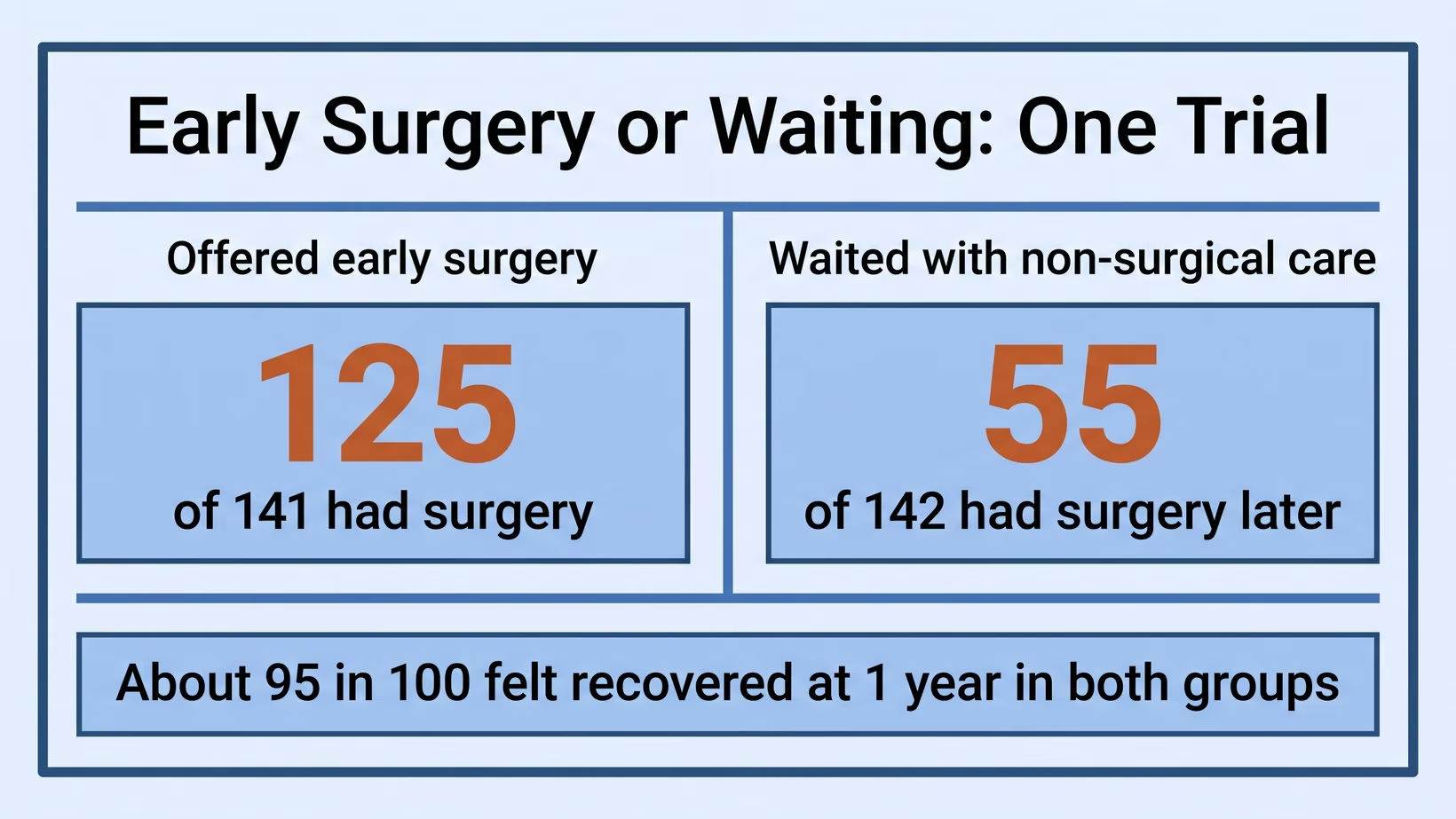
The Dutch trial enrolled 283 people with severe sciatica that had lasted 6 to 12 weeks. Of 141 people offered early surgery, 125 had a microdiscectomy, after about two weeks on average. Of 142 people who waited with non-surgical care, 55 had surgery later, after about 19 weeks on average.
Leg pain eased faster in the early-surgery group. People in that group also felt recovered sooner. Disability scores over the first year were not clearly different between the groups.
At one year, about 95 in 100 people in each group felt recovered. Recovery here means the patients’ own sense of recovery. It is not a cure rate. The waiting group’s figure includes the 55 people who had surgery later.
The US SPORT trial enrolled 501 people with a slipped disc seen on the scan and leg symptoms for at least six weeks. Both groups improved a lot over two years. The differences favored surgery, but they were small and could have been due to chance.
Many people in SPORT switched groups. Half of those offered surgery had it within three months, and 30 in 100 of those offered non-surgical care also had surgery. Because of this, the trial could not say which treatment is better.
For pain lasting 4 to 12 months, the Canadian trial found a clearer gain from surgery at six months. Ask your surgeon what result to expect in your own case.
What to do now
When to see a neurosurgeon, and how to refer
Who you see, and how soon, depends on your signs.
- Emergency room now: pain down both legs; severe or worsening weakness or numbness in both legs; numbness around the genitals or anus; new trouble peeing or controlling peeing or pooing.
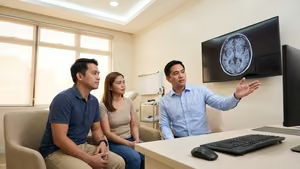
- Same day, at an emergency room or with a spine surgeon: new weakness in one leg. Ask for an examination by a spine surgeon and an MRI. Do not wait for a clinic day.
- Soon: leg pain that is getting worse.
- Regular visit: pain not better after a few weeks of home treatment, or pain that stops your normal activities.
Bring these to the visit:
- The MRI films or disc, and the written report
- A list of the medicines you take
- A list of the treatments you tried, and for how long
For doctors referring a patient:
- Suspected cauda equina syndrome: send the patient to the emergency room now.
- New leg weakness: arrange an emergency examination and MRI. AO Spine notes that delays often happen in primary care, the emergency room or radiology.
- Pain without weakness that has not improved: refer to a spine surgeon at a regular clinic visit.
- Send the date the weakness started and the MRC grade of each weak muscle, tested with pain controlled.
- Send the bladder, bowel and genital-area sensation findings, the scans and reports, and the treatments tried.
In the emergency room, the team calls a spine surgeon when one is available in the hospital. If none is available and the emergency team finds it safe for you to go home, book a clinic visit with a spine surgeon. You may book that visit with me. I see adults at the Lung Center of the Philippines, Room 1101, Quezon Avenue, Quezon City, on Tuesday and Thursday from 2 PM.
I see children and teenagers at the Philippine Children’s Medical Center (PCMC), Room 22, on Wednesday from 2 PM. If travel is not practical, book an online consult on the consultation page. Your doctor can also refer you to me. When admission is needed sooner, I admit patients at Capitol Medical Center, Quezon City. For any emergency sign, go to the nearest emergency room first.
Frequently asked questions
Will a slipped disc heal without surgery?
Sciatica from a slipped disc usually gets better without surgery in a few weeks to a few months, but it can last longer. In the trials above, people improved a lot with or without surgery. Watching for the emergency signs is part of letting a slipped disc heal on its own. Pain down both legs, numbness around the genitals or anus, or new bladder or bowel trouble means the emergency room now. New weakness in one leg needs a check the same day.
Can hilot or massage fix a slipped disc?
Hilot or massage on its own is not among the treatments NICE advises for sciatica. NICE advises considering massage or manipulation only as part of a package that includes exercise. Do not let hilot delay a check by a doctor. Pain down both legs, numbness around the genitals or anus, or bladder or bowel trouble means the emergency room now.
Can the disc slip again after surgery?
Yes, a slipped disc can slip again after surgery. In the Canadian trial, one person needed a repeat operation for a disc that slipped again. In the SPORT trial, about 15 in 100 people who had surgery had another operation within eight years. The Cochrane review found more re-admissions for this after keyhole methods.
Should I get a second opinion before spine surgery?
A second opinion before spine surgery is reasonable when the surgery is for pain without weakness. In that case, how long the pain has lasted, how bad it is and your preference guide the choice. In the Dutch trial, people who waited with non-surgical care did about as well at one year. New weakness, or any emergency sign, should not wait for a second opinion.
See sources
- NHS. Sciatica. NHS website (NHS England). 2026. https://www.nhs.uk/conditions/sciatica/
- National Institute for Health and Care Excellence (NICE). Low back pain and sciatica in over 16s: assessment and management (NG59), recommendations 1.3.7 and 1.3.8. 2016. https://www.nice.org.uk/guidance/ng59/chapter/Recommendations
- National Institute for Health and Care Excellence (NICE). Low back pain and sciatica in over 16s: assessment and management (NG59), recommendations 1.2.1, 1.2.2, 1.2.7 and 1.3.5. 2020. https://www.nice.org.uk/guidance/ng59/chapter/Recommendations
- National Institute for Health and Care Excellence (NICE). Low back pain and sciatica in over 16s: assessment and management (NG59), recommendations 1.1.4 to 1.1.6. 2016. https://www.nice.org.uk/guidance/ng59/chapter/Recommendations
- Peul WC, et al. Surgery versus prolonged conservative treatment for sciatica. N Engl J Med. 2007. doi:10.1056/NEJMoa064039. PMID 17538084.
- Vadalà G, et al (AO Spine Knowledge Forum Degenerative). AO Spine Clinical Practice Recommendations: When to Operate in Lumbar Disc Herniation. Global Spine J. 2026. doi:10.1177/21925682261492223. PMID 42770238.
- Overdevest GM, et al. Recovery of motor deficit accompanying sciatica: subgroup analysis of a randomized controlled trial. Spine J. 2013. doi:10.1016/j.spinee.2013.07.456. PMID 24200407.
- Bailey CS, et al. Surgery versus Conservative Care for Persistent Sciatica Lasting 4 to 12 Months. N Engl J Med. 2020. doi:10.1056/NEJMoa1912658. PMID 32187469.
- Weinstein JN, et al. Surgical vs nonoperative treatment for lumbar disk herniation: the Spine Patient Outcomes Research Trial (SPORT): a randomized trial. JAMA. 2006. doi:10.1001/jama.296.20.2441. PMID 17119140.
- Rasouli MR, et al. Minimally invasive discectomy versus microdiscectomy/open discectomy for symptomatic lumbar disc herniation. Cochrane Database Syst Rev. 2014. doi:10.1002/14651858.CD010328.pub2. PMID 25184502.
- Brinjikji W, et al. Systematic literature review of imaging features of spinal degeneration in asymptomatic populations. AJNR Am J Neuroradiol. 2014. doi:10.3174/ajnr.A4173. PMID 25430861.