
Back pain with trouble passing urine can be cauda equina syndrome. In it, the nerves at the bottom of the spine are squeezed, usually by a slipped disc or tumor. Surgery within 48 hours of the first symptoms was linked to better early bladder recovery. Go now to an emergency room that can scan the nerves with an MRI.
Why would back pain make it hard to pass urine?
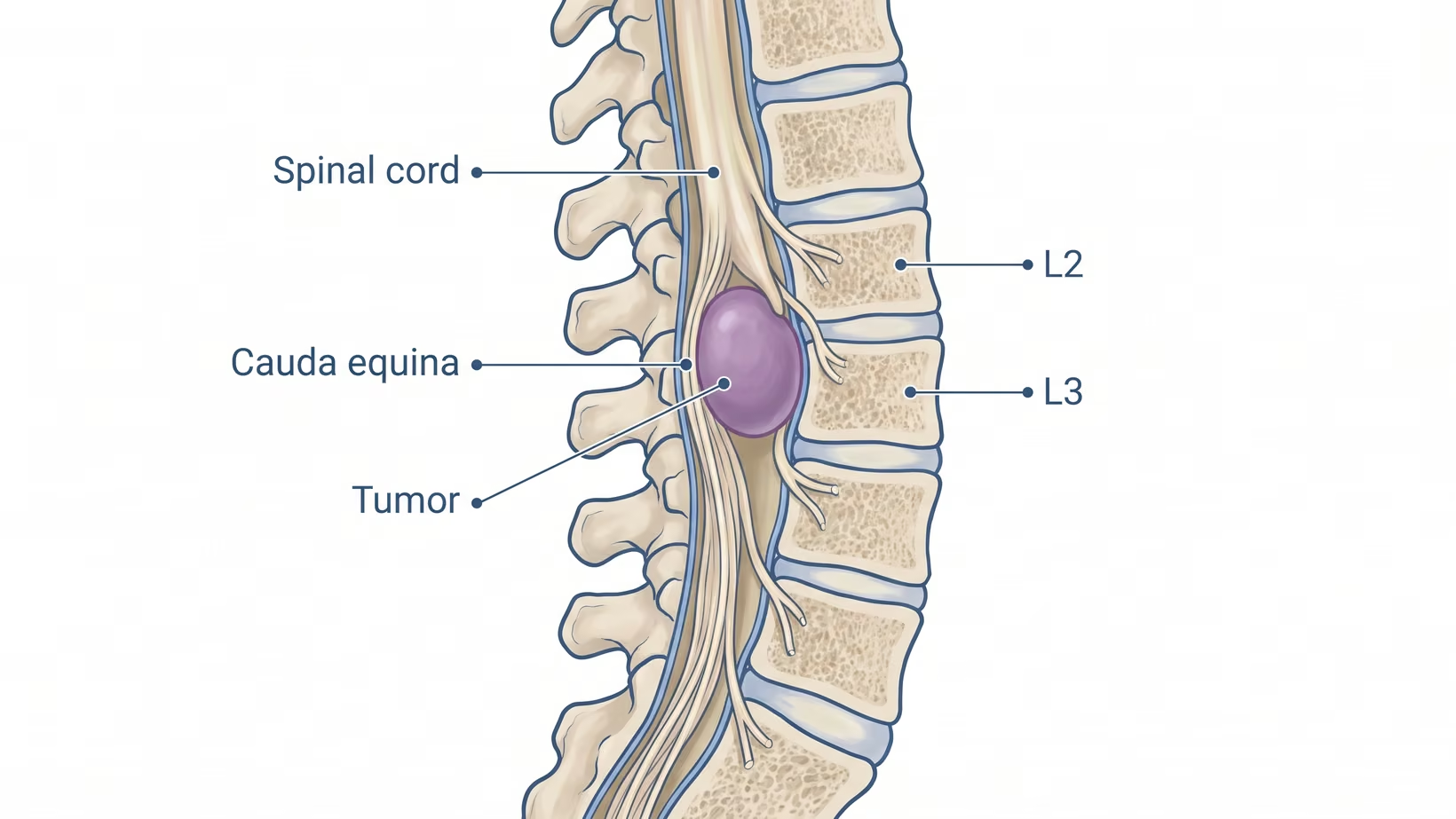
Back pain together with difficulty to pass urine indicate something in the low back presses on the nerves to the bladder. These nerves run inside the lower spinal canal, the tunnel of bone in the spine. The same bundle carries nerves to the bowel, the genitals and the legs. When the bundle is squeezed, the bladder can stop working normally.
Back pain and trouble passing urine are each common on their own. A summary of earlier studies puts them at 30 to 40 in 100 people in the general population. Fewer than 20 in 100 people checked for this nerve problem have the nerves squeezed on the scan. Because symptoms alone cannot tell which person that is, anyone with these symptoms needs the scan.
No single symptom reliably shows who has the squeezed nerves. That is why doctors check with an MRI scan and do not judge by symptoms alone.
What is cauda equina syndrome?
Cauda equina syndrome is pressure on the bundle of nerve roots in the low back. A nerve root is the start of a nerve where it leaves the spinal cord. The pressure usually comes from a slipped disc or a tumor. It can cause numbness between the legs, bladder, bowel or sexual problems, or pain down both legs.
A UK guideline calls it a spinal surgical emergency. If it is not treated in time, it can lead to permanent paralysis of the legs. It can also cause permanent loss of bladder, bowel and sexual function.
The same guideline says an MRI on its own cannot make the diagnosis. Doctors put the symptoms, the examination and the scan together. The studies on this page were done in adults.
What can press on these nerves?
The most common cause is a large slipped disc in the low back. A disc is the soft cushion between two bones of the spine. A slipped disc is a disc whose inner part has pushed out of place, here backward into the nerve bundle.
A UK study followed 621 adults whose syndrome was caused by a disc. In 50 in 100, the disc was between the fourth and fifth bones of the low back (L4/5). In 36 in 100, it was one level lower (L5/S1). In 11 in 100, it was one level higher (L3/4).
The UK guideline also names rarer causes. These are a blood clot (hematoma), an injury, an infection, a tumor, or a spinal or epidural anesthetic, an injection of numbing medicine near the spinal nerves. The guideline does not give how often each one happens.
Numb between the legs: what does saddle numbness feel like?
Saddle numbness is a loss of feeling in the parts of the body that would touch a saddle. That means the inner thighs, the genitals, the skin around the back passage (anus) and the buttocks. With back pain, numbness here is a reason to go to the emergency room now.
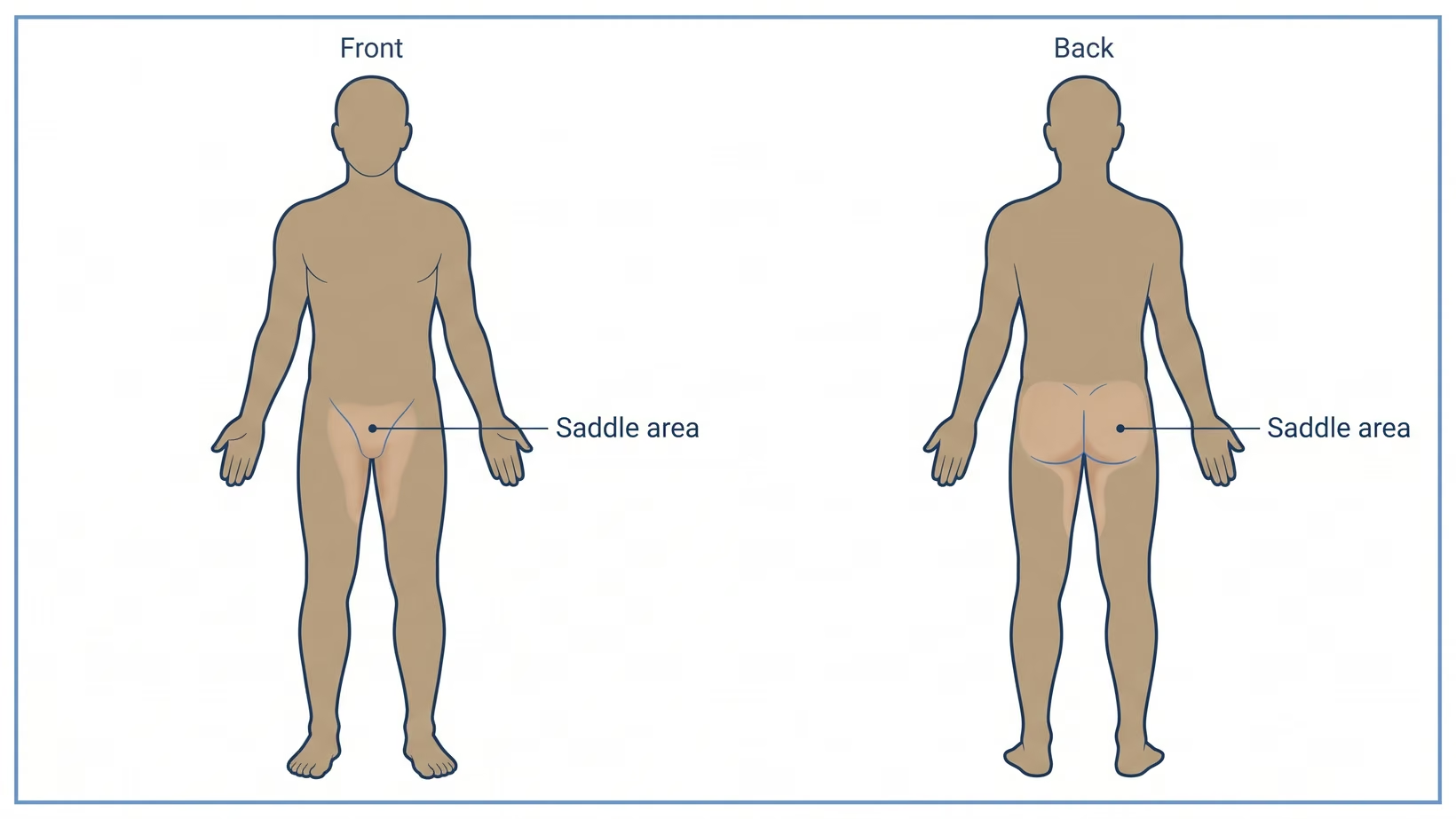
The UK warning card for patients describes pins and needles or loss of feeling in these areas. You may first notice it when you wipe after the toilet, because the paper feels different. Some people notice loss of feeling in the genitals during sex.
The UK referral guideline says the numb area may be a small patch or as big as a horse’s saddle. A small patch still counts.
In the UK study of 621 adults who had the syndrome, 81 in 100 had saddle numbness before surgery. That figure is about people who had the syndrome. It does not tell you the chance that numbness in one person means the syndrome.
Can’t control urine or stool with back pain: what does it mean?
Losing control of urine or stool with back pain can mean the nerves to the bladder and bowel are being squeezed. It is a reason to go to the emergency room now. Leaking, not feeling urine pass, and not knowing when your bladder is full are all on the UK warning list.
The same list includes trouble starting or stopping the flow, and not being able to hold back a bowel movement. Doctors also ask about the feeling of a full rectum, the last part of the bowel. Loss of that feeling is on the UK referral list.
In the UK study of adults who had the syndrome, 83 in 100 had bladder problems before surgery. Bowel problems were less common, in 39 in 100. So a normal bowel does not rule it out.
In some people the bladder fills and does not empty, without pain. Urine then leaks out because the bladder is too full. Doctors call this painless urinary retention with overflow. In the UK study, 31 in 100 needed a catheter, a soft tube into the bladder, before surgery for this.
Both legs weak suddenly: why does it matter with back pain?
Sudden weakness in both legs with back pain matters because the nerves to both legs may be squeezed at once. The UK guideline lists severe or worsening weakness of both legs as a reason for an emergency MRI. With this weakness, go to the emergency room now.
The guideline gives examples of this weakness. They include trouble straightening the knee, turning the ankle outward, or lifting the front of the foot.
Pain in both legs is a separate warning. Pain that suddenly runs down both legs, or pain in one leg that spreads to the other, may be a warning that the syndrome can follow.
If any warning sign appears while you wait, go to the emergency room now.
Mild weakness in one leg alone is not on the emergency list. If it spreads to the other leg, or any warning sign appears, go to the emergency room now. Back pain with leg weakness still needs a doctor to check the strength of each leg.
Seek care now
Where to go tonight with back pain and trouble passing urine
Go now to the emergency room of a hospital that can do an emergency MRI. Do not wait for a clinic appointment the next day. The UK guideline says a person with these symptoms should go to hospital now. If you are not sure a hospital can do an MRI tonight, call on the way. If no hospital near you can do one, still go to the nearest emergency room now.
Go now if back pain or leg pain comes with any of these:
- New trouble starting to pass urine, or not being able to pass urine at all
- Trouble stopping or controlling the flow of urine
- Not feeling urine or stool as it passes
- Leaking urine, or a new need to wear pads
- Not knowing when your bladder is full or empty
- Not being able to hold back a bowel movement
- Numbness or pins and needles between the inner thighs or in the genitals
- Numbness around the back passage or buttocks
- Toilet paper feels different when you wipe
- New trouble getting an erection or ejaculating, or loss of feeling during sex
- Severe or worsening weakness in both legs
What to tell the triage nurse
The triage nurse is the nurse who sees you first and decides who is seen first. Tell them plainly what is happening, in these words:
- “I have back pain and trouble passing urine.”
- “I am numb between my legs.” Say this only if it is true.
- When each symptom started, and whether it is getting worse
- Whether you have leaked urine or stool
Say that you are worried about cauda equina syndrome.
Bring and ask
What to bring
Bring these, but do not delay leaving to find them:
- Any earlier scans of your spine and their written reports
- A list of every medicine you take
- A bantay, a family member or friend who stays with you
The hospital may ask you not to eat or drink while you wait for the scan, in case you need surgery. The same papers help at your first neurosurgery appointment after you leave the hospital.
Why do the first 48 hours matter in cauda equina syndrome?
The first 48 hours matter because a 2026 review linked surgery within 48 hours of the first symptoms to better early recovery of the bladder and the nerves. A large UK study found no such link. The review recommends surgery within 48 hours, and the UK guideline asks for it as quickly as possible. It does not promise a full recovery. If more than 48 hours have already passed, still go to the emergency room now.
The review pooled observational studies, which watch patients without assigning treatment. Surgery within 48 hours was linked to better urine recovery, leg movement and nerve function than later surgery.
Doctors split the syndrome into two kinds. In incomplete cauda equina syndrome, the bladder is affected but still empties. In the retention kind, the bladder no longer empties and urine leaks out without pain.
In the review, timing made a strong difference in the incomplete kind. It made no clear difference in the retention kind. Surgery within 24 hours did not do consistently better than surgery at 24 to 48 hours.
The early gains were clearest in the short term. At 12 months or more, the gap between early and later surgery became smaller. By then, how the bladder worked before surgery mattered more than timing.
The UK study followed 621 adults. Half had surgery within three days of the first symptoms, and 32 in 100 within 48 hours. Bladder results and disability at one year were not linked to time to surgery. They were linked to how bad the symptoms were at the start.
In the UK study, 90 in 100 had surgery within one day of admission. So they could not say whether longer delays are worse. They argue for more urgent surgery in people who are getting worse fast.
The UK guideline describes the syndrome as time-sensitive and life-changing, but not life-threatening. That is the reason to go tonight.
What happens after the MRI?
If the MRI shows the nerves are squeezed, the treatment in the guideline and studies on this page is decompression surgery. This is an operation to take the pressure off the nerves. In the UK study, all 621 adults had this operation.
The UK guideline asks for a catheter before surgery so the bladder does not overstretch. An overstretched bladder can be damaged. After surgery, the catheter is taken out as soon as possible. Bladder scans then check that the bladder empties.
For the incomplete kind, the guideline asks for surgery as quickly as possible. For painless retention, the surgeon decides the timing, but within 24 hours of the MRI.
In the UK study, half of patients went home after three days or less. Of 609 patients, 94 in 100 went back to their usual home. Problems after surgery happened in 26 in 100. About 12 in 100 had a leak of the fluid around the nerves. Hospital stays here may differ.
Will bladder control come back?
Bladder control can improve after surgery, even in people whose bladder had stopped emptying. It does not return fully for everyone. A 2026 review of 16 studies found that about one in three people still had bladder problems a year or more after surgery.
In the UK study, of 190 people with a catheter before surgery, 30 in 100 still needed one when they went home. Of 84 followed to one year, 26 in 100 still needed one.
At one year, half of the 245 people who answered reported that their bladder did not work normally.
The review found worse bladder results in people who came in with retention than in the incomplete kind. For painless retention, the UK guideline says around 70 in 100 benefit from surgery. Benefit there does not mean full recovery. If problems remain, your team can teach you bladder and bowel care at home.
Emergency MRI and referral: a guide for the ER doctor
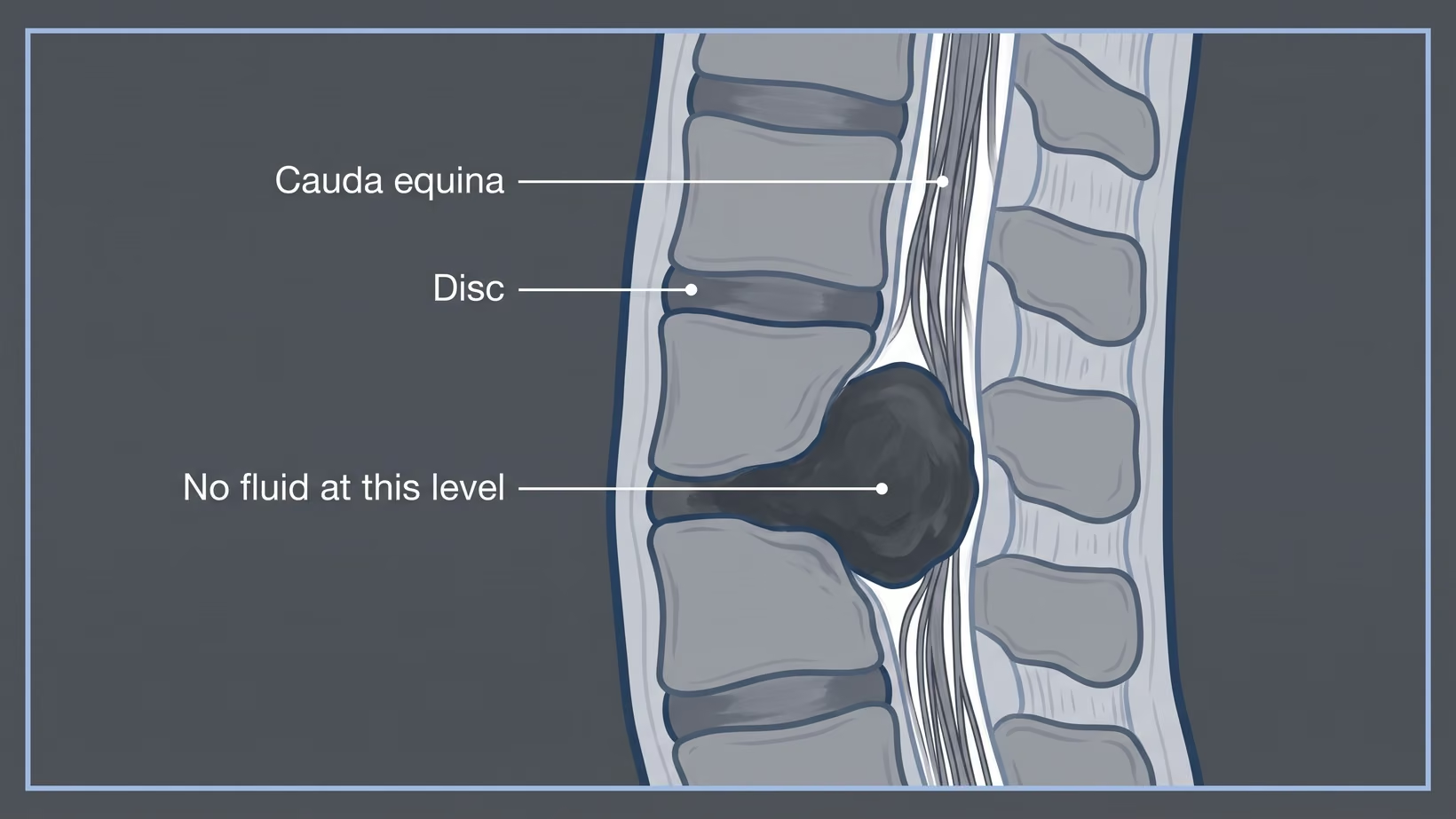
Suspected cauda equina syndrome needs an emergency MRI of the lumbar spine, the low back. The UK national guideline calls MRI at the presenting hospital best practice, day or night. Its standard is MRI as soon as possible, and within four hours of the request to radiology.
Which findings should prompt an emergency MRI?
The UK guideline asks for emergency referral to the nearest hospital with emergency MRI for back or leg pain with recent onset, within two weeks, of any of these:
- Difficulty starting urination, or reduced feeling of the urine flow
- Altered feeling around the anus, between the legs or in the genitals (the S2 to S5 skin areas), reported or tested
- Severe or progressive weakness of both legs, such as knee extension, ankle eversion (turning the sole outward) or foot dorsiflexion (lifting the foot)
- Loss of the feeling of a full rectum
- Inability to achieve an erection or ejaculate, or loss of vaginal sensation
No single feature reliably predicts compression on imaging. Across 18 studies of adults with suspected cauda equina syndrome, 19 in 100 had it confirmed on the scan and by examination. Most of those studies were small, single-center and from the UK.
Where does a bladder scan fit?
A bladder scan is a useful extra test, but the UK guideline says it should not decide alone whether to request an MRI. The scan measures the post-void residual, the urine left in the bladder after trying to pass urine.
In the UK study of adults with confirmed cauda equina syndrome, 368 had a bladder scan before surgery. Of these, 59 in 100 had less than 200 ml left after passing urine. The authors found it hard to support using bladder scans to decide who gets an MRI.
The guideline asks for a catheter when the residual is over 600 ml. Staff then record whether the patient feels the catheter and a gentle tug on it.
What to do now
How to refer, and what to send
Refer now, as an emergency, to the nearest hospital that can do an emergency MRI. Call the on-call neurosurgery or spine service of that hospital. Where the MRI can be done first, the UK guideline says it should not wait for a talk with the spinal team, because that can delay it.
Send a written summary with the patient. The UK guideline asks it to record:
- Time and date you saw the patient, and your examination findings
- Power and sensation in both legs
- Each symptom, when it began, how often it happens, and whether it is worsening
- Feeling around the anus as the patient reports it; a rectal examination is not required
- Who you referred to, and when
- Any advice you received, and from whom
Keep the patient with nothing to eat or drink. Ask a senior doctor to review the MRI request. A sagittal T2 sequence, a side-view image, is the one sequence needed to screen.
If you are the patient, go to the emergency room now with your scans and medicine list. After you go home, you can book a consultation with me for follow-up, or your doctor can refer you to me.
I see adults at my clinic at the Lung Center of the Philippines on Tuesday and Thursday from 2 PM (Room 1101, Quezon Avenue, Quezon City). If you live too far to come for follow-up, you can book an online consult on the consultation page. An online consult cannot replace the emergency room for these symptoms.
Frequently asked questions
Is cauda equina syndrome common?
Cauda equina syndrome is uncommon, but that does not mean you can wait: with back pain and any warning sign, go to the emergency room now. A review found it in about 3 in 1,000 people with low back pain seen in hospital care (0.27 percent). In one study of primary care, it was under 1 in 1,000 (0.08 percent). None of the studies on this page are from the Philippines.
Can I wait until morning to see a doctor?
You should not wait until morning with back pain and new trouble passing urine or numbness between the legs. The UK guideline says a person with these symptoms should go to hospital now. Go to the emergency room of a hospital that can do an emergency MRI.
Why was I told not to eat or drink at the hospital?
You may be asked not to eat or drink because surgery may be needed soon after the MRI. The UK guideline asks hospitals to keep patients with nothing by mouth when they request an emergency scan, in case emergency surgery is required.
Will surgery take away the back pain too?
Pain scores were lower after surgery for cauda equina syndrome in the UK study, but back pain did not go away for everyone. Scores were lower at discharge than on admission and stayed similar at one year. At discharge, doctors reported ongoing back pain in 18 in 100. Only 11 in 100 patients rated their back pain as zero.
Does every back pain need an MRI?
Not every back pain needs an MRI. A US radiology guideline says uncomplicated new low back pain does not need any scan. A scan is considered after up to six weeks of treatment without improvement, or with red flags such as cauda equina syndrome. Pain without these signs still has its own reasons to see a doctor about back pain.
See sources
- Woodfield J, Hoeritzauer I, Jamjoom AAB, et al. Presentation, management, and outcomes of cauda equina syndrome up to one year after surgery, using clinician and participant reporting: a multi-centre prospective cohort study. Lancet Regional Health – Europe. 2022. PMID 36426378; doi:10.1016/j.lanepe.2022.100545
- Getting It Right First Time (GIRFT), NHS England. Spinal Surgery: National Suspected Cauda Equina Syndrome (CES) Pathway. 2023. https://spinal.co.uk/wp-content/uploads/2023/08/National-Suspected-Cauda-Equina-Pathway-February-2023-FINAL-V1-1.pdf
- Hoeritzauer I, Wood M, Copley PC, et al. What is the incidence of cauda equina syndrome? A systematic review. Journal of Neurosurgery: Spine. 2020. PMID 32059184; doi:10.3171/2019.12.SPINE19839
- Najjar E, Egu C, Akil H, et al. Reassessing the clock in cauda equina syndrome: a systematic review and meta-analysis of surgical timing and outcomes. The Spine Journal. 2026. PMID 41991105; doi:10.1016/j.spinee.2026.04.013
- Najjar E, Muscogliati R, Trumble C, et al. Reassessing bladder recovery in cauda equina syndrome: long-term outcomes after surgical decompression: a systematic review and meta-analysis. The Spine Journal. 2026. PMID 42480656; doi:10.1016/j.spinee.2026.07.005
- Expert Panel on Neurological Imaging, American College of Radiology (Hutchins TA, Peckham M, Shah LM, et al). ACR Appropriateness Criteria Low Back Pain: 2021 Update. Journal of the American College of Radiology. 2021. PMID 34794594; doi:10.1016/j.jacr.2021.08.002