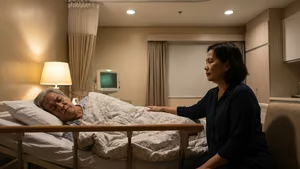

A slipped disc, or herniated disc, is disc material pushed past the edge of a spine disc. It can press on a nerve and cause back pain, leg pain, numbness or weakness. Many people improve without surgery. Surgery is for when other care has not helped. Trouble passing urine or numbness between the legs needs the emergency room now.
What is a slipped disc (herniated disc)?
A slipped disc is disc material that has been pushed out beyond the normal edge of a spinal disc. Doctors call it a herniated disc. When the material presses on a nerve, it can cause pain, weakness or numbness in the part of the body that nerve supplies.
The discs are the cushions between the bones of the spine, the vertebrae. “Slipped” is the everyday word, but only part of the disc material moves, not the whole disc.
The pushed-out material can press on a nerve root. A nerve root is the start of a nerve where it leaves the spinal cord. Low back pain with leg pain, called sciatica, may be caused by a slipped disc pressing on a nerve root in this way.
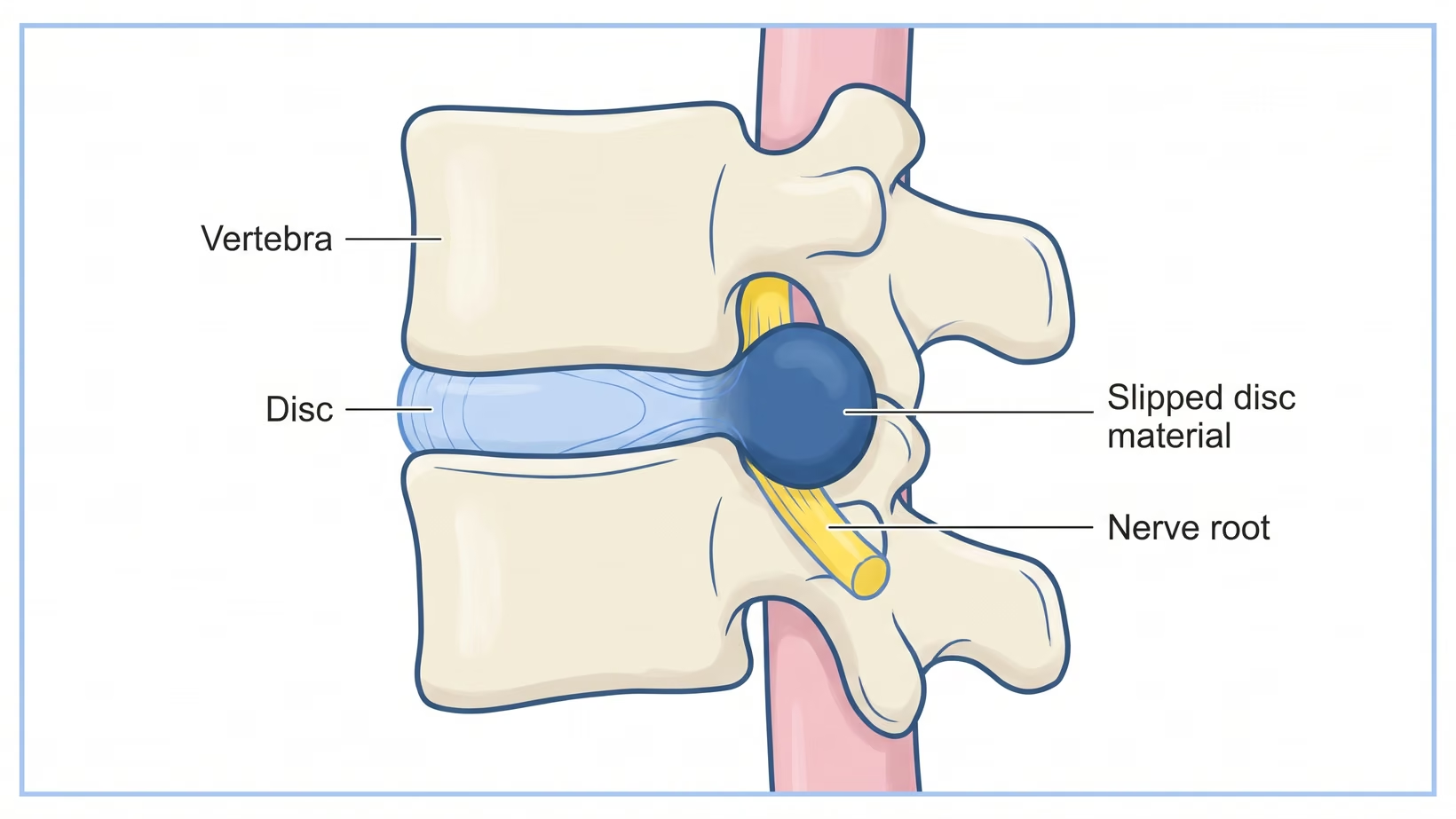
This page covers discs in the lower back, the lumbar spine, which is where the guidelines and trials here were done.
What causes a slipped disc?
Wear of the discs becomes more common with age, even in people who have no back pain. A review of scans in 3,110 people without pain found disc wear in about 37 in 100 twenty-year-olds and 96 in 100 eighty-year-olds.
The same review found that many of these changes are likely part of normal aging. They were not linked to pain. So a scan finding is read together with your symptoms and your examination.
Who gets a slipped disc: teenagers, adults and older people?
The trials on this page studied adults. In one large US trial, the average age of the patients was 42. Disc bulges on scans also rise with age: about 30 in 100 twenty-year-olds and 84 in 100 eighty-year-olds with no pain had one.
The sources give no figures for children or teenagers. A teenager with back or leg pain needs a doctor’s check before anyone calls it a slipped disc. Trouble passing urine or numbness between the legs needs the emergency room now.
What are the symptoms of a slipped disc?
A slipped disc in the lower back can cause back pain and pain that spreads down the leg. It can also cause numbness or weakness. These symptoms follow the area that one nerve root supplies, because the disc is pressing on that nerve root. Doctors call this radiculopathy, meaning symptoms from a pinched nerve root.
Each nerve root supplies a strip of skin, called a dermatome, and a group of muscles, called a myotome. The symptoms can include:
- Pain in the low back together with pain that spreads into one leg
- Pain that follows the strip of skin one nerve root supplies
- Numbness in that same strip of skin
- Weakness in the muscles that the same nerve root moves
This leg pain is called sciatica, the pain that shoots down the leg.
A slipped disc does not always cause symptoms. Disc bulges and protrusions, where disc material pushes out a little, are common on scans of people who have no pain at all.
When should you see a doctor for a slipped disc?
See a doctor if leg pain from your back is not settling with simple care. See a doctor today if one leg is getting weaker. Go to the emergency room now if you have trouble passing urine, numbness between the legs or weakness in both legs. These signs can mean the nerves at the bottom of the spine are squeezed.
Seek care now
Signs that mean the emergency room now
Back or leg pain with any one of these new signs:
- Trouble starting to pass urine, or not feeling the urine flow
- Numbness around the anus, between the legs or on the genitals, a patch as small as a coin or as big as a saddle
- Weakness in both legs that is severe or getting worse
- Not feeling when the rectum is full
- New loss of erection or ejaculation, or loss of feeling in the vagina
Go now to the emergency room of the nearest hospital with an MRI scanner. If you do not know which hospital has one, go to the nearest emergency room now and do not wait. One sign is enough.
These signs can mean cauda equina syndrome, pressure on the bundle of nerve roots at the bottom of the spine. A normal examination does not rule it out when you have these symptoms. This is why trouble passing urine with back pain cannot wait.
When to see a doctor urgently
These signs need a doctor today. If no doctor can see you today, go to an emergency room:
- Pain that starts suddenly in both legs
- Pain in one leg that has spread to both legs
- Weakness in one leg that is severe or getting worse
Pain spreading to both legs may be a warning that cauda equina syndrome could follow.
What to do now
What to bring, and how to book a consult
Match the timing to your signs:
- Any sign in the red box above: the emergency room now.
- Pain in both legs, or weakness getting worse: a doctor today, or an emergency room if no doctor can see you today.
- Leg pain that is not settling: your doctor soon, then a neurosurgeon or spine surgeon.
Bring these to the visit:
- Your MRI images on a disc or USB, and the radiologist’s report
- A list of your medicines
- A note of when the leg pain started and what makes it worse
- The treatments you have already tried
If you are near Quezon City, you may see me at the Lung Center of the Philippines, Room 1101, on Tuesday and Thursday from 2 PM. I see teenagers at the Philippine Children’s Medical Center (PCMC), Room 22, on Wednesday from 2 PM.
If travel is not practical, book an online consult on the consultation page. Your doctor can also refer you to me.
How do doctors confirm a slipped disc?
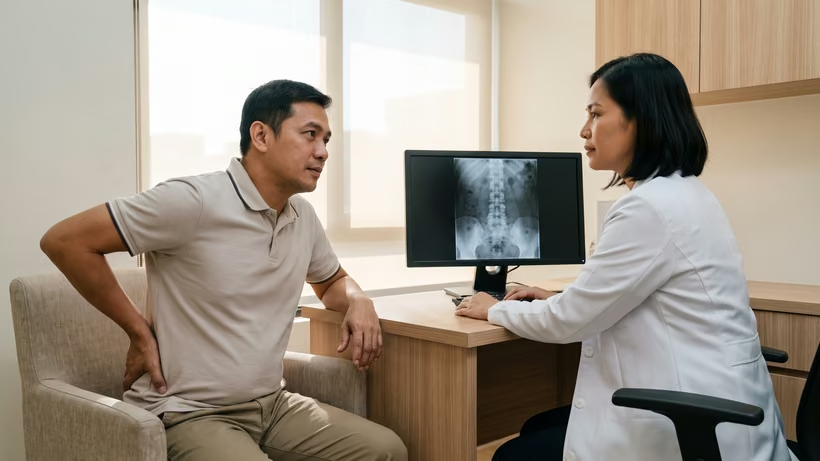
Doctors confirm a slipped disc by matching your story and your examination first. The examination tests muscle strength, feeling in the skin and the straight leg raise. When the story and the examination fit a slipped disc, an MRI scan, which shows the discs and the nerves, is recommended to confirm it. A scan alone does not decide it.
In the straight leg raise, you lie on your back and the doctor lifts your straightened leg to see if it brings on the leg pain. In studies of patients who went on to surgery, it was positive in about 92 in 100 of those who had a herniated disc. But only about 28 in 100 of those without one had a negative test.
Most single examination tests performed poorly on their own, so a doctor combines several.
Not everyone with back pain needs a scan, and a UK guideline advises against routine scans outside specialist care. A US guideline advises an MRI for lasting leg pain from a nerve only if you may need surgery or a steroid injection. Scans and tests are done sooner when weakness is severe or getting worse.
Bulges are common in people with no pain, so a disc bulge on an MRI report is read together with your examination.
Can a slipped disc heal on its own?
A slipped disc can get better without surgery, and many do. In one trial of people with sciatica, 87 in 100 reported improvement after 12 weeks. Herniated disc material can also shrink over time, as repeat scans show.
A North American spine guideline panel judged that most patients improve whatever the treatment, and that herniated discs often shrink. The panel said this was its opinion, because the studies were not strong enough to answer it.
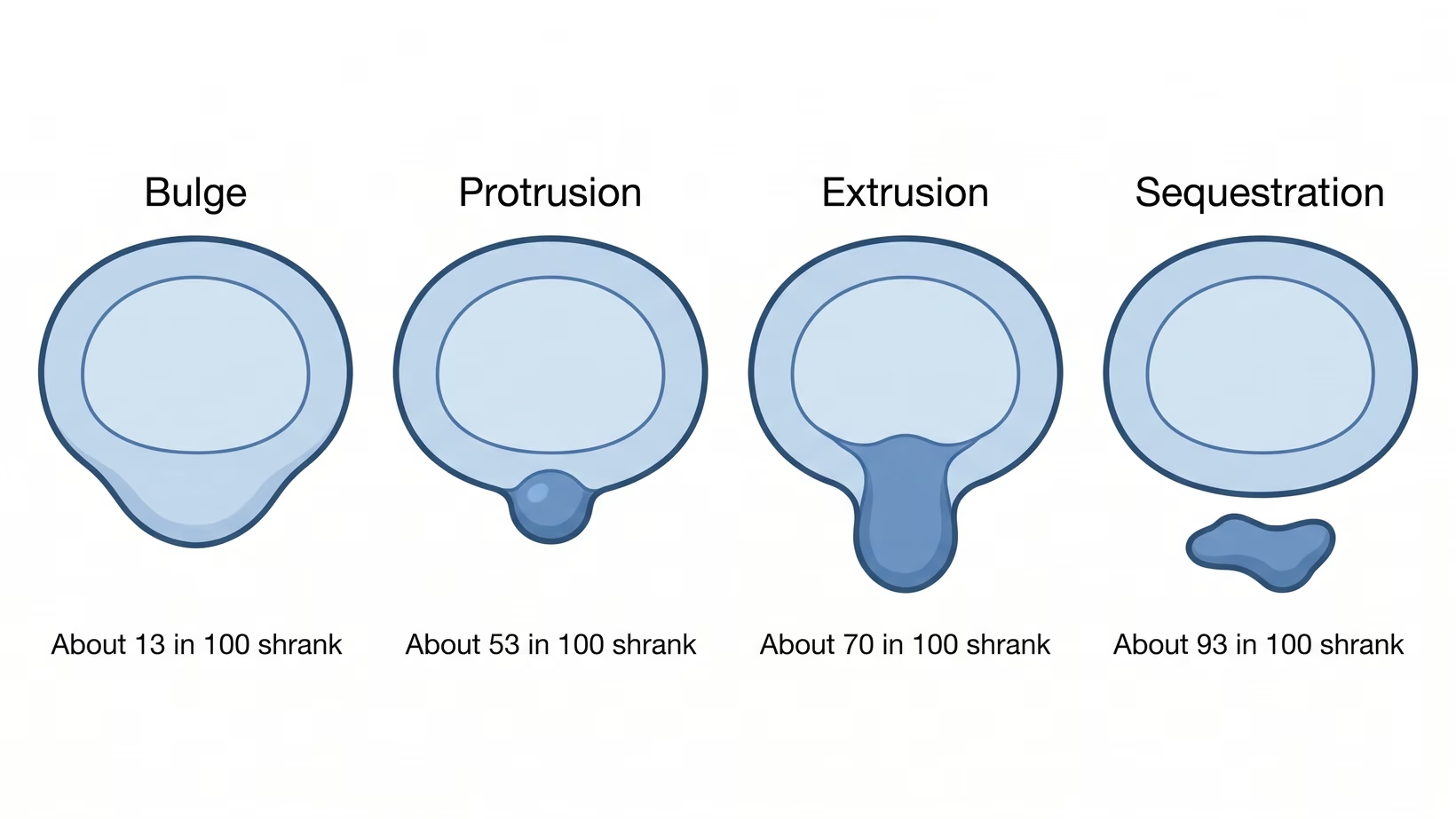
A review of 360 cases with two MRI scans counted how often the disc shrank. The repeat scan came on average 11.5 months later. Shrinking depended on the shape of the disc:
- A bulge, where the disc edge pushes out broadly: about 13 in 100 shrank
- A protrusion: about 53 in 100 shrank
- An extrusion, a larger push of material: about 70 in 100 shrank
- A sequestration, where a piece has broken free: about 93 in 100 shrank
These figures are shrinkage seen on scans, not pain relief. Shrinking was linked to symptoms getting better.
In a Dutch trial, 283 people with severe sciatica for 6 to 12 weeks were split into two groups. One group had early surgery. The other waited, with surgery if needed, and 39 in 100 of them had surgery. After one year, 95 in 100 in both groups felt recovered.
What is the treatment for a slipped disc?
Guidelines start treatment for a slipped disc without surgery: advice, staying active and exercise. Some medicines and injections help a little, and some do not help. Surgery is considered when this care has not improved the pain or function, and the MRI matches the symptoms.
What usually helps first
A UK guideline advises doctors to help you manage the pain yourself and to encourage you to continue your normal activities. It suggests considering a group exercise program. In a trial, bed rest was no better than staying up and waiting.
Anti-inflammatory pain medicines (NSAIDs) have limited evidence of benefit in sciatica and carry a risk of harm. When doctors prescribe them, the guideline advises the lowest dose that works, for the shortest time.
The guideline considers massage or spinal manipulation only as part of a treatment program that includes exercise.
What does not help, or may harm
In a trial of 209 people, pregabalin, a nerve-pain medicine, did not reduce leg pain more than a dummy pill (placebo) at 8 weeks. Leg pain was no lower with it at one year, and it caused more side effects, such as dizziness.
The UK guideline advises doctors not to offer pregabalin-type medicines, other seizure medicines, steroid tablets or sedatives called benzodiazepines for sciatica. If you take one of these, do not stop it on your own. Ask the doctor who prescribed it.
The guideline also advises against back belts, corsets and traction. It does not mention hilot. If you have leg weakness, numbness or any warning sign, see a doctor first and do not have your back pressed or manipulated.
Do epidural steroid injections help?
Epidural steroid injections probably reduce leg pain slightly, for a short time. In an epidural injection, steroid medicine is placed in the space around the nerves in the spine. A review of 25 trials with 2,470 people found a small effect between two weeks and three months, which patients may not notice.
One person in the review who was taking a blood thinner had serious bleeding after the injection. If you take a blood thinner, tell the doctor before any injection, and do not stop it on your own.
When does a slipped disc need surgery?
A slipped disc may need surgery when leg pain or weakness has not improved with non-surgical care, and the MRI matches the symptoms. The UK guideline then advises doctors to consider decompression, an operation that takes the pressure off the nerve. Warning signs of cauda equina syndrome need emergency care.
The North American guideline suggests that discectomy, removing the piece of disc pressing on the nerve, relieves symptoms better than non-surgical care. This applies when symptoms are bad enough for surgery. With less severe symptoms, both surgery and non-surgical care appear to work.
In the Dutch trial, early surgery relieved leg pain faster. Disability over the first year was not different between the groups.
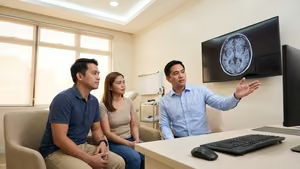
I operate on slipped discs in adults. A planned operation is done at the Lung Center of the Philippines or the National Kidney and Transplant Institute. When admission is needed sooner, it is done at Capitol Medical Center, Quezon City. Whether a slipped disc needs surgery depends on your pain, your weakness and your MRI, and you decide it with your surgeon.
What happens in the operation?
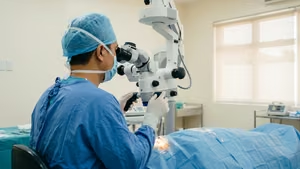
In the Dutch trial, the operation was a microdiscectomy: removing the disc piece with the help of an operating microscope.
The North American guideline suggests the microscope gives results comparable to open discectomy. It suggests endoscopic discectomy, done through a thin tube with a camera, for carefully selected patients. Compared with open surgery, it can reduce disability in the first weeks and the need for opioid pain medicine. That benefit is about early recovery, not the final result.
Recovery after surgery
The studies on this page did not measure when people walk, sit, drive or return to work after a discectomy. Every operation on the spine has risks, and your surgeon explains them before you agree to it.
For doctors: disc herniation grading and when to refer
For referring doctors: describe a lumbar disc herniation on MRI by its shape, and read it against the examination. Refer as an emergency for any new cauda equina symptom. Refer urgently for new nerve-root pain in both legs. Refer for a surgical opinion when care without surgery has not helped and imaging matches.
When to refer, and how urgently
Refer as an emergency, to the nearest facility with emergency MRI, for any new symptom of cauda equina syndrome (CES). These include difficulty starting to pass urine, altered perianal or genital sensation (S2 to S5) and severe or worsening weakness in both legs. Loss of rectal fullness and sexual dysfunction count too.
Negative physical tests do not rule out CES when the symptoms are present. Sudden nerve-root pain in both legs, or pain in one leg that spreads to both, may warn of CES and needs urgent referral.
Image and test for severe or worsening weakness or numbness. Otherwise, avoid routine imaging in a non-specialist setting; a patient referred for a specialist opinion may not need imaging first. Refer for a surgical opinion when non-surgical care has not improved pain or function and imaging matches. Do not let BMI, smoking or psychological distress decide the referral.
On timing, NASS suggests surgery before six months when symptoms warrant it (grade B). No studies directly addressed timing.
Bring and ask
What to send with the referral
Send these with the patient:
- The MRI images, not only the report
- Neurological findings, with dates
- How long the leg pain has lasted
- Treatments tried and the response
- The red-flag screen
Adults can be seen at my Lung Center clinic on Tuesday and Thursday from 2 PM, and teenagers at PCMC on Wednesday from 2 PM. A patient far from Quezon City can book an online consult on the consultation page.
Frequently asked questions
Is it a slipped disc or a muscle strain?
A slipped disc that presses on a nerve causes pain, numbness or weakness in the area one nerve root supplies, which can include the leg. The sources on this page do not describe how a muscle strain differs. Pain that spreads down the leg, numbness or weakness needs a doctor’s examination to tell them apart. Trouble passing urine or numbness between the legs needs the emergency room now.
How long does a slipped disc take to heal?
A slipped disc has no single healing time in the studies on this page. In one trial, 87 in 100 people with sciatica reported improvement by 12 weeks. In another, 95 in 100 felt recovered at one year, though some had surgery. Neither gives a healing time for a slipped disc that fits everyone.
Which exercises should I avoid with a slipped disc?
For a slipped disc, the UK guideline encourages you to continue your normal activities and suggests considering a group exercise program. It names no exercise as harmful. A physical therapist can help choose a program that fits your needs. Stop and see a doctor today if new weakness appears. Go to the emergency room now if you have trouble passing urine, numbness between the legs or weakness in both legs.
Does spinal decompression therapy fix a slipped disc?
Spinal decompression therapy uses a machine to pull on the spine, a form of traction. The UK guideline advises doctors not to offer traction for low back pain, with or without sciatica. It does not name decompression machines. Decompression surgery, which removes the disc material pressing on the nerve, is a different treatment.
See sources
- Kreiner DS, et al; North American Spine Society Evidence-Based Guideline Development Committee. An evidence-based clinical guideline for the diagnosis and treatment of lumbar disc herniation with radiculopathy. The Spine Journal. 2014. PMID 24239490. doi:10.1016/j.spinee.2013.08.003
- Brinjikji W, Luetmer PH, Comstock B, et al. Systematic literature review of imaging features of spinal degeneration in asymptomatic populations. AJNR American Journal of Neuroradiology. 2015. PMID 25430861. doi:10.3174/ajnr.A4173
- Rashed S, et al. Systematic review and meta-analysis of predictive factors for spontaneous regression in lumbar disc herniation. Journal of Neurosurgery: Spine. 2023. PMID 37486886. doi:10.3171/2023.6.SPINE23367
- Peul WC, van Houwelingen HC, van den Hout WB, et al. Surgery versus prolonged conservative treatment for sciatica. New England Journal of Medicine. 2007. PMID 17538084. doi:10.1056/NEJMoa064039
- Weinstein JN, Tosteson TD, Lurie JD, et al. Surgical vs nonoperative treatment for lumbar disk herniation: the Spine Patient Outcomes Research Trial (SPORT): a randomized trial. JAMA. 2006. PMID 17119140. doi:10.1001/jama.296.20.2441
- Vroomen PC, de Krom MC, Wilmink JT, et al. Lack of effectiveness of bed rest for sciatica. New England Journal of Medicine. 1999. PMID 9971865. doi:10.1056/NEJM199902113400602
- Mathieson S, Maher CG, McLachlan AJ, et al. Trial of pregabalin for acute and chronic sciatica. New England Journal of Medicine. 2017. PMID 28328324. doi:10.1056/NEJMoa1614292
- National Institute for Health and Care Excellence (NICE). Low back pain and sciatica in over 16s: assessment and management (NICE guideline NG59). 2016, updated 2026. https://www.nice.org.uk/guidance/ng59/chapter/Recommendations
- Oliveira CB, Maher CG, Ferreira ML, et al. Epidural corticosteroid injections for lumbosacral radicular pain. Cochrane Database of Systematic Reviews. 2020. PMID 32271952. doi:10.1002/14651858.CD013577
- Chou R, Qaseem A, Snow V, et al. Diagnosis and treatment of low back pain: a joint clinical practice guideline from the American College of Physicians and the American Pain Society. Annals of Internal Medicine. 2007. PMID 17909209. doi:10.7326/0003-4819-147-7-200710020-00006
- van der Windt DA, Simons E, Riphagen II, et al. Physical examination for lumbar radiculopathy due to disc herniation in patients with low-back pain. Cochrane Database of Systematic Reviews. 2010. PMID 20166095. doi:10.1002/14651858.CD007431.pub2
- GIRFT Spinal Surgery programme, NHS England. Spinal Surgery: National Suspected Cauda Equina Syndrome (CES) Pathway. 2023. https://spinal.co.uk/wp-content/uploads/2023/08/National-Suspected-Cauda-Equina-Pathway-February-2023-FINAL-V1-1.pdf