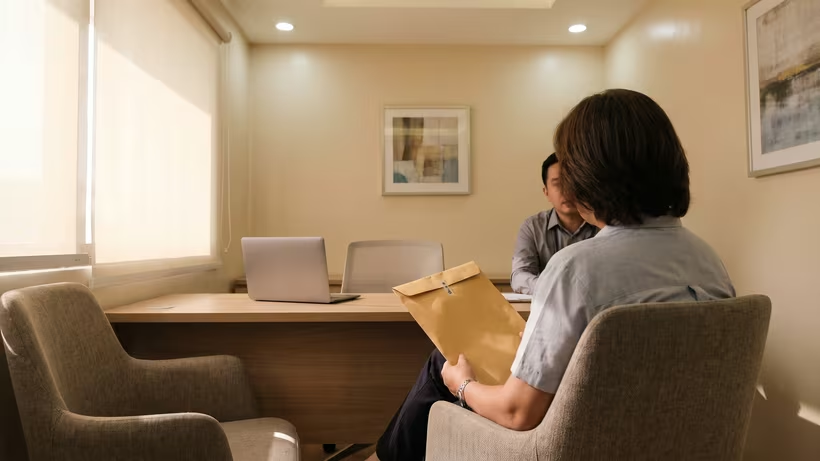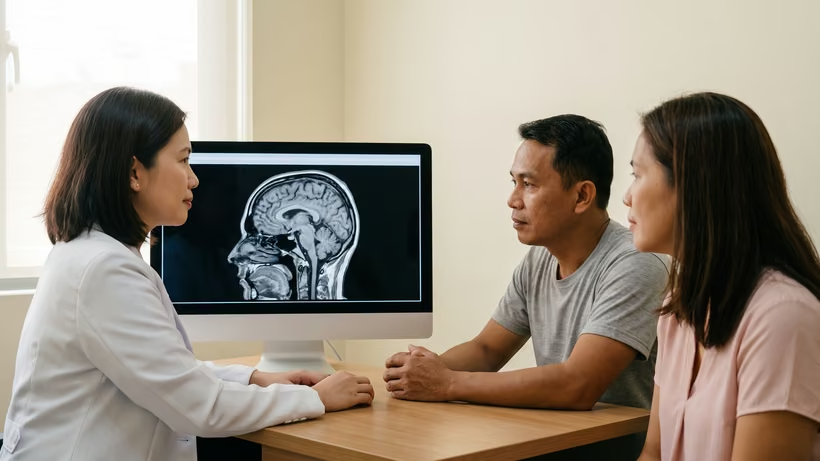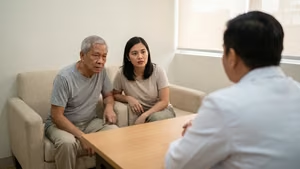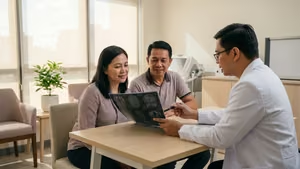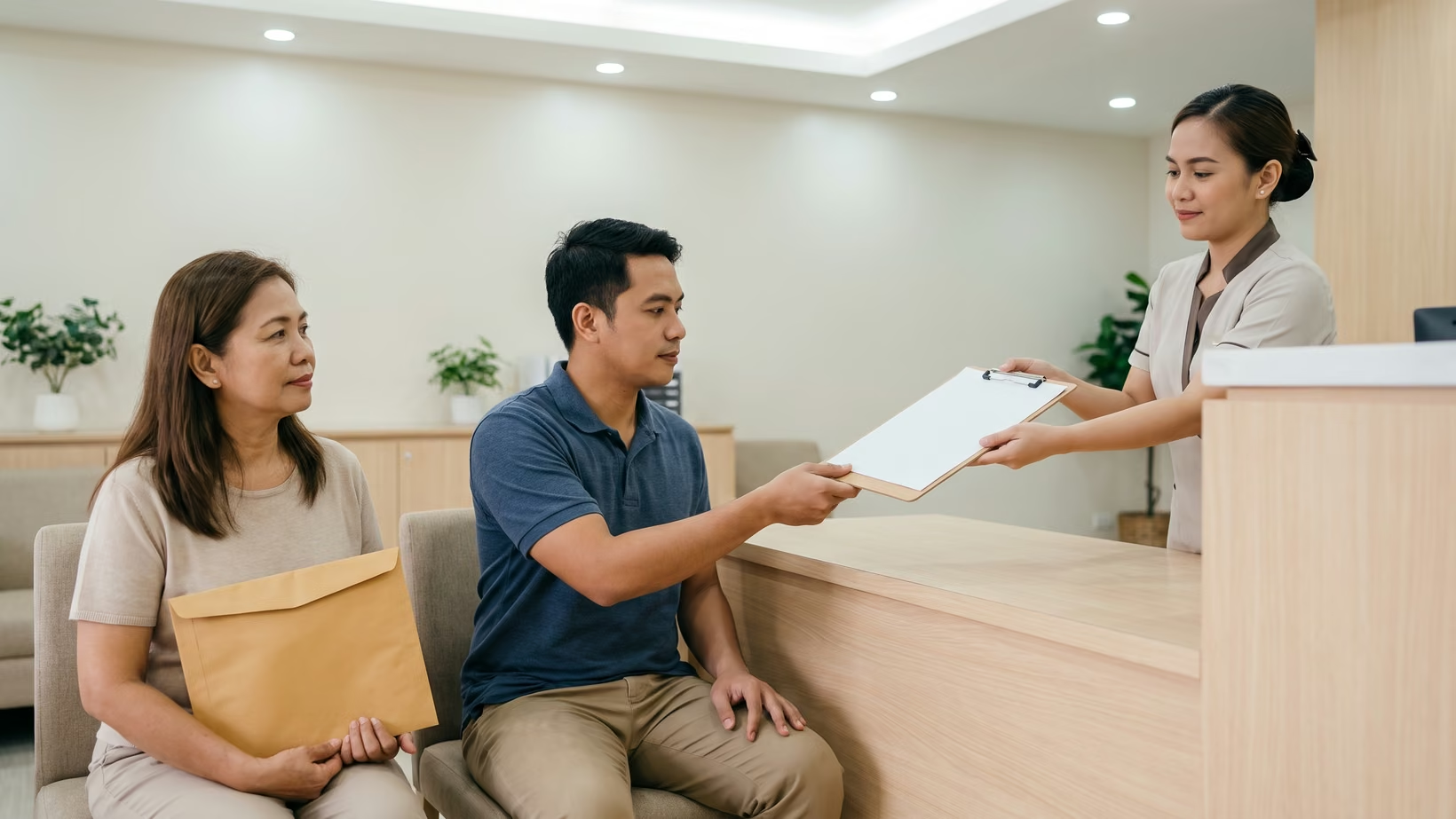

There is no single neurosurgeon consultation fee in the Philippines. Each doctor and hospital sets its own, and a private clinic charges differently from a government hospital’s outpatient department. Ask the clinic secretary the amount when you book. Majority of Neurosurgeons are not covered by an HMO.
How much is a neurosurgeon check-up in the Philippines?
A neurosurgeon check-up in the Philippines has no single price. Each neurosurgeon sets the fee for a private clinic visit, and the amount differs between hospitals and between cities. The clinic secretary can tell you the exact fee when you book. Ask before the day of the visit, so the amount is not a surprise at the clinic.
A neurosurgeon is a surgeon of the brain, the spine and the nerves. Many see patients in a clinic inside or beside a hospital. The fee is for the doctor’s time with you. The hospital may add its own charges, such as for registration or records, so ask about those too.
Ask the secretary these questions when you call or send a message:
- How much is the fee for a first visit?
- How much is the fee for a follow-up visit?
- Is the reading of scans done elsewhere a separate charge?
- How can I pay: cash, card or bank transfer?
- Does the clinic accept my HMO, and what do I bring for it?
A first visit can take longer than a follow-up. The neurosurgeon asks about your symptoms from the start, examines you and looks at every scan you bring. Come early, and bring all your records in one folder.
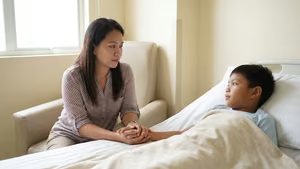
You may be booking for a parent, a spouse or a child. The questions to ask are the same. Bring the family member who knows the history best, and the one who will help decide about treatment.
The fee question is for a planned visit. Do not wait for a clinic slot if you see any of these signs.
Seek care now
Signs that cannot wait for a clinic visit
Go to the nearest hospital emergency room now, with someone else driving, if an adult has any of these:
- Sudden dizziness, weakness or change in vision
- Being unable to speak
- Confusion, unusual behavior or being hard to wake
- Fainting or loss of consciousness
- A head or spine injury
- Sudden, severe pain anywhere in the body, such as a sudden, severe headache
For a child, also go now for a seizure, more sleepiness than usual, or a severe headache or vomiting after a head injury.
The emergency room doctor checks the patient first. When that hospital has a neurosurgeon, the emergency room asks for a neurosurgery consult there. Sudden symptoms of the brain or spine are a reason to see a neurosurgeon through the emergency room. Questions about fees can wait until the patient has been seen.
What the consultation fee covers, and what it does not
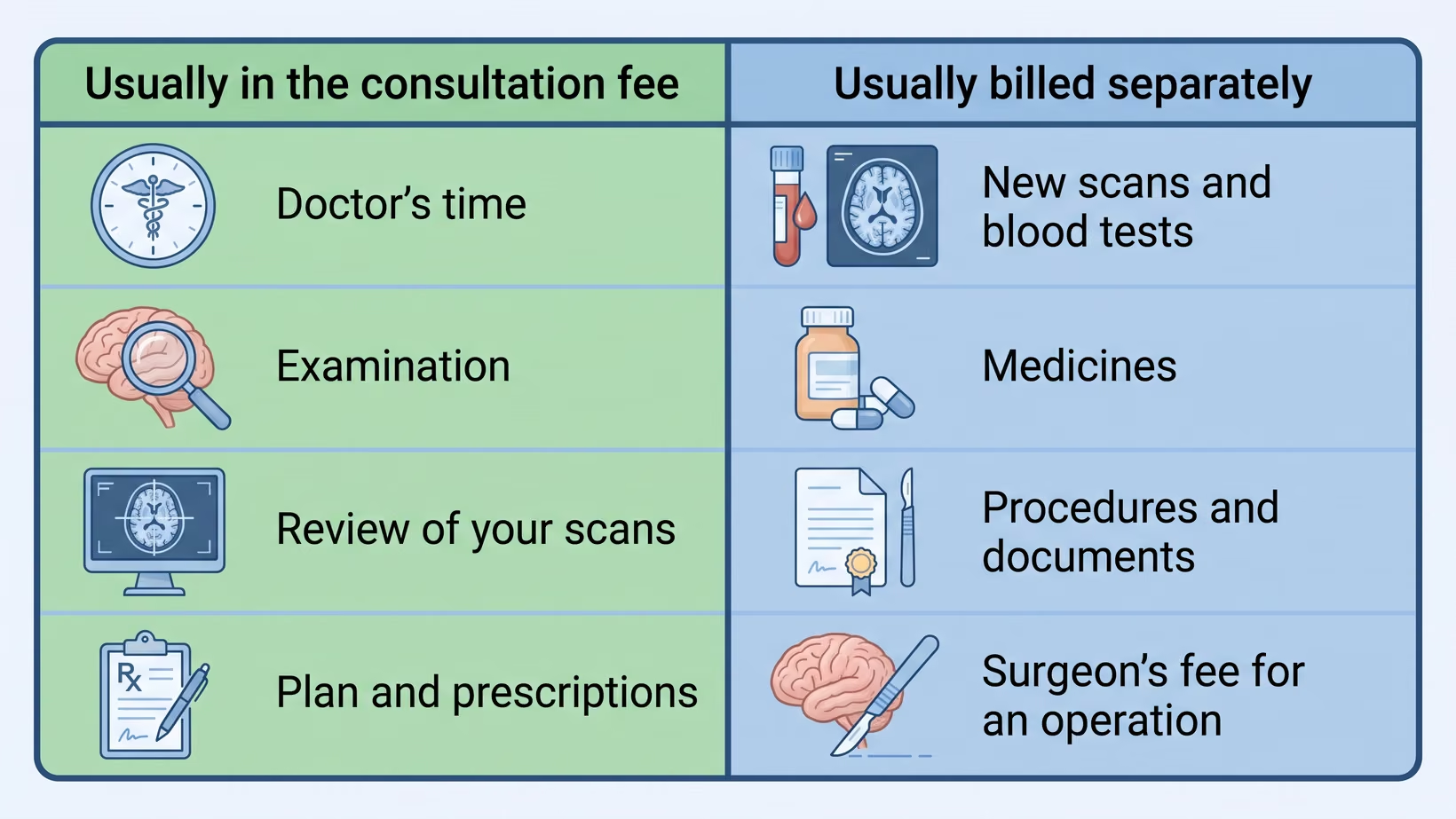
The consultation fee usually pays for the neurosurgeon’s time: the questions about your symptoms, the examination, the review of the scans you bring and the plan. New tests, medicines, procedures and an operation are usually billed separately. Ask the secretary which charges apply at that clinic.
What is usually part of the consultation fee:
- The doctor’s time with you
- The questions about your history and the examination
- The review of the scans and reports you bring
- The plan, and any prescriptions or requests for tests
What is usually billed separately:
- New scans, such as a CT scan or an MRI, and blood tests
- Medicines, bought at the pharmacy
- Procedures done in the clinic
- Documents at some clinics, such as a medical certificate or a medical abstract, which is a written summary of your case
- The surgeon’s professional fee, if an operation is planned
The professional fee for an operation is a different fee from the consultation. It is also separate from the hospital bill. Ask what the neurosurgeon’s professional fee for the operation covers before the day of admission. Prepare that money at the same time as the tests, not after the bill comes.
Scans you already have can save money. Bring the images on a disc, not only the printed report. The neurosurgeon decides whether those images are enough or whether a new scan is needed.
Some clinics charge for filling in insurance forms or for a medical abstract. Others include it. Ask when you book, and ask how many days the document takes to prepare.
Can you see a neurosurgeon at a government hospital’s OPD?
Yes, you can see a neurosurgeon at a government hospital’s outpatient department (OPD) when that hospital has a neurosurgery service. How you register, what you pay and how long you wait differ by hospital. Call or visit the OPD before the clinic day and ask. If any of the emergency signs above appears while you wait for the clinic day, go to the nearest hospital emergency room now, with someone else driving.
An OPD visit often starts with registration, where you get a hospital record. Some hospitals ask for a referral slip from another clinic or doctor. Then you line up for the neurosurgery clinic on its clinic day.
Bring the same records you would bring to a private clinic:
- The scan images on a disc, and the printed reports
- Earlier test results and any discharge summary
- A referral letter, if you have one
- A list of the medicines you take
- A valid ID and your PhilHealth details
If you need help with the cost, ask for the medical social service at the hospital. A medical social worker talks with your family and checks which help you can get.
At the government hospitals where I operate, admission for a planned operation can need lead time. When a patient needs to be admitted sooner, I point them to Capitol Medical Center in Quezon City.
Is there a PhilHealth outpatient consultation benefit?
PhilHealth’s benefit for outpatient consultations, as its 2025 circular (an official PhilHealth notice) describes it, is primary care at the YAKAP clinic you register with. For specialist visits, the same circular says PhilHealth will release a separate Specialty Outpatient package. Ask PhilHealth or the hospital’s PhilHealth desk what it pays for a neurosurgeon visit now.
YAKAP is the newer form of the PhilHealth Konsulta program. It covers primary care, and it also changes how PhilHealth works with the providers of outpatient tests and medicines. You register with one primary care clinic, now called a YAKAP clinic. You then stay with that clinic for at least a year, unless you transfer.
That clinic is your first contact for health problems. It gives your primary care. It also coordinates the rest of your care, including visits to other doctors.
The circular sets a different goal for primary care clinics inside hospitals. They are to move toward giving specialist outpatient services. PhilHealth says this is in preparation for its Specialty Outpatient benefit package, which it will release in a separate circular.
Currently the Philhealth Specialist Outpatient Package is still being planned and not yet implemented. This project is very promising and will surely benefit a lot of patients in the future.
How the primary care clinic fits in before a specialist visit
The Universal Health Care Act aims to give every Filipino a primary care provider who coordinates care. The law says every Filipino shall register with a public or private primary care provider of choice. It also says that, “except in emergency or serious cases and when proximity is a concern, access to higher levels of care shall be coordinated by the primary care provider.”
A neurosurgeon is one of those higher levels of care. Your primary care doctor can write a referral letter that states the question to be answered. That letter helps the neurosurgeon at the first visit.
Bring and ask
How to get an HMO letter of authorization for a specialist
Where a plan does cover a specialist consultation, it may need the doctor to be accredited with it (approved by the HMO to see its members) and a letter of authorization (LOA). An LOA is the HMO’s written approval for that visit. Rules differ by HMO and by plan, so ask your HMO before the visit.
- Check that the neurosurgeon and the hospital are accredited with your HMO. The clinic secretary or the HMO hotline can tell you.
- Ask your HMO how to get the LOA for a specialist consultation. Some give it through an app or a hotline. Others give it at the hospital’s HMO desk.
- Ask whether your plan needs a referral from its own primary care doctor first.
- Ask how long the LOA stays valid, and book the visit within that time.
- Bring your HMO card, a valid ID and the LOA on the day.
- Ask whether tests ordered at the visit, such as an MRI, need their own LOA.
Each plan has a limit on how much it pays. Ask your HMO how much of your limit is left before tests or admission are planned.
If your HMO does not cover the visit, or the doctor is not accredited with it, you can still pay the fee yourself. Ask the secretary the amount first. Keep the official receipt, because some plans pay back part of the fee later.
When your budget is limited
When your budget is limited, there is help for part of the bill. PhilHealth and the Malasakit Center cover part of a hospital bill. Government hospitals give charity care to families who need full help. The medical social worker at the hospital checks which help your family can get.
A Malasakit Center is a one-stop shop for medical and financial assistance in government hospitals. Each center has staff from four offices. These are the Department of Health (DOH), the Department of Social Welfare and Development (DSWD), the Philippine Charity Sweepstakes Office (PCSO) and PhilHealth.
The law sets the center up for patients the government classifies as indigent, meaning poor. It also covers patients who are not classified as indigent but who clearly do not have enough to pay. A medical social worker certifies that.
Through the center, you can ask for DOH medical assistance, DSWD financial assistance and PCSO medical assistance. Ask the center which papers to bring when you apply for Malasakit Center medical assistance.
There is also a rule for admission in a ward. The Universal Health Care Act says no co-payment is charged for services in basic or ward accommodation. A co-payment is a flat fee paid at the point of service. Ward accommodation means regular meals, a bed in a shared room, fan ventilation, and a shared toilet and bath. This rule is for admission, not for the clinic visit.
Government hospitals give charity care to families who need full help. If your family needs that help and you want me as your surgeon, I also operate at East Avenue Medical Center in Quezon City, a government hospital.
Start these requests early. Prepare the money and the papers while the tests are being done, not after the bill comes.
What to do now
Who to see, and how to book
For a planned brain, spine or nerve problem, you can see a primary care doctor or a neurologist first. See a neurosurgeon directly when a scan or a doctor already points to a problem in the brain, spine or nerves. For an emergency, go to the nearest hospital emergency room now, with someone else driving.
- Planned problem: a clinic visit with a neurosurgeon, booked ahead
- Bring the scan discs and the printed reports
- Bring earlier results and a list of your medicines
- Bring your HMO card and LOA, or your PhilHealth details
If you are not sure whether to see a neurologist or a neurosurgeon first, your primary care doctor can help you decide. At a first neurosurgery appointment, the neurosurgeon asks about your symptoms, examines you and reviews your scans.
If you are near Quezon City, you may book a visit with me. I see adults at the Lung Center of the Philippines, Room 1101, on Tuesday and Thursday from 2 PM. I see children at the Philippine Children’s Medical Center, Room 22, on Wednesday from 2 PM.
Book through my secretary or on the consultation page, and ask the fee when you book. Your own doctor can also refer you to me.
When travel is not practical: an online consultation
An online consultation is an option when you live too far for a clinic visit. I see patients online on Monday, Wednesday and Saturday from 8 AM, and on Tuesday and Thursday from 4 PM. You can book it on the consultation page.
Have your scans and reports ready to share before the call. Photos of the printed reports help, but the scan images themselves help more. Ask the secretary how to send them, and ask the fee when you book.
For referring doctors: what to send with the patient
A first neurosurgery consult is most useful when the referral states the clinical question. Send these with the patient:
- A referral letter with the question you want answered, the history and your examination findings
- The images on a disc, not only the radiologist’s report
- Relevant laboratory results
- The current medicine list, including any blood thinner (anticoagulant or antiplatelet medicine)
- Whether the patient has an HMO LOA, or needs a government hospital’s charity service
To refer, book through my secretary on the clinic days above, or on the consultation page. For an emergency, send the patient to the emergency room of a hospital with a neurosurgery service.
Frequently asked questions
Short answers to the questions families ask when they book.
Is a follow-up visit charged the same as the first consultation?
A follow-up visit may be charged differently from the first consultation, and it depends on the clinic. Ask the secretary for both amounts when you book. A follow-up is often shorter, because the full history and the first review of your scans are already done.
Do you need a referral to see a neurosurgeon?
Whether you need a referral to see a neurosurgeon depends on the clinic and on your HMO. The Universal Health Care Act has a primary care provider coordinate access to higher levels of care, “except in emergency or serious cases and when proximity is a concern.” Ask the clinic, and your HMO, when you book.
Will PhilHealth reimburse the fee for a private clinic visit?
Ask PhilHealth or the hospital’s PhilHealth desk whether it pays toward a private clinic visit with a neurosurgeon. Its 2025 circular describes its outpatient benefit as primary care at YAKAP clinics. The same circular says a Specialty Outpatient package will be released in a separate circular.
Can you bring scans done elsewhere instead of repeating them?
Yes, you can bring scans done elsewhere to a neurosurgeon consultation. Bring the images on a disc or a USB drive, together with the printed reports. The neurosurgeon decides whether those images are enough, or whether a new scan is needed.
See sources
- Congress of the Philippines. Republic Act No. 11223: Universal Health Care Act. Official text hosted by PhilHealth. 2019. https://www.philhealth.gov.ph/about_us/RA11223_UHC.pdf
- Philippine Health Insurance Corporation (PhilHealth). PhilHealth Circular No. 2025-0017: Guidelines on the Selection and Empanelment for PhilHealth’s Primary Care Benefit Package. 2025. https://www.philhealth.gov.ph/circulars/2025/PC2025-0017.pdf
- Congress of the Philippines. Republic Act No. 11463: Malasakit Centers Act. 2019. https://lawyerly.ph/laws/view/l16a79
- MedlinePlus, U.S. National Library of Medicine. Recognizing medical emergencies. 2025. https://medlineplus.gov/ency/article/001927.htm