
See your own doctor or a neurologist first, before a neurosurgeon. A neurologist diagnoses and treats brain, spine and nerve conditions without operating, and most problems stop there. A neurosurgeon operates, and sees you when a scan shows something an operation can fix. Sudden, severe or fast-worsening symptoms go to the nearest emergency room now.
What is the difference between a neurologist and a neurosurgeon?
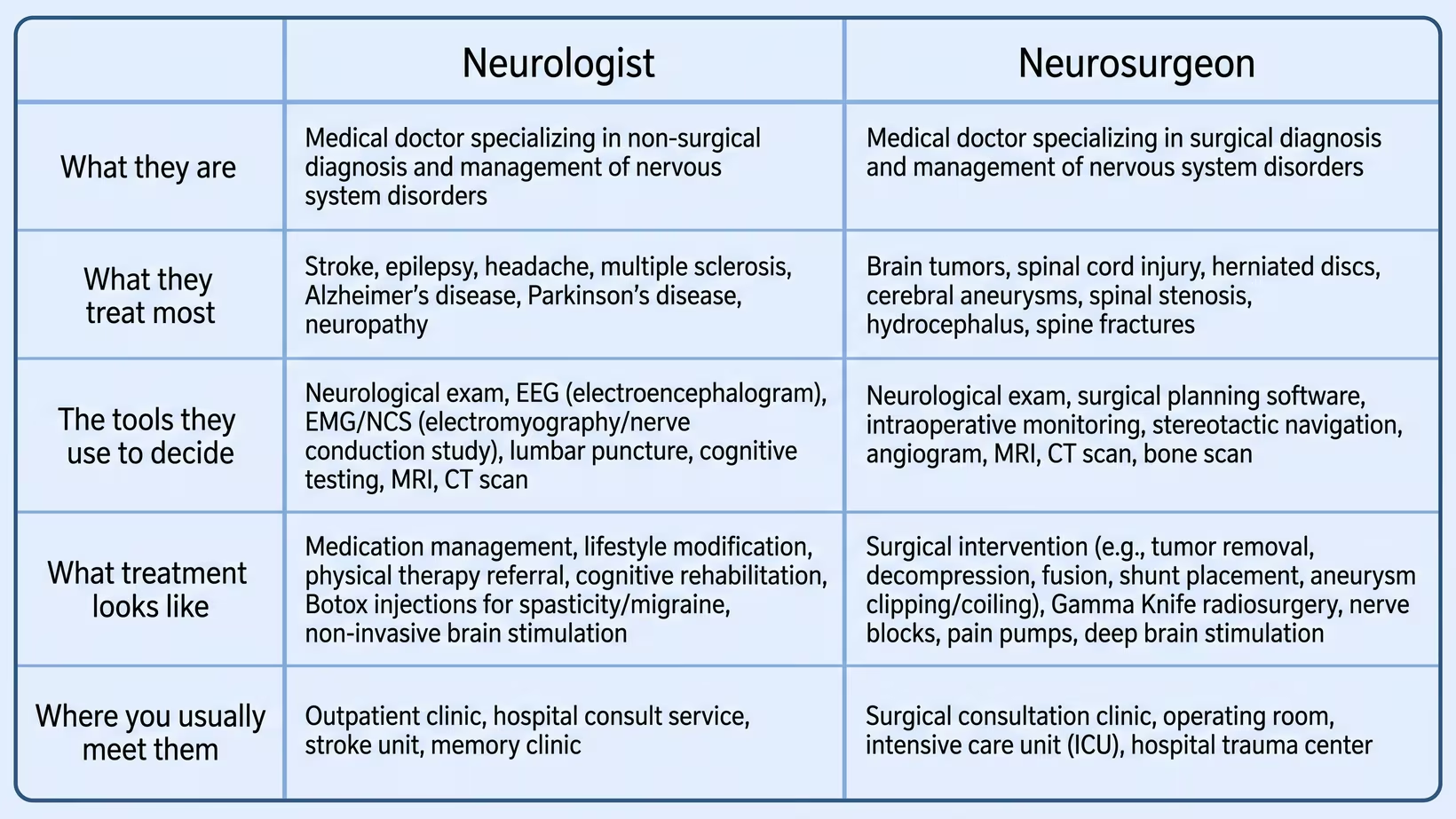
A neurologist and a neurosurgeon are both specialists in the nervous system, meaning the brain, the spinal cord and the nerves. A neurologist diagnoses and treats these conditions with medicines, tests and time. A neurosurgeon is trained to operate on the same structures. Both finish medical school and then a long specialty residency.
The spinal cord is the thick cable of nerves running inside your backbone. The nerves travel out from it to the arms, legs, face and organs.
Among the most common reasons people are sent to a neurologist are headache, seizures and nerve problems. A neurosurgeon sees patients with conditions where an operation is one of the options: a bleed, a tumor, a trapped nerve, pressure on the spinal cord, or a question about a shunt, meaning a tube that drains extra fluid from the brain. A neurosurgeon also sees many patients who do not need an operation at all. Telling them so is part of the job.
Which one do you see first?
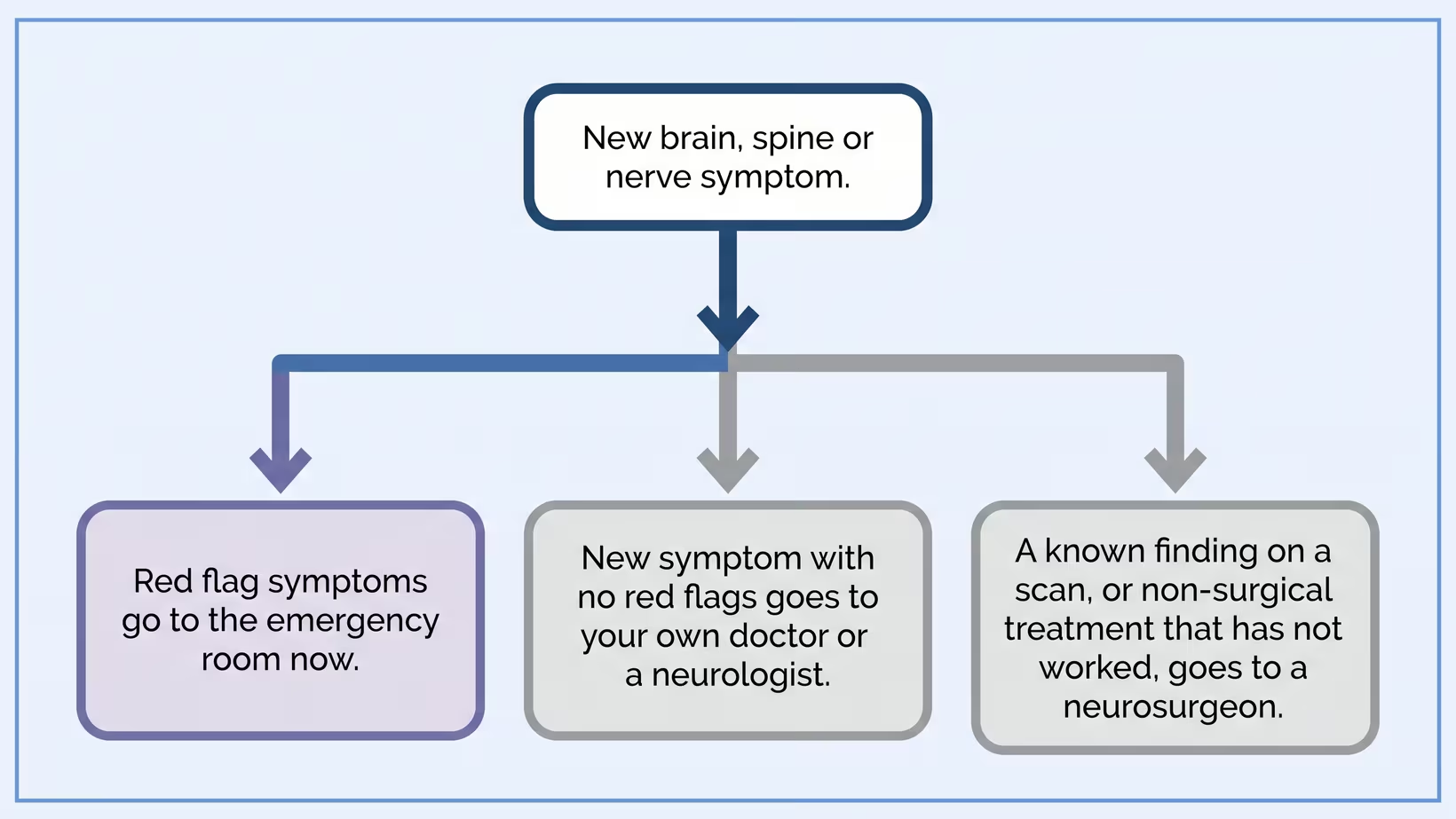
For a new symptom, start with your own doctor or a neurologist. The neurosurgeon usually comes second, after a scan, or after non-surgical treatment has been given a fair trial. The one exception is an emergency, and an emergency goes to an emergency room rather than to either clinic.
The first visit is better spent with a doctor who can examine you, order the imaging and decide whether a surgeon is needed at all.
When your doctor or your scan shows that a neurosurgeon is needed, you may see me. I see adults at my clinic at the Lung Center of the Philippines in Quezon City. If you live too far to come, you can consult me online.
Seek care now
When to skip the clinic and go straight to the emergency room
Some symptoms cannot wait for a clinic appointment. They can mean bleeding around the brain, a stroke, or a squeezed nerve bundle at the base of the spine. Go to the nearest emergency room now if any of these appear:
- A headache that reaches its worst within an hour, or the worst headache of your life
- A first seizure in someone who has never had one before
- Sudden weakness or numbness on one side of the body
- Sudden loss of speech, or sudden loss of vision
- A head injury followed by vomiting, drowsiness, confusion or a seizure, at any age
- A head injury in an older adult after a fall, especially in someone taking a blood thinner
- New loss of bladder or bowel control, with back pain and numbness between the legs
Among adults who came to Canadian emergency departments with a headache that peaked within an hour and a normal neurological examination, about 6 in 100 (6.2%) had bleeding around the brain. A headache that reaches its worst within an hour still needs the emergency room now.
Sudden one-sided weakness or loss of speech may be a stroke. The emergency treatment for a stroke caused by a clot works better the sooner it is given, and the window is hours rather than days, so leave at once. The same treatment raises the risk of bleeding inside the head, so only the hospital can decide who may receive it.
Loss of bladder or bowel control with numbness between the legs can mean the nerve bundle at the base of the spine is being squeezed. It is treated as an emergency and usually needs surgery to take the pressure off the nerves.
Leave at once. If they are at hand, bring any previous scans, a written list of your medicines, and someone who can speak for you, but do not wait for them. Expect a neurological examination and usually a CT scan. Do not wait to see whether the symptom settles on its own.
Headache: neurologist or neurosurgeon?
For headache, see a neurologist, not a neurosurgeon, in almost every case. The neurologist finds out which kind of headache it is and treats it. The neurologist also looks for the small number of headaches that have another cause behind them, and sends those on when needed.
In UK general practice, adults who brought a new headache to a family doctor had a one-year risk of a malignant (cancerous) brain tumor of about 1.5 in 1,000 (0.15%). Above the age of 50 it was about 2.8 in 1,000 (0.28%). That is not Philippine data, and it does not mean a headache is never serious.
A change in pattern changes the answer. Warning signs of a headache with another cause include sudden onset, fever, a history of cancer, and a new weakness, numbness or loss of function. Others are a first headache after the age of 65, a headache that changes with position or starts with coughing or straining, and a headache that starts after a head injury.
A sudden headache or a new weakness, numbness or loss of function goes to the emergency room now. Any of the other features needs a doctor’s check today. A headache with fever and confusion or drowsiness goes to the emergency room now.
A headache that starts weeks after a bump on the head needs a doctor’s check today, because a slow bleed can be the cause. If it comes with drowsiness, confusion, vomiting, or new weakness, numbness or loss of function, go to the emergency room now. A slow bleed is a question for a neurosurgeon.
Seizures: neurologist or neurosurgeon?
A first seizure goes to the emergency room first (see the list above). After that, and for long-standing epilepsy, see a neurologist. A seizure that will not stop, or seizures that follow one another without the person waking in between, need the emergency room now, even in someone known to have epilepsy.
A neurosurgeon usually becomes involved in two situations: when a scan shows a cause an operation can treat, such as a tumor or a bleed, or when seizures keep happening despite medicines that were properly chosen and properly used.
After a first unprovoked seizure in an adult, the risk of another one is highest in the first two years. A US guideline puts that early risk at about 21 to 45 in 100 (21% to 45%). A scan and an EEG, which is a recording of the brain’s electrical activity, are part of the workup. A previous brain injury, an abnormal EEG, a significant abnormality on imaging and a seizure during sleep all raise the risk.
Most people whose epilepsy is newly diagnosed do get control. In a long-running specialist cohort in Glasgow, nearly two-thirds had been free of seizures for a year or more. About nine in ten of those were controlled on the first or second medicine tried. More than a third of patients stayed uncontrolled.
For that uncontrolled third, surgery can be discussed. The discussion is about a check, not about booking an operation.
Numbness, tingling or weakness: neurologist or neurosurgeon?
For numbness, tingling or weakness, start with a neurologist. Two exceptions cannot wait and go to the emergency room now: weakness that is getting worse, and a change in bladder control. Where the numbness sits is the first clue to which part of the nervous system is involved, and that decides who treats it.
Notice the pattern and tell your doctor; do not try to diagnose it at home. Numbness in one hand or one foot points to a single nerve. A stripe running down one limb points to a nerve root leaving the spine.
Both legs, with a change in bladder control, points to the spinal cord. One whole side of the body points to the brain. If numbness or weakness on one side comes on suddenly, or both legs go numb with a change in bladder control, go to the emergency room now.
Most of this settles without an operation. In a Dutch trial of adults with severe sciatica of six to twelve weeks, about 95 in 100 (95%) in both groups felt recovered at one year. That held whether they had early surgery or waited, with surgery if it was still needed; about four in ten of those who waited did have the operation. Surgery mainly made the leg pain settle faster.
Pressure on the spinal cord in the neck is an exception. Guidelines describe it as a progressive disease and as the most common cause of spinal cord dysfunction in adults worldwide. It can show as clumsy hands, an unsteady walk, pins and needles, and increasing stiffness. If these are getting worse, see a doctor this week. Weakness that is getting worse, or a change in bladder control, goes to the emergency room now, as above.
Types of brain doctors, and who does what
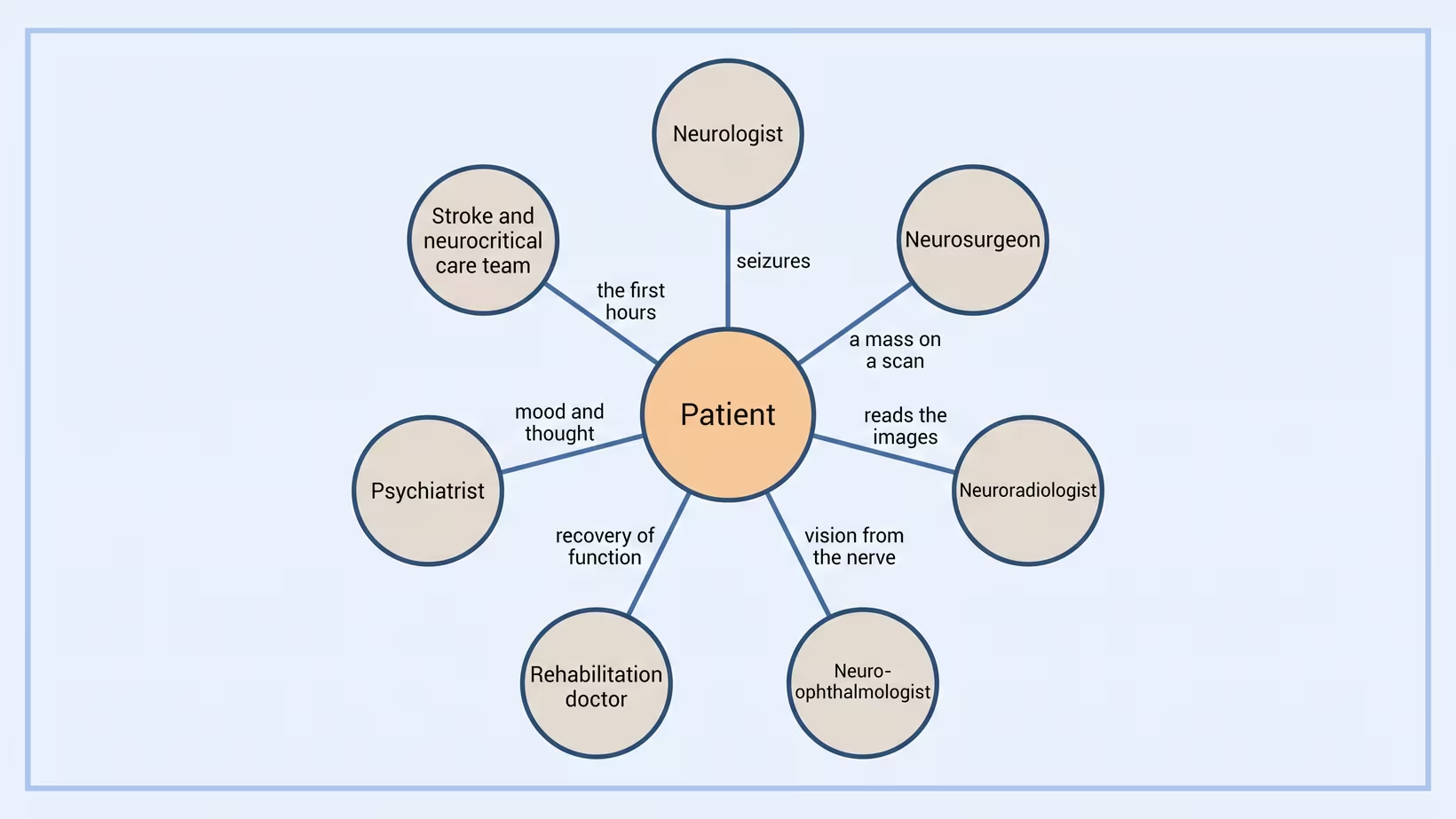
Several specialties care for the nervous system. The neurologist treats without operating, the neurosurgeon operates, and the neuroradiologist reads the scans. Other doctors look after vision problems that come from the brain, rehabilitation, mood and thought, and the first hours after a stroke. Each one, and what sends you there:
- Neurologist: diagnoses and treats brain, spine and nerve conditions without operating. Headache, seizures, stroke, movement disorders, nerve problems.
- Neurosurgeon: operates on the brain, spine and nerves, and decides when not to. A bleed, a tumor, pressure on the cord, a shunt question.
- Neuroradiologist: reads the CT and MRI images and writes the report your doctor then acts on. You rarely meet this one in person.
- Neuro-ophthalmologist: vision problems that come from the brain or the optic nerves rather than from the eye itself.
- Rehabilitation doctor, also called a physiatrist: rebuilds function after a stroke, a spinal injury or an operation, working with the therapists.
- Psychiatrist: conditions of mood, thought and behavior, which often occur together with neurological conditions.
- Stroke and neurocritical care team: the hospital team that takes over in the first hours. Their work is timed in minutes.
It is normal for spinal patients to see several of these before anyone mentions a surgeon. After a stroke in the family, some of the risk factors that cause a stroke can still be changed.
When a neurologist sends you to a neurosurgeon
A neurologist sends you to a neurosurgeon when a scan shows something an operation may treat, or when a treatment has had a fair trial and has not worked. A referral is a request for an opinion. It is not a booking for surgery.
Six findings usually lead to it: a mass on a scan; bleeding in or around the brain; raised pressure inside the head; something pressing on a nerve, a nerve root or the spinal cord; a question about a shunt or other implanted hardware; and epilepsy that no longer responds to medicine.
That last one has an agreed threshold. International consensus defines drug-resistant epilepsy as the failure of two tolerated, appropriately chosen and used medicine schedules to achieve sustained freedom from seizures. At that point the neurologist is expected to reconsider the diagnosis and refer the patient for a check at an epilepsy center. Referral for seizures not controlled by medicine is worth raising early with your doctor.
Not every referral ends in an operation. Take a chronic subdural hematoma, meaning a slow bleed between the skull and the surface of the brain in an older adult. In one US veterans cohort, about 29 in 100 (29%) of those found on CT needed surgical drainage. Whether drainage is needed is decided after a scan, so a new headache, confusion or weakness after a fall still needs to be seen.
Bring and ask
What to bring, whichever one you see
Whichever one you see, bring the scan images themselves, a written list of your medicines and a timeline of your symptoms. Both specialists make their decision from the images, and a one-page report is not the same thing. Bring someone who can listen with you, and your PhilHealth and HMO details.
- The actual films and the discs, not only the radiologist’s report
- A written list of every medicine, including blood thinners, supplements and herbal preparations
- A timeline of when each symptom started and how it has changed since
- A phone video of any episode, such as a seizure, a collapse or a tremor
- Someone who can listen with you and remember what was said
- Your PhilHealth and HMO details, and any referral letter you were given
If a symptom is new, or has not settled in the time your doctor said it should, book the appointment now. If weakness, numbness or bladder control is getting worse, go to the emergency room instead. Many clinics will see you without a referral, or your doctor can refer you.
To see me, come to my clinic at the Lung Center of the Philippines, Room 1101, Quezon Avenue, Quezon City, on Tuesday or Thursday from 2 PM. Your doctor can also refer you to me. If the trip is not practical, book an online consult on the consultation page. Before the visit, read what to expect at a first neurosurgery appointment.
For referring physicians: what to send, and to whom
Route each patient by the lesion (the abnormal area) and by how fast the problem is moving, not by the name of the symptom. Neurology takes the undifferentiated presentation, neurosurgery takes the structural lesion and the progressive deficit, and the emergency department takes anything with a time-critical mechanism.
To neurology: a first unprovoked seizure with a normal examination, chronic headache without red flags, suspected demyelination, movement disorders, peripheral neuropathy, and functional presentations.
Directly to neurosurgery: an intracranial mass, meaning a growth inside the skull; hydrocephalus, meaning fluid building up in the brain, or imaging signs of raised intracranial pressure; symptomatic degenerative cervical myelopathy, meaning cord compression in the neck; radiculopathy, a pinched nerve root, with a progressive motor deficit; and any shunt or implanted-hardware question.
To an emergency department regardless of the clinic queue: thunderclap headache, meaning one peaking within an hour; suspected cauda equina syndrome; an acute focal deficit still inside the thrombolysis window; and head injury while taking a blood thinner (an anticoagulant).
Send with the patient: the imaging itself rather than the report alone; the anticoagulant (blood thinner) and antiplatelet (a medicine that thins the blood) history with the last dose taken; the neurological examination at its worst and at referral; the functional baseline; and any other illnesses (comorbidities) that affect anesthesia.
Refer early rather than observing. In a published comparison of pediatric head-injury care in a high-income and a lower-middle-income country, the times to neurosurgical consult, to imaging and to surgery were all longer in the lower-middle-income country. What should come back to you is an operative decision, or a documented reason not to operate, with a stated review interval.
Frequently asked questions
Can a neurosurgeon be my regular doctor for a brain condition?
A neurosurgeon can be your regular doctor for a condition managed with an operation or with follow-up imaging, such as a shunt. For a condition managed with medicines over years, such as epilepsy or migraine, the neurologist is the better long-term doctor.
Do I need a referral to see a neurosurgeon in the Philippines?
Many neurosurgery clinics in the Philippines will see you without a referral. Bring one if you have it, because it carries the history and the imaging request with you. Practice varies by hospital, and some HMOs require a referral before they will cover the consult, so ask your HMO first.
Is a neurologist cheaper than a neurosurgeon?
Whether a neurologist is cheaper than a neurosurgeon depends on the doctor and the hospital, because consultation fees vary. Call the clinic for the consult fee. Ask the hospital billing or PhilHealth desk about coverage before the visit, and ask whether the scan is billed separately.
Does seeing a neurosurgeon mean I need an operation?
Seeing a neurosurgeon does not mean you need an operation. A referral is a request for a surgical opinion. A large part of that opinion is deciding whether an operation is needed at all, or needed yet. Many patients a neurosurgeon sees do not need an operation.
Which one reads my MRI?
A neuroradiologist writes the formal report on your MRI. Your neurologist and your neurosurgeon also read the images themselves and compare them with your examination. That is why you should bring the actual films and discs, which matter more than the printed report.
Can I see both?
You can see both a neurologist and a neurosurgeon, and for many conditions that is the correct arrangement. The neurologist manages the day-to-day treatment, such as medicines for epilepsy or migraine. The neurosurgeon watches the one question that could become surgical.
See sources
- Stone J, Carson A, Duncan R, et al. Who is referred to neurology clinics? The diagnoses made in 3781 new patients. Clinical Neurology and Neurosurgery. 2010. PMID 20646830
- Kernick D, Stapley S, Goadsby PJ, Hamilton W. What happens to new-onset headache presented to primary care? A case-cohort study using electronic primary care records. Cephalalgia. 2008. PMID 18771496
- Do TP, Remmers A, Schytz HW, et al. Red and orange flags for secondary headaches in clinical practice: SNNOOP10 list. Neurology. 2019. PMID 30587518
- Perry JJ, Stiell IG, Sivilotti MLA, et al. Clinical decision rules to rule out subarachnoid hemorrhage for acute headache. JAMA. 2013. PMID 24065011
- Kwan P, Arzimanoglou A, Berg AT, et al. Definition of drug resistant epilepsy: consensus proposal by the ad hoc Task Force of the ILAE Commission on Therapeutic Strategies. Epilepsia. 2010. PMID 19889013
- Chen Z, Brodie MJ, Liew D, Kwan P. Treatment outcomes in patients with newly diagnosed epilepsy treated with established and new antiepileptic drugs: a 30-year longitudinal cohort study. JAMA Neurology. 2018. PMID 29279892
- Wiebe S, Blume WT, Girvin JP, Eliasziw M. A randomized, controlled trial of surgery for temporal-lobe epilepsy. New England Journal of Medicine. 2001. PMID 11484687
- Engel J, McDermott MP, Wiebe S, et al. Early surgical therapy for drug-resistant temporal lobe epilepsy: a randomized trial. JAMA. 2012. PMID 22396514
- Krumholz A, Wiebe S, Gronseth GS, et al. Evidence-based guideline: management of an unprovoked first seizure in adults. Neurology. 2015. PMID 25901057
- Peul WC, van Houwelingen HC, van den Hout WB, et al. Surgery versus prolonged conservative treatment for sciatica. New England Journal of Medicine. 2007. PMID 17538084
- Fehlings MG, Tetreault LA, Riew KD, Middleton JW, Wang JC. A clinical practice guideline for the management of degenerative cervical myelopathy: introduction, rationale, and scope. Global Spine Journal. 2017. PMID 29164027
- Woodfield J, Lammy S, Jamjoom AAB, et al. Demographics of cauda equina syndrome: a population-based incidence study. Neuroepidemiology. 2022. PMID 36315989
- Emberson J, Lees KR, Lyden P, et al. Effect of treatment delay, age, and stroke severity on the effects of intravenous thrombolysis with alteplase for acute ischaemic stroke: a meta-analysis of individual patient data from randomised trials. The Lancet. 2014. PMID 25106063
- Balser D, Farooq S, Mehmood T, Reyes M, Samadani U. Actual and projected incidence rates for chronic subdural hematomas in United States Veterans Administration and civilian populations. Journal of Neurosurgery. 2015. PMID 25794342
- Gupta S, Gal ZT, Athni TS, et al. Mapping the global neurosurgery workforce. Part 1: consultant neurosurgeon density. Journal of Neurosurgery. 2024. PMID 39508199
- Rolle ML, Pascual JSG, Williams AL, et al. Time to care: analysis of time differences and outcomes in the management of pediatric traumatic brain injury for a high-income and lower-middle-income country. World Neurosurgery. 2023. PMID 37121503