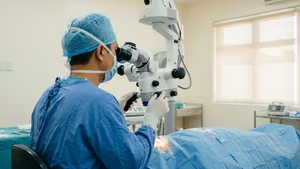

Burr hole surgery for a chronic subdural hematoma, a slow bleed under the brain’s covering, can be done with you awake. Only the scalp needs numbing medicine. The skull bone and the brain’s covering do not. It is a main treatment for this condition. It removes the old blood and fluid through a small hole in the skull bone.
What is a burr hole?
A burr hole is a small round hole made through the skull bone. The surgeon works through this hole to reach the space under the bone. The rest of the skull stays closed. A 2025 review describes the operation as making a hole in the skull, then rinsing the space below to wash out the old blood and fluid.
That space is the subdural space. It lies under the dura, the tough covering that wraps the brain like a pouch. A chronic subdural hematoma collects in this space, between the dura and the brain.
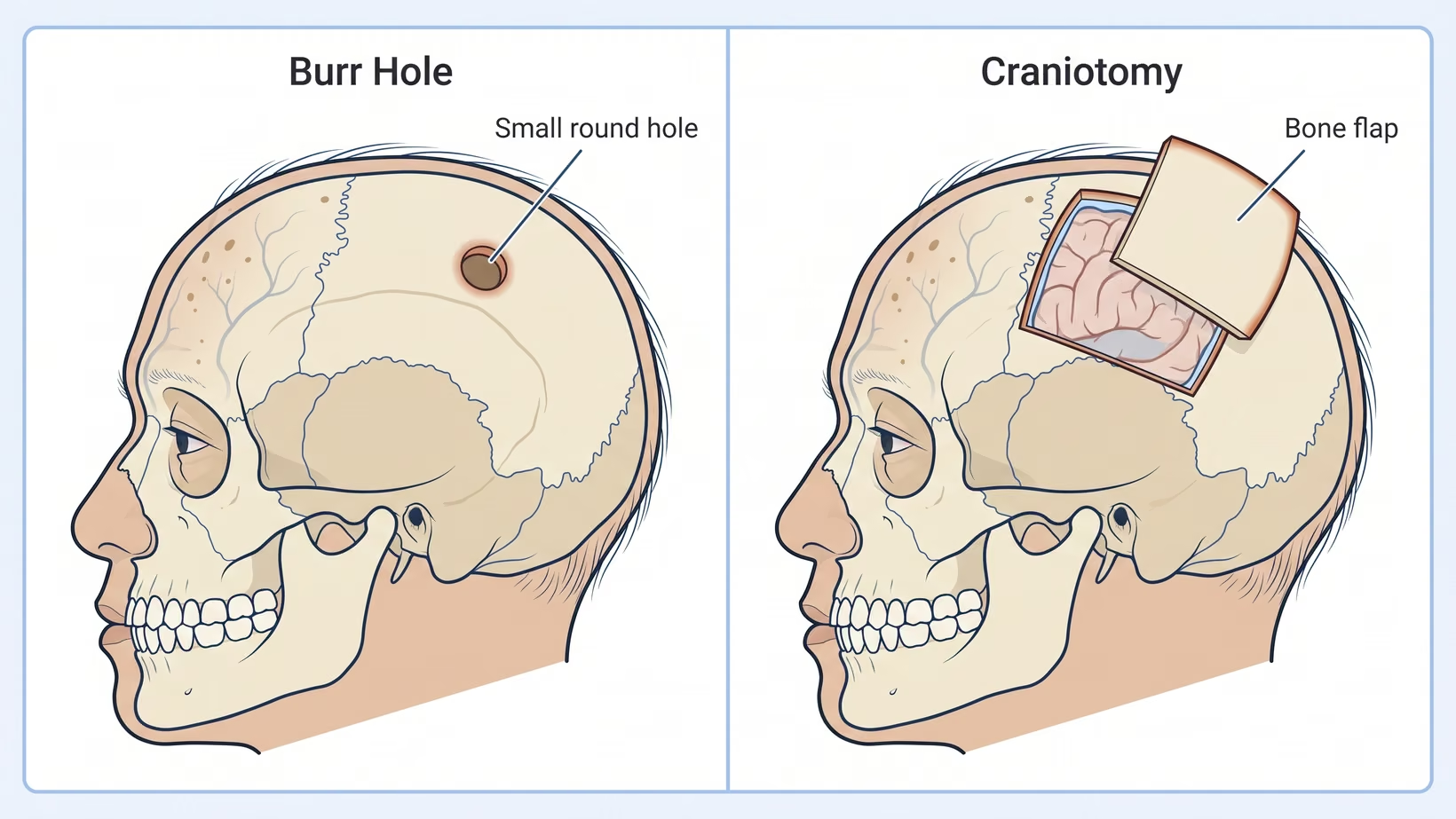
There is more than one way to drain this space. The same review lists three: a small craniotomy, a hollow screw placed through the skull (called a twist drill), and the classic burr hole. The review describes the burr hole as the most common of the three.
Surgeons still debate where to place the hole, the review notes. Your surgeon will explain where your hole goes, based on your scan.
How is a burr hole different from a craniotomy?
A craniotomy lifts out a larger piece of the skull bone and puts it back at the end. A burr hole leaves the skull in place except for the hole. For a chronic subdural hematoma, a 2003 review of the evidence rated burr hole drainage as safer than a craniotomy.
The same review found that burr hole drainage gave a good balance of results against complications. It called burr hole and twist drill drainage first-choice treatments, with craniotomy as a second choice. Its evidence was weak, with no high-quality trials. Choosing between a burr hole and a craniotomy is your surgeon’s decision.
What does burr hole surgery treat?
Burr hole surgery is a way to drain a chronic subdural hematoma, old blood that has collected over the surface of the brain. The studies on this page are about that condition, in adults. A burr hole is also the entry point for some other brain operations.
A child with a collection over the brain should be seen by a neurosurgeon as soon as possible. The neurosurgeon explains the options for that child. If the child is hard to wake or getting worse, go to the nearest emergency room now.
Chronic subdural hematoma: old blood pressing on the brain
A chronic subdural hematoma is old blood and fluid that collects under the dura and presses on the brain. A large UK trial calls it a common condition, especially among older people. In that trial, the average age was 74.
Older people are more likely to get a chronic subdural hematoma. A 2025 review links this to two things: the brain shrinking with age, and changes in how the body handles inflammation and the growth of new blood vessels.
In the UK trial, 94 in 100 patients had surgery to remove the blood during their hospital stay. That figure applies to adults with symptoms who joined the trial. It does not mean every chronic subdural hematoma needs an operation.
Brain abscess and other reasons for a burr hole
A brain abscess is a pocket of pus in the brain. A European guideline for children and adults recommends draining the pus with a needle, or removing the abscess, whenever this is possible. The exception is an abscess caused by toxoplasmosis, a parasite infection.
Seek care now
Which signs mean you should go to the emergency room now?
A chronic subdural hematoma typically causes symptoms that come late and get worse over time. If you notice any of these signs in yourself or a relative, go to the nearest emergency room now:
- Confusion
- A headache that keeps getting worse
- Dizziness
- Growing drowsiness, or being hard to wake
- Trouble speaking or finding words
- Weakness of the arm and leg on one side of the body
Go to a hospital with a neurosurgeon if one is just as near. Otherwise go to the nearest emergency room. Do not wait for a clinic appointment.
If these signs come back after burr hole surgery, go to the emergency room now. Tell the doctors about the operation.
What to do now
What to do next, and who to see
Who you see depends on the signs.
- Any warning sign above: the nearest emergency room now.
- A subdural hematoma found on a scan, with no warning sign: see a neurosurgeon as soon as you can. Book the outpatient consult right away.
- While you wait for that consult: go to the emergency room if any warning sign appears.
Bring these to the consult:
- The CT or MRI on a disc, with its written report
- A list of every medicine taken, especially blood thinners. Do not stop or change any medicine on your own; ask the doctor who prescribed it.
I see adults at my clinic at the Lung Center of the Philippines, Room 1101, Quezon Avenue, Quezon City, on Tuesday and Thursday from 2 PM. I see children at the Philippine Children’s Medical Center (PCMC), Room 22, on Wednesday from 2 PM. If travel is not practical, you can book an online consult on the consultation page. Your doctor can also refer you to me.
Can burr hole surgery be done under local anesthesia?
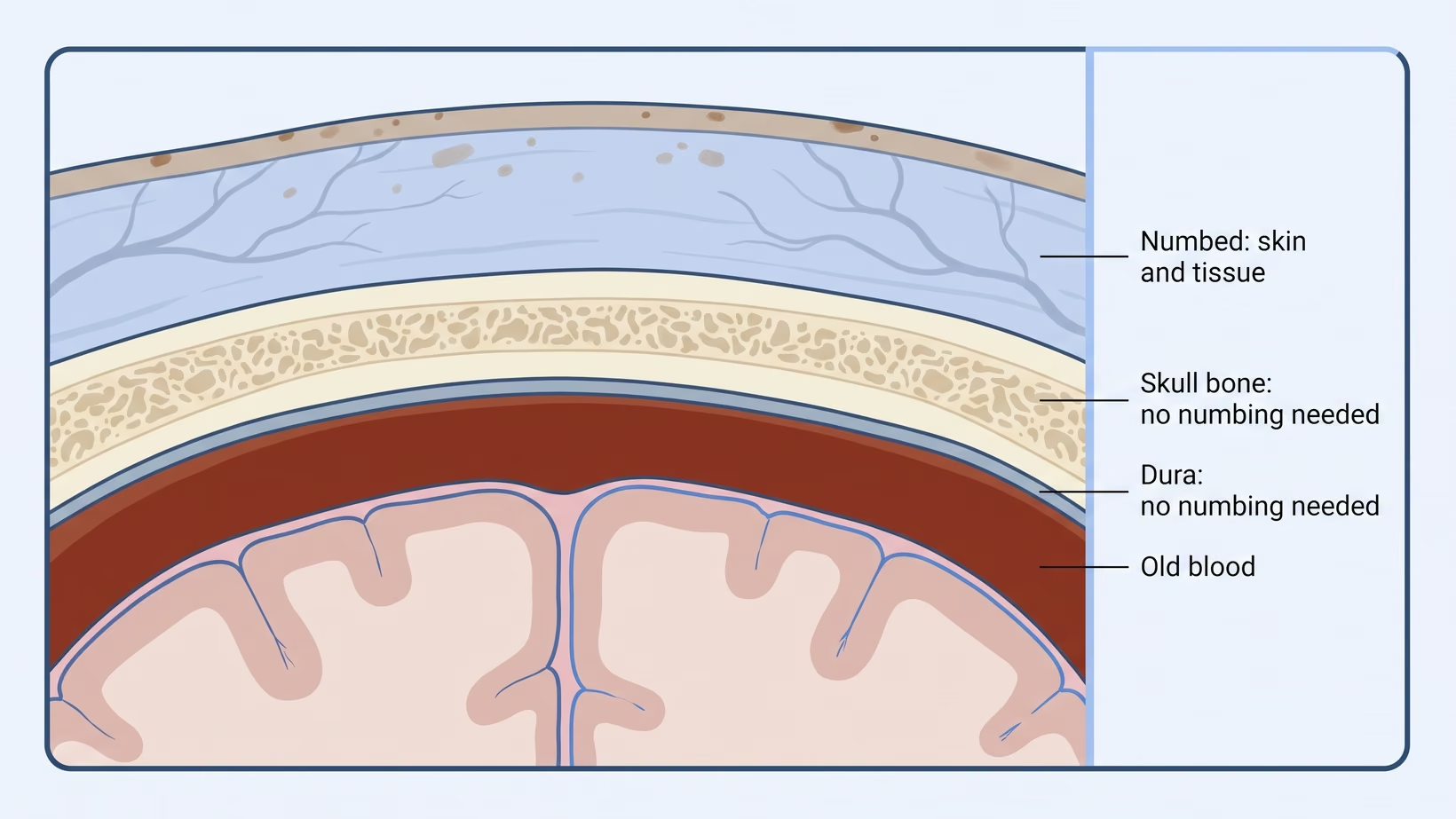
Yes, burr hole surgery for a chronic subdural hematoma can be done under local anesthesia, with you awake. Numbing medicine is injected into the skin and the tissue under it. The skull bone and the brain’s coverings do not need numbing. Many patients in the studies were also given calming medicine (sedation).
The operation can also be done under general anesthesia, where you are fully asleep. This uses several medicines and a breathing tube. A 2025 review says the operation is typically done this way.
This condition mainly affects older people. After an operation, older patients are at greater risk of waking slowly and of delirium, a sudden confusion. Doctors studied awake surgery as a way to lower these problems.
The review pooled 22 studies with 3,917 patients. Local anesthesia was linked to fewer complications, a shorter operation and a hospital stay about two days shorter. The chance of the blood coming back, seizures after surgery and air left inside the skull were not clearly different.
Most of the studies comparing the two looked back at old records. The patients chosen for local anesthesia may have differed from the others. These results show a link. They do not prove that awake surgery causes better results.
What will you feel and hear if you are awake?
If you are awake for burr hole surgery, numbing medicine is first injected into the skin of your scalp and the tissue under it. The skull bone and the brain’s covering do not need numbing, a 2025 review explains. Many patients in the studies were also given calming medicine. So awake can mean fully alert, or calm and drowsy.
You stay awake, so you can respond to the team during the operation. No breathing tube needs to be removed at the end. The review’s authors give this as one reason the time around the operation is likely shorter.
The studies on this page did not describe what patients hear or feel moment by moment. On the day before the operation, ask your surgeon and your anesthesiologist to explain three things: what you will hear, how long you will lie still, and how you can tell them if you are uncomfortable.
When is general anesthesia chosen instead?
General anesthesia is chosen when your surgeon and anesthesiologist decide, with you and your family, that being fully asleep suits your situation better. A 2025 review names two advantages. The team controls your breathing through a tube, and the operation can be changed to a craniotomy if needed.
In the studies the review included, no switch to a craniotomy was reported. The results also did not show the expected benefits of general anesthesia as clear differences.
The review does not give a list of which patients should be asleep. Your own surgeon and anesthesiologist make this choice with you. Ask them why they suggest one or the other.
What happens during burr hole surgery, step by step?
During burr hole surgery for a chronic subdural hematoma, your scalp is numbed or you are put to sleep. The surgeon makes a cut in the scalp and a hole in the skull bone. The old blood and fluid under the dura are rinsed out. A thin tube, called a drain, may be left in place.
These are the steps in order:
- Numbing medicine in the scalp, with or without calming medicine, or general anesthesia.
- A cut in the scalp over the planned spot.
- A hole made through the skull bone.
- The dura, the tough covering of the brain, opened.
- The space under the dura rinsed to wash out the old blood and fluid.
- A drain left in that space, if the surgeon chooses, and the skin closed.
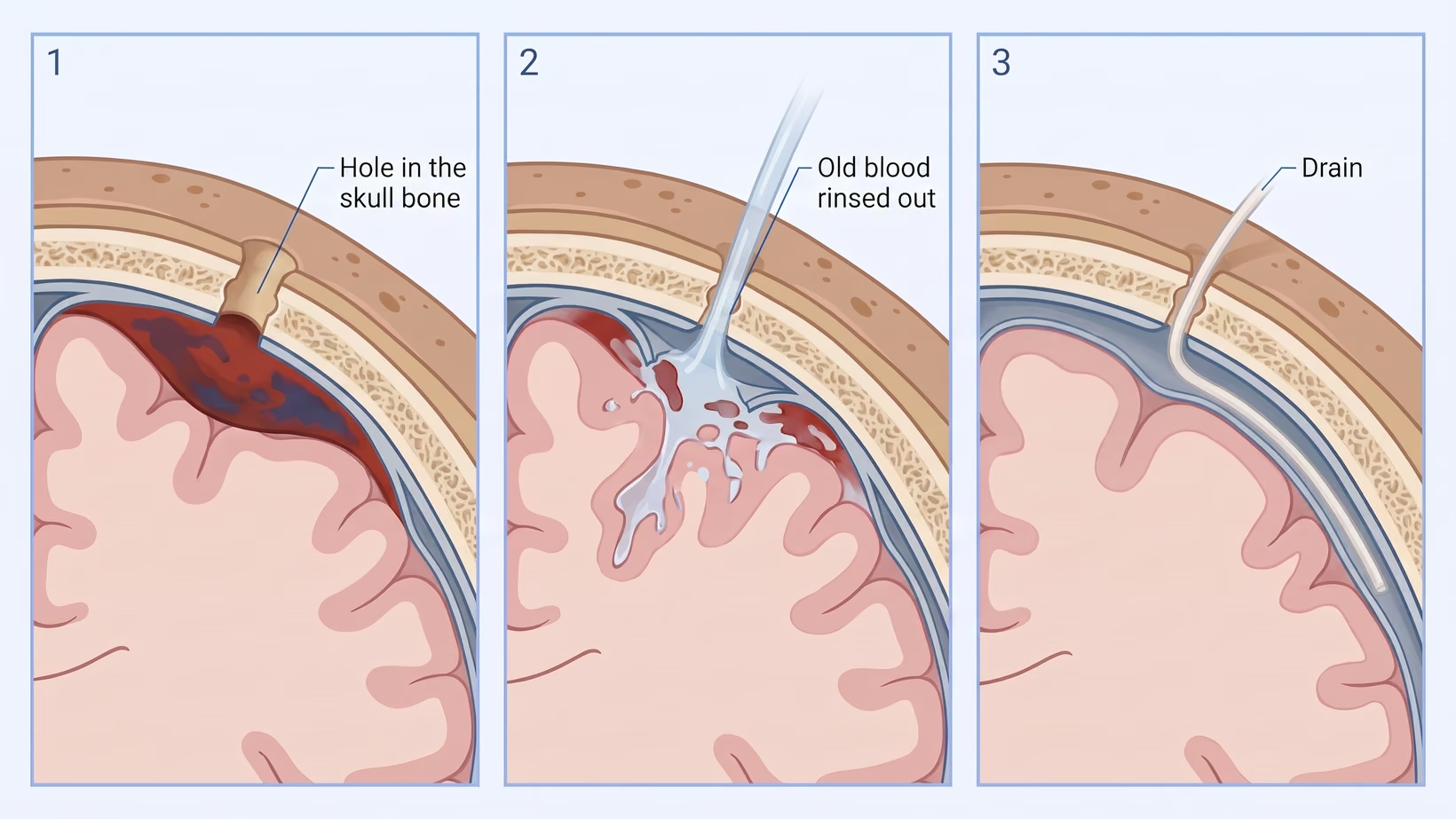
A UK trial at one hospital tested the drain in adults having burr hole drainage. Another drainage was needed in about 9 in 100 patients with a drain, against 24 in 100 without one. Deaths at six months were about 9 in 100 with a drain and 18 in 100 without. Complications were much the same. These are the results of one trial. Your surgeon can tell you what applies to you.
Your surgeon decides how long the drain stays after burr hole surgery. Your surgeon will also explain how many holes you need and where.
How long does burr hole surgery take?
Burr hole surgery for a chronic subdural hematoma took about 37 minutes on average under local anesthesia, in the studies a 2025 review pooled. Under general anesthesia it took about 45 minutes. In studies comparing the two directly, awake surgery was about 21 minutes shorter.
These times count the operation itself. They do not include preparation, the anesthesia, waking in the recovery room or the hospital stay. Your time in the operating room will be longer than the operation alone. The studies also measured time in different ways.
What happens in the first days after?
In the first days after burr hole surgery, you stay in the hospital and the team watches for the warning signs listed above. In the 2025 review, the stay was about two days shorter after awake surgery than after general anesthesia. The studies varied widely in this. How long you stay and when the drain comes out depend on how you recover. Your surgeon will tell you.
The blood can collect again. A 2009 trial reports that a chronic subdural hematoma comes back after surgery in 5 to 30 in every 100 patients.
When to refer: notes for referring doctors
Refer any patient with a subdural collection on CT or MRI and symptoms to a neurosurgeon without delay. Send the images, the report and a full medicine list, including antiplatelets and anticoagulants (blood thinners). A patient with falling consciousness, speech difficulty or weakness on one side goes to an emergency room with a neurosurgeon now.
The typical presentation is delayed and progressive: confusion, headache, dizziness and a falling level of consciousness. Dysphasia (trouble with speech) and hemiparesis (one-sided weakness) are also common, depending on the side. Elderly patients are particularly prone. This is linked to age-related brain atrophy, meaning shrinkage.
On anesthesia, the 2025 meta-analysis of 22 studies found local anesthesia linked to fewer complications, shorter operations and about two fewer hospital days. Recurrence, seizures and pneumocephalus (air inside the skull) did not differ significantly. Most comparative studies were retrospective chart reviews.
No included study measured delirium with a standard checking tool. The authors call for randomized trials before firm conclusions on delirium.
For a planned adult operation, I operate at the Lung Center of the Philippines and the National Kidney and Transplant Institute (NKTI). When a patient needs admission sooner, I admit at Capitol Medical Center, Quezon City. When an ICU bed is needed quickly, I admit at MCU Hospital, Caloocan.
What the trials show about drains, steroids and embolization
In trials of chronic subdural hematoma, a drain after burr hole drainage lowered redrainage. A steroid, dexamethasone, lowered repeat surgery but gave fewer good outcomes. Middle meningeal artery embolization blocks an artery of the dura. Added to surgery, it lowered repeat surgery in one trial and gave similar recurrence in another. If you were prescribed a steroid, do not stop it on your own. Ask your doctor.
Dexamethasone was tested in a UK trial of adults with symptoms. A good outcome was a score of 0 to 3 on the Rankin disability scale, a doctor’s rating of how disabled a person is, at six months. About 84 in 100 reached it on dexamethasone, and 90 in 100 on placebo. Repeat surgery was about 2 in 100 against 7 in 100. More side effects and other harms occurred with dexamethasone.
The embolization is done from inside the blood vessels. In the EMBOLISE trial, 400 patients had a subacute (more recent) or chronic subdural hematoma that needed surgery. Repeat surgery within 90 days was about 4 in 100 with embolization and 11 in 100 without. Serious embolization complications occurred in 2 in 100, including disabling stroke in two patients.
In the MAGIC-MT trial in China, 722 patients took part and 78 in 100 had burr hole drainage. Recurrence or growth with symptoms within 90 days was about 7 in 100 with embolization and 10 in 100 without. That difference could have been due to chance. Serious problems of any kind were about 7 in 100 against 12 in 100.
Frequently asked questions
Can a very old person have burr hole surgery?
A very old person can be considered for burr hole surgery. The surgeon and anesthesiologist weigh age together with overall health. In a large UK trial, the average age was 74. For a parent in their nineties, subdural hematoma surgery in a 90-year-old is weighed the same way.
Will my head be shaved?
Whether your head is shaved for burr hole surgery, and how much, is decided by your surgeon and the hospital. The studies on this page did not set a rule. Ask your surgeon before the day of surgery how much hair will be removed and where the cut will be.
Does burr hole surgery hurt afterwards?
How much pain you have after burr hole surgery was not measured in the studies on this page. During the operation the scalp is numbed, and the bone and the brain’s covering do not need numbing. Tell the nurses if you have pain. A headache that keeps getting worse at home means the emergency room now.
Can the blood come back after burr hole surgery?
Yes, a chronic subdural hematoma can come back after burr hole surgery. A 2009 trial reports that it recurs in 5 to 30 in every 100 patients. In that trial, a drain lowered the need for another drainage. A 2003 review found burr hole drainage appears to work better than twist drill drainage for a collection that comes back.
See sources
- Weigel R, Schmiedek P, Krauss JK. Outcome of contemporary surgery for chronic subdural haematoma: evidence based review. Journal of Neurology, Neurosurgery, and Psychiatry. 2003. PMID 12810784. doi:10.1136/jnnp.74.7.937
- Weber CF, Ferdowssian K, Hecht N, et al. Burr hole evacuation of chronic subdural hematoma in general versus local anesthesia: a systematic review and meta-analysis. Acta Neurochirurgica. 2025. PMID 40056228. doi:10.1007/s00701-025-06475-x
- Hutchinson PJ, Edlmann E, Bulters D, et al. Trial of Dexamethasone for Chronic Subdural Hematoma. The New England Journal of Medicine. 2020. PMID 33326713. doi:10.1056/NEJMoa2020473
- Santarius T, Kirkpatrick PJ, Ganesan D, et al. Use of drains versus no drains after burr-hole evacuation of chronic subdural haematoma: a randomised controlled trial. The Lancet. 2009. PMID 19782872. doi:10.1016/S0140-6736(09)61115-6
- Davies JM, Knopman J, Mokin M, et al. Adjunctive Middle Meningeal Artery Embolization for Subdural Hematoma. The New England Journal of Medicine. 2024. PMID 39565988. doi:10.1056/NEJMoa2313472
- Liu J, Ni W, Zuo Q, et al. Middle Meningeal Artery Embolization for Nonacute Subdural Hematoma. The New England Journal of Medicine. 2024. PMID 39565989. doi:10.1056/NEJMoa2401201
- Bodilsen J, D’Alessandris QG, Humphreys H, et al. European Society of Clinical Microbiology and Infectious Diseases guidelines on diagnosis and treatment of brain abscess in children and adults. Clinical Microbiology and Infection. 2023. PMID 37648062. doi:10.1016/j.cmi.2023.08.016