

Symptoms that start weeks after hitting your head, or that keep getting worse, can be a sign of a chronic subdural hematoma, a slow collection of blood under the brain’s outer covering. Most symptoms after a bump settle within 10 to 14 days. Sudden weakness, slurred speech, repeated vomiting or difficulty waking means the emergency room now.
How Long Do Symptoms Normally Last After a Bump on the Head?
Most symptoms after a bump on the head last 10 to 14 days at most, and most people are better sooner. About 9 in 10 (90%) symptoms of concussion, a mild brain injury from a bump, are temporary and usually go away in that time. Most patients recover in the first seven to 10 days and need no further check.
Kung kayo mismo ang natamaan sa ulo at masakit pa rin pagkatapos ng dalawang linggo, hindi kayo nagdadrama. Your symptoms have lasted longer than usual. That is a reason to see a doctor this week. It is not a reason to panic.
The Window Most People Recover In
Headache, fatigue, vision changes, unsteadiness, confusion, dizziness, poor sleep and difficulty concentrating are the usual symptoms after a mild head injury. They are expected to fade. Some people with a mild traumatic brain injury, meaning an injury to the brain from a blow to the head, have symptoms that last longer. A small number of those need a further check.
Symptoms that last longer are common, and they are usually not a bleed. The difference is not the symptom itself. It is whether the symptom is getting better or worse.
Why New or Worsening Is the Phrase That Matters
A symptom that is slowly getting better behaves the way a bruised brain behaves. A symptom that is new weeks after the bump, or clearly worse this week than last week, behaves the way something that is still growing behaves.
Ask two questions of every symptom below: is it new, and is it getting worse? Ang tanong ay hindi kung gaano kasakit ngayon. Ang tanong ay kung lumalala ba ito o gumagaan.
Seek care now
Which Signs Mean the Emergency Room Now?
Go to an emergency department now, not in the morning, if symptoms get worse fast or anything looks like a stroke. A slow bleed usually gets worse slowly. When it starts to get worse quickly, that is an emergency. Any of these signs means going now to the nearest emergency room, not waiting for tonight:
- A sudden severe headache, or a headache clearly worse than yesterday’s
- Difficulty waking him, or drowsiness he keeps sliding back into
- New weakness, numbness or droop on one side of the face or body
- Speech that has suddenly become slurred or cannot find words
- Repeated vomiting, especially with drowsiness
- A first seizure, or any jerking or shaking
- Confusion that has come on over hours rather than weeks
- Any new head injury in someone taking a blood thinner, even if he seems fine
For that last sign, going to the emergency room is the right thing to do. Antiplatelet medicines (such as aspirin and clopidogrel, which thin the blood) and anticoagulants (blood thinners) are a known risk factor for this kind of bleed. So a person who looks well on the evening after a fall may still have a bleed.
Why Would a Headache Start Weeks After a Fall?
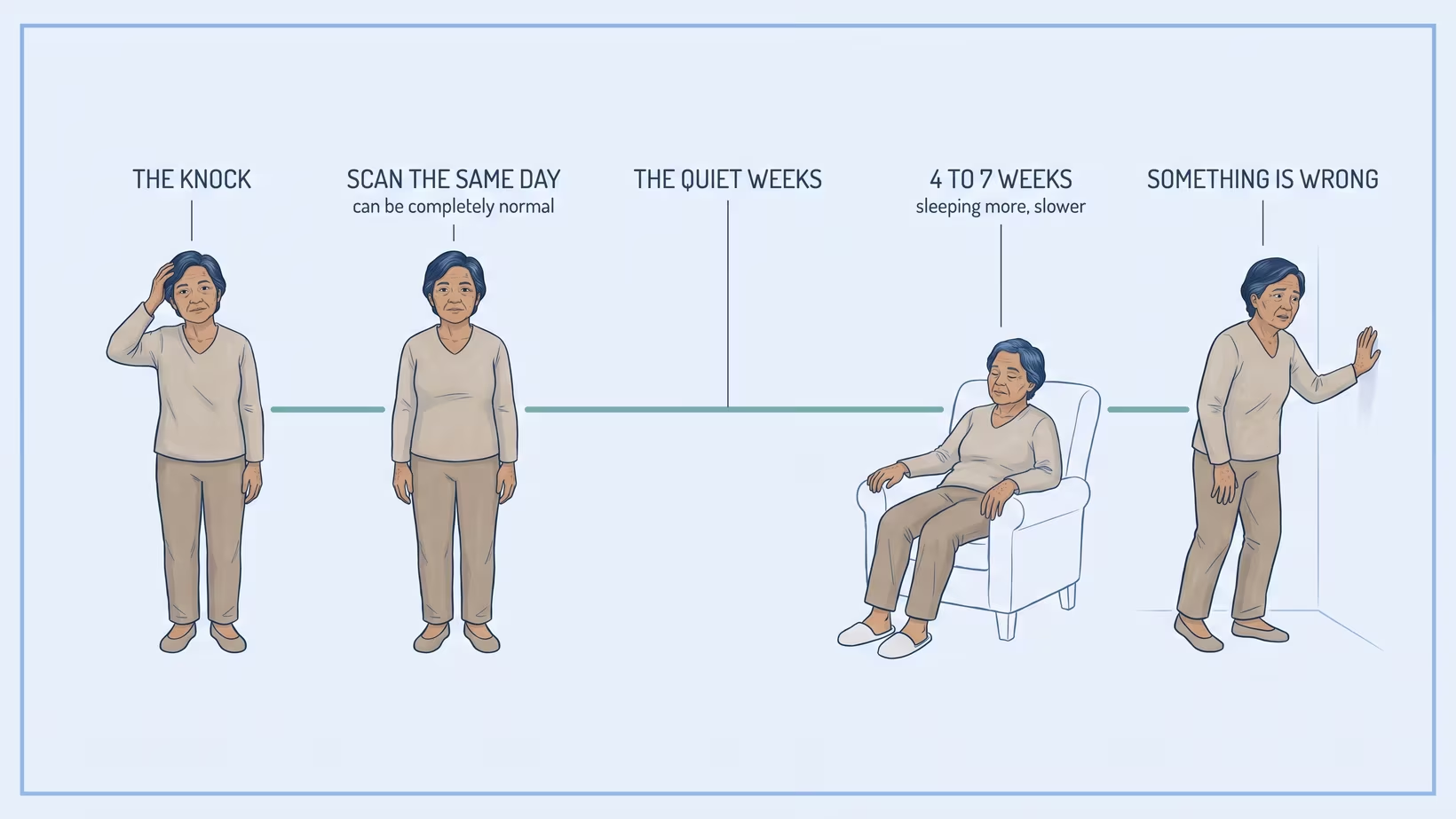
A headache can start weeks after a fall because a collection of blood on the surface of the brain can take weeks to grow large enough to be felt. On average, four to seven weeks pass between the injury and the first symptoms. That is why the headache seems unrelated to the fall.
Doctors describe a chronic subdural hematoma, meaning a slow collection of blood under the brain’s outer covering, in three periods. First comes the injury. Then comes a quiet period with no symptoms, called the latency period. Then the symptoms appear. Because nothing happens in the middle period, a headache in week five looks unrelated to the bump in week zero.
Headache is the symptom people expect. In a large group of patients at a regional referral hospital in Uganda, it was the most common symptom, reported by about 9 in 10 patients (89.6%). A headache on its own is not the alarm. A headache that started late, or that is getting worse, is the alarm.
He Is Sleeping More Than Usual. Is That Just Age?
Sleeping more can be just age, but it can also be a sign of a slow bleed. A person who becomes slower, quieter and less interested over the weeks after a head bump is showing one of the changes this condition causes. Families often describe that change as sleeping more, or as being tired all the time.
Published symptom lists for a chronic collection include slowed thinking, apathy (loss of interest) and confusion that comes and goes. They appear alongside the more obvious signs, such as weakness. This sign is often missed because it does not look like an emergency. It looks like your father getting older. Kaya ang mahalagang tanong ay hindi kung matanda na siya, kundi kung kailan nagsimula ang pagbabago.
Ask it directly: was he like this three months ago? If the answer is no, and there was a bump on the head in between, show that sequence to a doctor this week. If he is hard to wake, or keeps sliding back to sleep, go to the nearest emergency room now.
Confusion and slowed thinking are also linked to a worse outlook. In a study of 1,307 patients with an average age of 74, those who came in with problems in thinking did worse in daily life afterward than those who came in with headache.
Walking Like a Drunk: Why Does Balance Get Hit?
Balance gets worse because a decline in walking is common once a slow collection of blood is there. In older people, it is often a better clue than headache. That is what the published guidance says. It does not say which symptom comes first. So steady walking today is not a reason to wait.
Families describe a person who walks as though he has had a drink. He walks with his feet wide apart, carefully, drifting to one side and holding on to furniture. He may start falling again. Repeated falls are on the published symptom list.
Families often blame the falls for the head injury. The falls can be a result of it instead. If the unsteadiness started after a bump and is getting worse, see a doctor this week and tell the doctor in that order. Dementia is the other explanation families usually think of first, and a slow bleed can be told apart from dementia.
Weakness on One Side That Came On Slowly
Weakness on one side that came on slowly, over days or weeks rather than in a minute, is one of the most common findings in a slow bleed. In a Philippine series of 71 adults operated on for a chronic subdural collection, 46, about 2 in 3, had weakness in moving the arms or legs (a motor deficit) when they first came in.
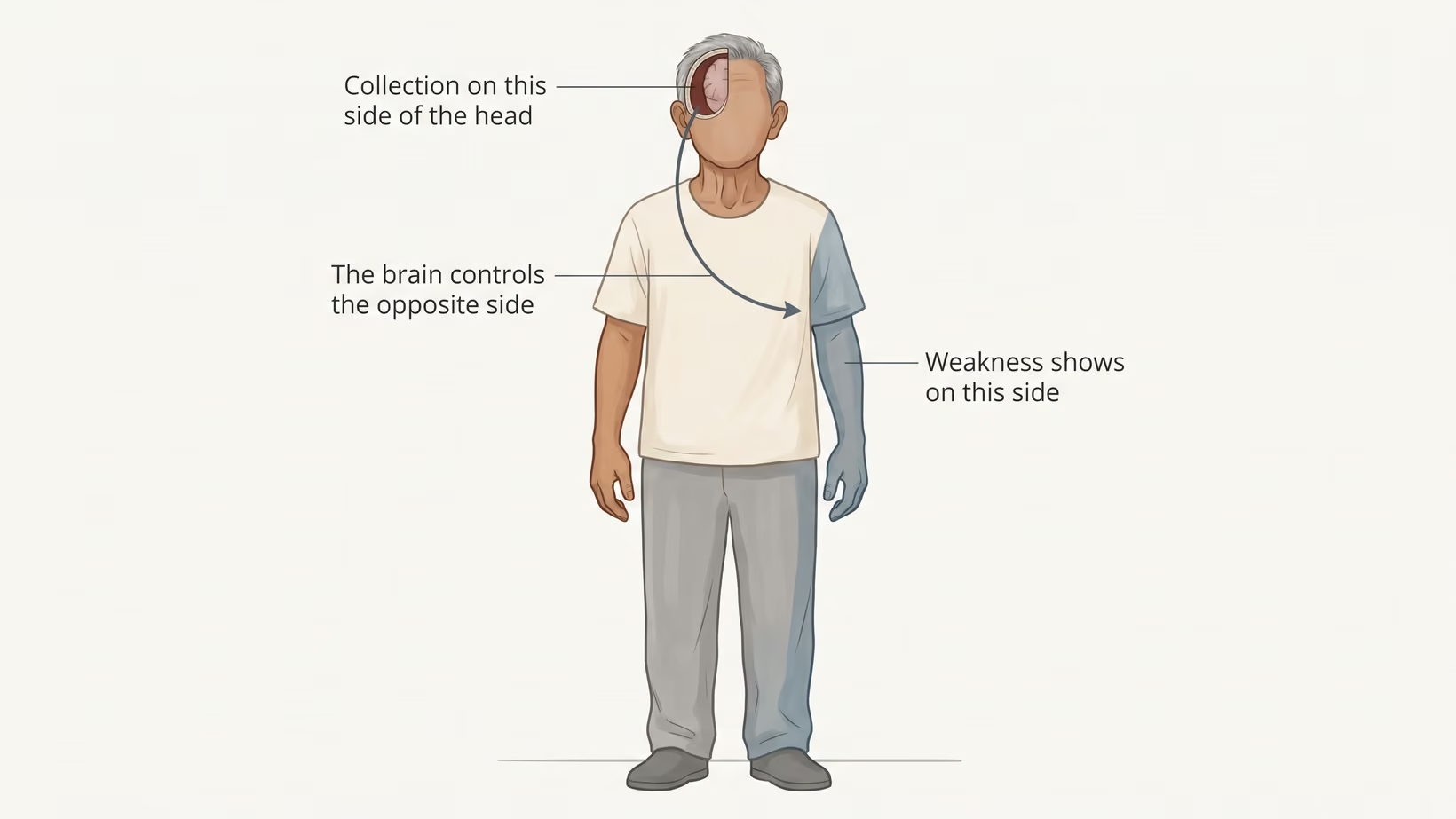
In the same series, 23, about 1 in 3, had a reduced level of alertness. Families are often confused about which side is weak. A collection on the left side of the head causes weakness on the right side of the body, and the other way around. This is because each half of the brain controls the opposite half of the body. You do not need to work out which side the problem is on.
Weakness that appears within a minute is treated as a stroke until proven otherwise. That person needs the nearest emergency department now. Weakness that has come on slowly over two weeks still needs a scan this week, today if it is worse than yesterday. If it suddenly gets worse, or drowsiness or confusion join it, go to the nearest emergency room now.
Slurred Speech in an Elder: Stroke, or Something Slower?
Slurred speech in an older person should always be taken seriously, and the first step is to tell sudden from gradual. Sudden slurring is a sign of stroke and needs an emergency department immediately. Speech that changes gradually in the weeks after a bump on the head is a reason to be scanned this week.
Families use one word for two different speech changes. One is slurring: the words come out thick or clumsy, but they are the right words. The other is difficulty finding words: the speech is clear, but the word will not come. The published symptom list for a chronic collection names this second one, along with clumsiness of one hand and a drooping face.
Sudden symptoms belong to a different bleed, one that causes symptoms within hours and is managed as an emergency.
When Does a Late Symptom Mean a Bleed?
A late symptom may mean a bleed when it is new or getting worse, when it appeared weeks to a few months after a bump, and especially when the person is older or on a blood thinner. The average is four to seven weeks, but later is common. None of these makes it certain. Together they make it worth a scan.
Reading the symptoms alone cannot answer the question. A scan of the inside of the head answers it, and that scan is quick to get.
Who Is Most at Risk
The risk factors named in the medical literature are older age, being male, and taking blood-thinning medicines (antiplatelets or anticoagulants). It is mainly a condition of older people. Reported rates range from about 2 to about 21 new cases per 100,000 people a year, and the condition is most common in older people.
It can also happen to younger adults. In the Philippine series of 71 patients, the average age was 74, but the ages ranged from 21 to 94. In a younger patient, one risk factor that can explain it is heavy drinking, which changes the risk.
The Test That Answers It
The test is a plain CT scan of the head, which takes X-ray pictures in layers. It takes minutes, and it is available at hospitals that have an emergency department. A collection of this kind usually appears clearly on it. Sometimes it does not, so ask what should bring you back if the scan is read as normal.
A scan taken on the day of the injury can be entirely normal, and a collection can still form weeks to months later. The first days after an older person falls have their own signs to watch. Not remembering a fall does not lower the suspicion either. This condition usually follows a minor injury, but often nobody remembers one.
Bring and ask
What to Bring to the Consult, and What to Ask
Bring:
- The date of the head bump, or the last time anyone remembers one, even if it seemed like nothing
- A short written timeline of when each symptom started and whether it is better or worse than last week
- A complete list of medicines, including aspirin, clopidogrel, warfarin and the newer blood thinners
- Any scan done at the time of the injury, images and report
- Someone who has seen the person daily, because the change is easier to notice from outside
Ask:
- Does this need a plain CT scan of the head, and can it be done today
- If the scan is normal, what would make us come back
- Should the blood thinner be changed or paused, and who decides (do not stop or skip it on your own before you ask)
- Which of these symptoms should make us come straight to the emergency room
- What is the estimate for the scan, and is any of it covered by PhilHealth here
Frequently Asked Questions
It Was Weeks Ago and the Scan Was Normal. Can It Still Be That?
Yes, a slow bleed can still appear weeks after a normal scan. A scan taken at the time of an injury can be entirely normal, with no sign of bleeding. A collection can still form weeks to months later, so the old scan does not answer the current question.
I Am Forty, Not Eighty. Does This Apply to Me?
It can, although a slow bleed on the brain is far more common in older people, and the number of new cases rises steeply with age. The Philippine surgical series in this post had patients as young as 21. Being middle-aged does not rule it out, especially with a blood thinner or heavy drinking.
Is a Headache Alone Enough to Get Scanned?
A headache alone, with no bump and no other change, is not usually a reason for a scan. A headache that began weeks after a head bump needs a doctor this week. A headache that is clearly worse from one day to the next, or comes with drowsiness, vomiting or weakness, means the nearest emergency room now. Bring the timeline, not only the headache, because the timeline is what shows the doctor the pattern.
If It Is a Bleed, Is It an Operation?
A slow bleed often needs an operation, but not always. The decision depends on the size of the collection and on how the person is functioning, not on the diagnosis alone. In one Philippine series of 71 patients who had surgery, all 71 improved afterward, and 6 of them, about 9 in 100 (8.5%), were left with some weakness. Results differ from person to person.
How Long Until He Is Himself Again?
There is no reliable figure for how long recovery takes after a slow bleed, and anyone who gives you one confidently is guessing. The more useful measure is week to week. Ask whether he is better than last week, the same, or worse.
What to do now
What to Do Now
If the symptoms are the ones in the red box above, stop reading and go now to the nearest emergency department. Bring the medicine list and any old scan.
If the symptoms are slow ones, and they are new or getting worse some weeks after a bump on the head:
- Write the timeline down today, before the details are forgotten
- Book a consultation with a neurosurgeon this week, or ask your doctor to refer you, rather than waiting to see if it settles
- Ask directly whether a plain head CT is needed, and tell the doctor the date of the head bump
- Bring the medicine list, any old scan, and someone who sees the person daily, and say if there is a blood thinner on the list
If you would like me to see you or your parent, I hold clinic at the Lung Center of the Philippines in Quezon City on Tuesday and Thursday from 2 PM. When the trip is hard for an older person, or you live far away, an online consult is possible: book it on the consultation page. Your doctor can also refer you to me.
If the symptoms are steadily improving, it has been under two weeks, no sign in the red box is present and no blood thinner is involved, you are most likely watching an ordinary recovery. Watch whether they are getting better or worse, not how they feel on one day, and come back to this page if that changes.
Hindi po kayo OA kung nag-aalala kayo.
See sources
- Permenter CM, Fernández-de Thomas RJ, Sherman AL. Postconcussive syndrome. StatPearls Publishing, updated 28 August 2023. https://www.ncbi.nlm.nih.gov/books/NBK534786/
- Pierre L, Julien C, Margetis K, Kondamudi NP. Subdural hematoma. StatPearls Publishing, updated 24 May 2026. https://www.ncbi.nlm.nih.gov/books/NBK532970/
- Edlmann E, Giorgi-Coll S, Whitfield PC, Carpenter KLH, Hutchinson PJ. Pathophysiology of chronic subdural haematoma: inflammation, angiogenesis and implications for pharmacotherapy. Journal of Neuroinflammation, 2017. PMID 28558815, DOI 10.1186/s12974-017-0881-y
- Yang W, Huang J. Chronic subdural hematoma: epidemiology and natural history. Neurosurgery Clinics of North America, 2017. PMID 28325454, DOI 10.1016/j.nec.2016.11.002
- Mercado CMC, Maala JMD, Bayhon MV, et al. Predictors of recurrence of chronic subdural hematoma among adult Filipinos after surgery: developing a preliminary model for prognosis. Cureus, 2025. PMID 40395255, DOI 10.7759/cureus.82599
- Kitya D, Punchak M, Abdelgadir J, Obiga O, Harborne D, Haglund MM. Causes, clinical presentation, management, and outcomes of chronic subdural hematoma at Mbarara Regional Referral Hospital. Neurosurgical Focus, 2018. PMID 30269586, DOI 10.3171/2018.7.FOCUS18253
- Blaauw J, Meelis GA, Jacobs B, et al. Presenting symptoms and functional outcome of chronic subdural hematoma patients. Acta Neurologica Scandinavica, 2021. PMID 34448196, DOI 10.1111/ane.13518