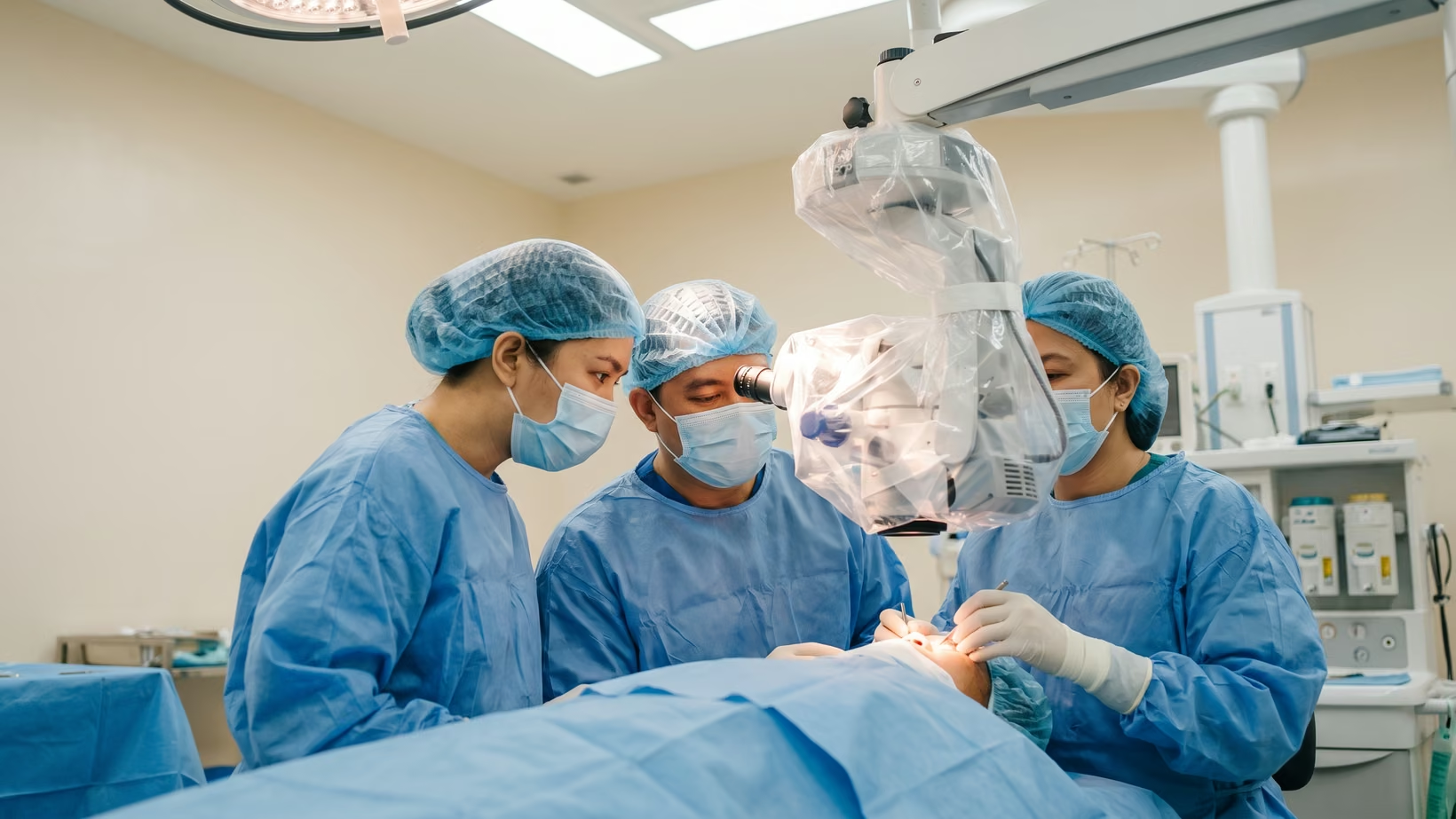

In brain tumor surgery, the surgeon lifts a disc of skull bone, removes as much tumor as can be removed safely, and puts the bone back. Before the operation, you have tests, a talk with your surgeon and a signed consent form. After it, you recover first in the ICU or the ward, then at home.
What does craniotomy mean?
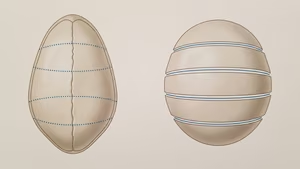
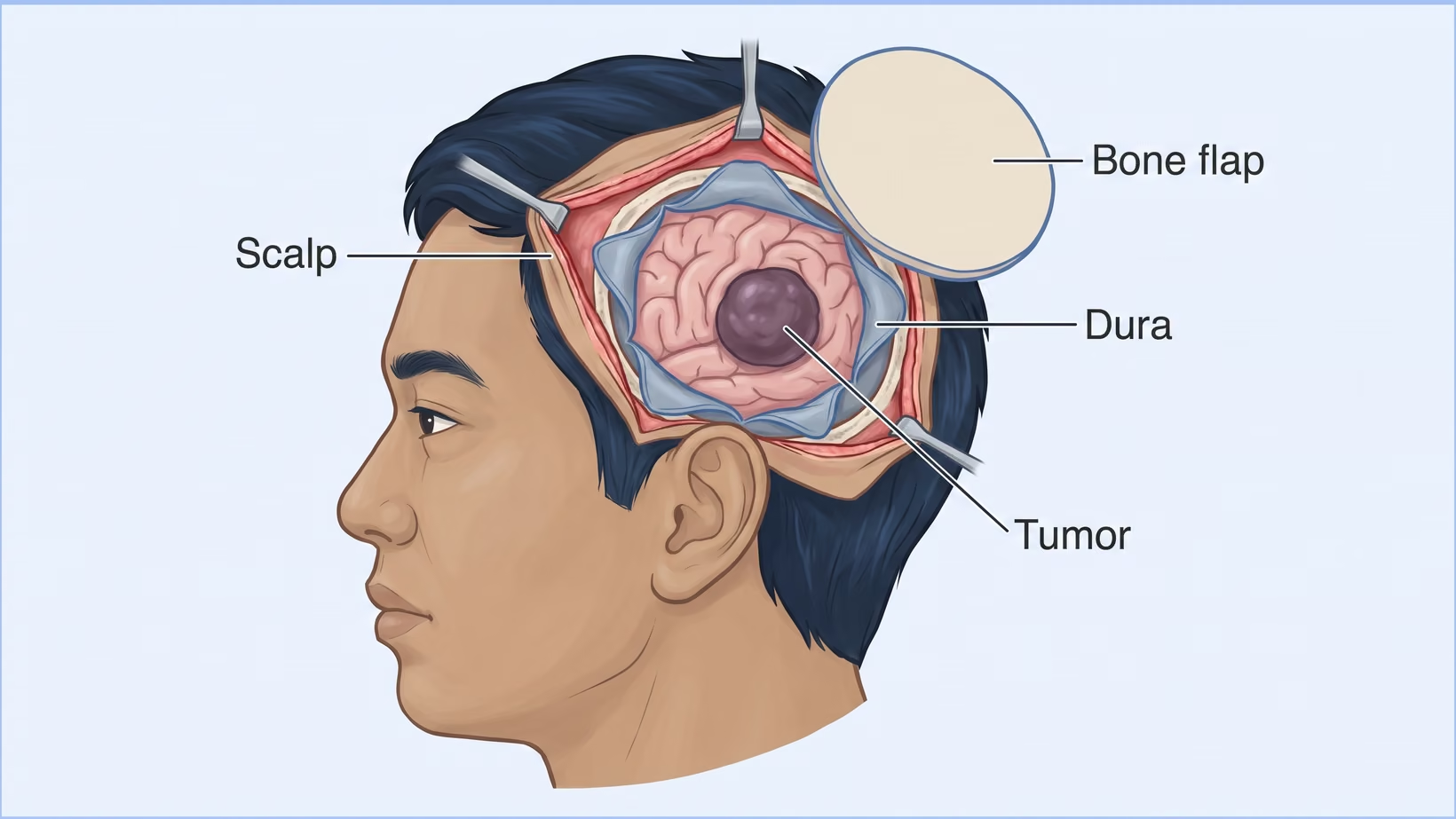
A craniotomy is an operation where a disc of skull bone is removed with special tools, so the surgeon can reach the brain underneath. In brain tumor surgery, the tumor is removed through this opening. At the end, the bone is put back.
At one UK neurosurgical center, you are asleep under a general anesthetic. A very small amount of hair is shaved along the line of the cut. The surgeon opens the scalp and cuts out a disc of bone, called the bone flap. Under the bone lies the dura, the thick membrane around the brain. The surgeon opens the dura too.
A tumor on the brain surface, such as a meningioma, is separated from the brain and removed. A tumor inside the brain is reached through a cut in the brain surface. Then the dura is stitched closed. The bone flap is fixed back with three small plates, and the scalp is closed with staples.
When does a brain tumor patient need the emergency room?
A brain tumor patient needs the nearest emergency room now for a seizure that is the first one, lasts too long, or repeats without recovery. So does a headache that comes with drowsiness, confusion, numbness or weakness, or difficulty speaking. Go with someone else driving.
Before or after surgery, a worsening headache, increasing drowsiness, or new weakness, numbness or speech trouble needs your surgeon’s team right away. If you cannot reach the team at once, go to the nearest emergency room now.
Seek care now
Signs to go to the emergency room now
Go to the nearest emergency room now, with someone else driving, for a seizure (fit) that:
- Is the first seizure the person has ever had
- Lasts longer than is usual for them, or longer than five minutes if you do not know how long their seizures usually last
- Is not followed by recovery as usual
- Comes again before they have recovered from the last one
- Brings the count to three or more seizures in 24 hours
Also go now for a headache that comes with any of these:
- Drowsiness or confusion
- Numbness or weakness in the body or face
- Difficulty speaking, balancing, walking or remembering things
- Loss of vision
- A sudden start, with extreme pain
Signs to tell your surgeon’s team about right away
Contact your surgeon’s team right away if you notice:
- A headache that keeps getting worse
- Drowsiness, or drowsiness that is increasing
- New or worsening weakness or numbness of the arms or legs
- New problems with speech
- Blackouts, if you have not had these before
- Neck stiffness or pain
- A fever or high temperature, or a rash
- Leakage or discharge from the wound, more redness or swelling, or pain at the wound that keeps increasing
If you cannot reach the team at once, go to the nearest emergency room now, with someone else driving.
Ask for an urgent appointment if you think you had a first seizure and did not go to a hospital, or had one after a long time with none.
What to do now
What to do next, and who to see
Who to see depends on what is happening now.
- A seizure with the signs above: the nearest emergency room now, with someone else driving.
- A headache with the signs above: the nearest emergency room now, with someone else driving.
- Any sign on the second list: your surgeon’s team, right away. If you cannot reach them at once, the nearest emergency room now.
- A brain tumor found on a scan: a neurosurgeon, who works with the other doctors who treat a brain tumor to decide whether you need an operation.
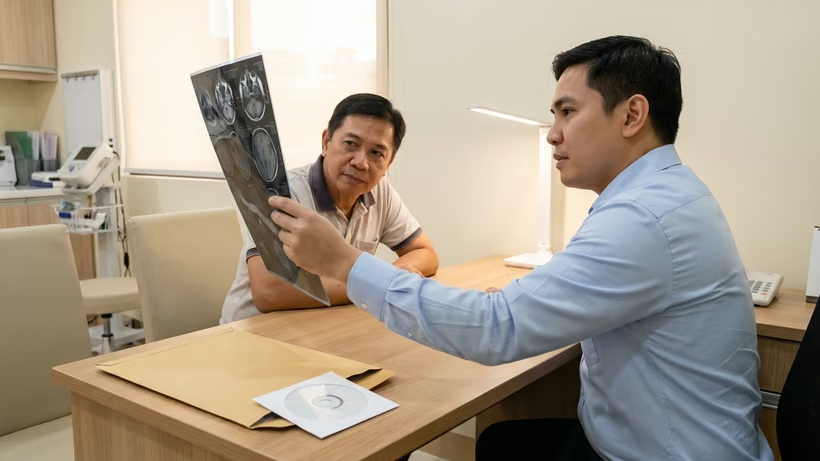
- Bring the MRI and CT on a disc or as a link, the radiologist’s report, any biopsy report, and a list of your medicines.
You may see me at the Lung Center of the Philippines clinic, Tuesday and Thursday from 2 PM, or for a child at the Philippine Children’s Medical Center, Wednesday from 2 PM. If travel is not practical, book an online consult on the consultation page. Your doctor can also refer you.
How do I prepare for brain tumor surgery, and how long is it?
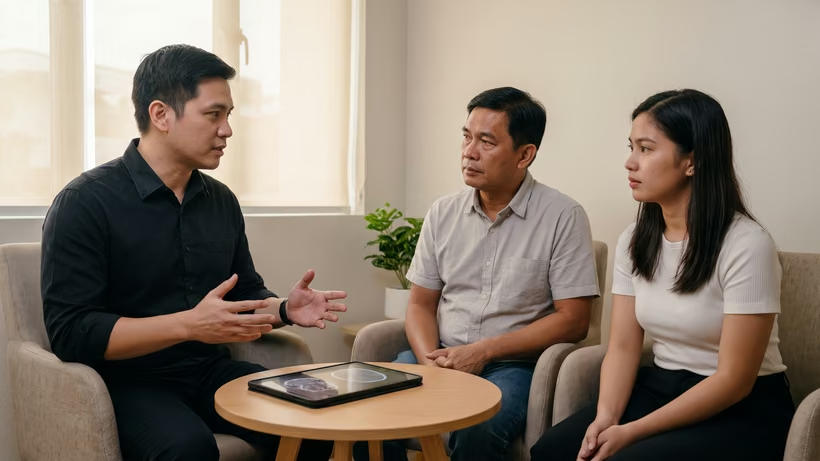
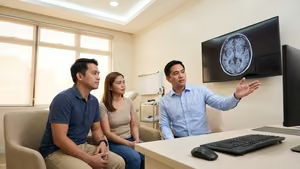
You prepare for brain tumor surgery with tests, a talk with your surgeon, and a signed consent form. Your surgeon explains the particular risks of your operation. How long the operation takes depends on the tumor, where it is and how it is reached. Your surgeon gives you an estimate.
The anesthesia team arranges the tests it needs and tells you when to stop eating and drinking. Ask which of your usual medicines to take on the day. Decide early who will stay with you as your bantay, and who will be at home with you after discharge.
I operate on brain tumors in adults at the Lung Center of the Philippines and the National Kidney and Transplant Institute, both in Quezon City. When admission is needed sooner, Capitol Medical Center in Quezon City is an option.
Is a biopsy enough, or does the tumor need to come out?
A biopsy, a small sample of the tumor taken for testing, is used when removing the tumor is not appropriate. For a suspected low-grade glioma (a tumor that grows inside the brain) in adults, UK guidance says to consider a biopsy in that case, to get a diagnosis from the tissue.
For a single metastasis, meaning cancer that has spread to the brain from elsewhere, UK guidance says to consider either surgery or focused radiation (stereotactic radiosurgery or radiotherapy).
Can children and older adults have brain tumor surgery?
Children and older adults can both have brain tumor surgery. The risk depends on the tumor’s size, location and type, and on general health and age. I treat brain tumors in children at the Philippine Children’s Medical Center (PCMC) in Quezon City, with a pediatric anesthesiologist and a pediatric intensive care unit.
The UK guidance quoted here covers ages 16 and over. In older adults, a European guideline says many meningiomas found without symptoms may be watched with repeat scans instead.
How navigation and brain mapping help decide how much tumor is removed
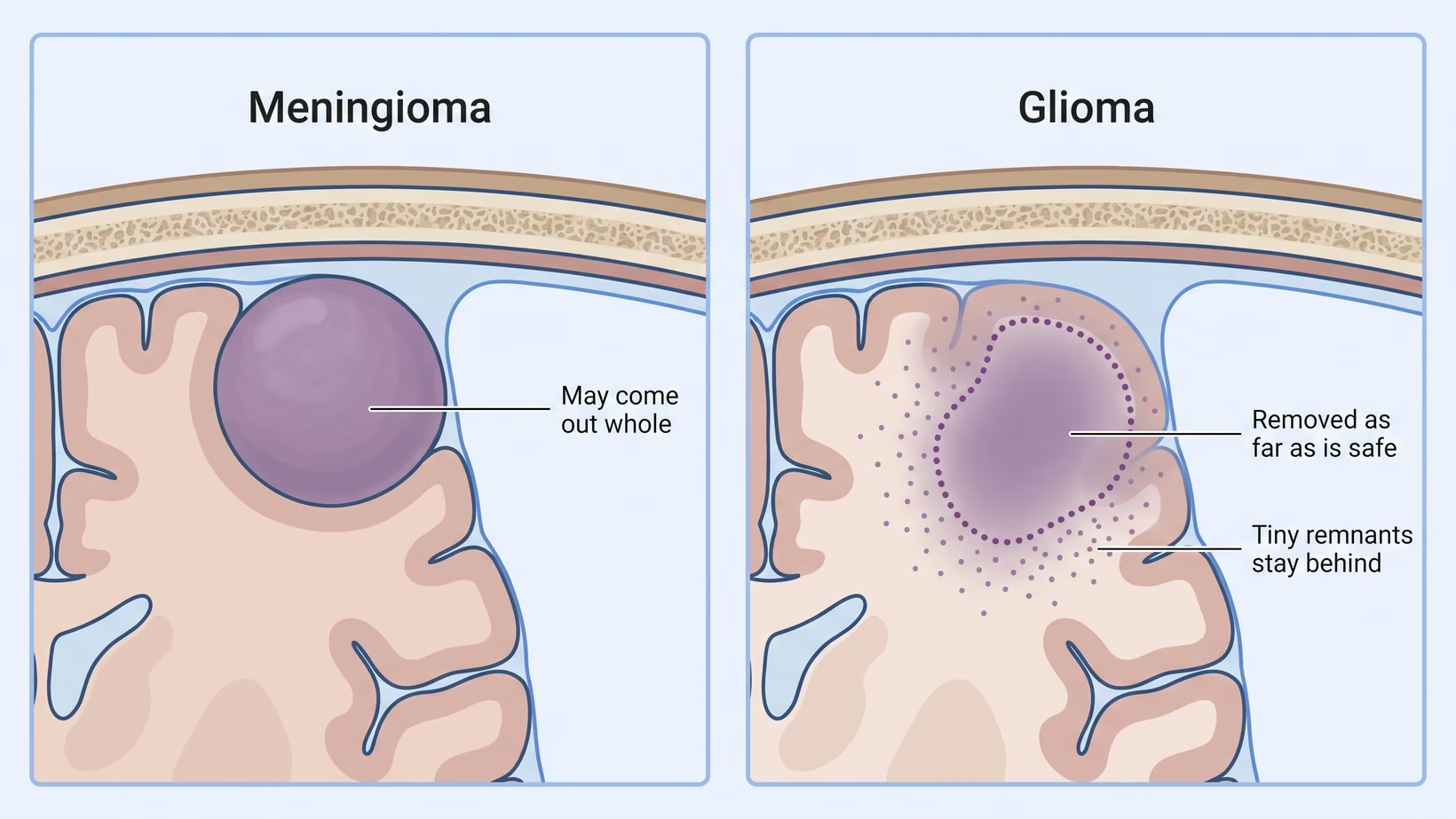
During brain tumor surgery, a navigation system and your scan show the surgeon where the tumor is. The surgeon removes as much abnormal tissue as can be removed safely. Some tumors, such as meningiomas, may come out whole. Others, such as gliomas, grow inside the brain, and tiny remnants of these stay behind.
How does the surgeon find the tumor and protect the brain?
The surgeon finds the tumor with neuronavigation, a computer system that works like a satellite navigation system. It uses your scan from before surgery to locate the tumor.
For a suspected high-grade glioma that appears bright on a contrast scan, where the team thinks all of it can be removed, UK guidance says to offer 5-ALA, a substance that makes the tumor glow. For glioma surgery, it also says to consider an MRI scan or ultrasound during the operation.
In a trial of adults with suspected malignant glioma, a cancer, all the tumor that lit up on MRI was removed in 90 of 139 patients with 5-ALA (about 65 in 100). With standard white light, it was 47 of 131 (about 36 in 100).
What is awake brain surgery, and why is it done?
Awake brain surgery is a craniotomy done while you are awake for part of it. UK guidance says to consider it for low-grade or high-grade glioma, to help preserve neurological function.
A review of 8,091 adults having glioma surgery looked at stimulation mapping. Mapping tests the brain with small electrical currents during surgery, and it includes awake surgery. Late severe loss of brain function was found in about 3 in 100 patients with mapping and about 8 in 100 without. The studies were observational, so this is a link, not proof.
Why is some tumor sometimes left behind?
Some tumor is left behind when removing more would harm the brain.
A meningioma sits on the brain surface, and in meningioma surgery the tumor may be removed whole. For many tumors inside the brain, such as gliomas, the surgeon removes as much as can be safely removed. Tiny remnants of tumor, seen only under a microscope, stay in the brain around it.
In adults with newly diagnosed glioblastoma, a review of 37 studies and 41,117 patients linked removing all visible tumor with about one fewer death at one year for every nine patients, compared with partial removal. The quality of that evidence was moderate to low.
What are the risks of brain tumor surgery?
Every brain tumor operation carries a risk. How big the risk is depends on the tumor’s size, location and type, and on your general health and age. Your surgeon explains the particular risks of your operation and the likely chance of complications.
One UK hospital’s leaflet lists these complications, among others:
- Loss of function for a time or for good, such as paralysis of the limbs or loss of speech (stroke)
- A blood clot (hematoma)
- Brain swelling
- Infection
- Seizures (fits)
- A leak of the fluid from around the brain (CSF leak)
- General problems: a clot in the leg veins, a clot that travels to the lungs, pneumonia, a heart attack or a urinary infection
Some of these may need another operation, and some can be life-threatening. Before you sign, ask your surgeon which of the risks of brain tumor surgery apply to your tumor.
What happens in the ICU and the first week after brain tumor surgery
After brain tumor surgery, you go first to a recovery area, then to the ICU or the ward. Your team decides which, based on the operation and your condition. At one UK neurosurgical center, patients spend about one hour in recovery and then go to the neurosurgery ward.
Nurses check how awake you are, your pupils, the strength of your arms and legs, your pulse, blood pressure and breathing. A head bandage, if used, is removed after a day or two. You may eat, drink and move around as soon as you feel able.
You get medicine for headache and for sickness (nausea). You are often given steroids to prevent brain swelling, in a slowly reducing dose. To prevent clots in the legs, you wear special stockings, walk early, and may get daily injections of a blood thinner (anticoagulant).
A Cochrane review found only limited, low-certainty evidence on whether seizure medicine prevents seizures after a craniotomy. Your team decides whether you need it.
For a glioma, UK guidance says to consider an MRI scan within 72 hours of the operation. At the UK center described above, you go home as soon as your condition is stable.
What to expect when you go home, and life after brain tumor surgery
At home after brain tumor surgery, keep the wound clean and dry, keep taking your pain relief, and have someone stay with you. You may have headaches that lessen with time, and you will feel tired. Numbness and tingling around the wound is normal and may last a few months. A headache that keeps getting worse needs your surgeon’s team right away.
You can bathe or shower, but keep the wound dry until the clips or stitches are out. At one UK center, a GP removes them five to ten days after surgery, sometimes later.
The same center asks patients not to stop any prescribed medicine unless the doctors advise it. Being off work for about six weeks is not unusual. Because of the small risk of a seizure, avoid climbing ladders, working certain machines, or swimming without someone watching.
A brain tumor and its treatment can affect behavior, thinking and personality, as well as the body. UK guidance says to consider a rehabilitation check of body, thinking and emotions at diagnosis and at every follow-up stage.
When do the biopsy results come, and what treatment comes next?
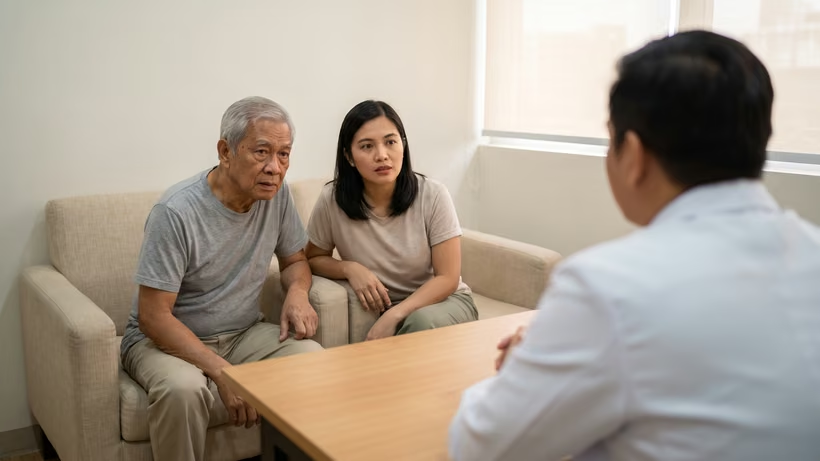
At one UK center, the surgeon discusses the biopsy results usually five to seven days after surgery. Ask your surgeon when your own result is expected. The surgeon then explains any plans for further treatment and follow-up.
It is not always possible to remove all of a tumor. Radiotherapy or chemotherapy may be needed to treat any abnormal cells left behind.
How successful is brain tumor surgery, and what is survival after it?
Success after brain tumor surgery depends on the tumor type and grade. For non-cancerous tumors, treatment is often successful and a full recovery is possible. For a meningioma, a European guideline says removing the whole tumor with the dura it involves is often curative.
One UK center’s leaflet says headaches caused by the tumor have a good chance of improving. Weakness from the tumor pressing on the brain may improve. Weakness from tumor growing into the brain is unlikely to improve.
One trial treated 573 adults with newly diagnosed glioblastoma. Of these, 84 in 100 had already had surgery to remove tumor. They had radiotherapy, with or without the medicine temozolomide. With both, half lived longer than 14.6 months, and about 26 in 100 were alive at two years. With radiotherapy alone, half lived longer than 12.1 months.
The trial’s five-year report found about 10 in 100 alive at five years with temozolomide, against about 2 in 100 with radiotherapy alone. These figures describe the whole treatment after surgery or biopsy, not surgery alone. Ask your doctors how glioblastoma life expectancy figures apply to your own tumor.
What a GP can manage after brain tumor surgery
After brain tumor surgery, a GP can remove the clips or stitches, renew prescriptions, and watch for new symptoms and late effects. Steroids are reduced slowly, as the surgeon prescribed. A seizure or a headache with the danger signs needs the emergency room now. Other new neurological signs need the surgeon’s team right away.
What the GP can manage
- Wound: at one UK center, clips or stitches come out at five to ten days, sometimes longer.
- Steroids: the dose is reduced slowly, as prescribed by the surgeon.
- Late effects: UK guidance says treatment can cause side effects months or years later, including epilepsy, a decline in thinking and memory, hypopituitarism (low pituitary hormones), hearing loss, stroke and secondary tumors.
When to send the patient back to the surgeon
Contact the surgeon’s team right away for any sign on the second list, from a worsening headache or drowsiness to new weakness, fever or a wound problem. If the team cannot be reached at once, send the patient to the nearest emergency room now.
For a suspected first seizure not seen in hospital, arrange an urgent appointment. For glioma, UK guidance says to arrange a clinical review with imaging for new or changing neurological symptoms or signs at any time.
Bring and ask
How to refer, and what to send
Send these with the referral:
- The operative note and the histology report
- The latest MRI and CT on a disc or as a link, with the radiologist’s report
- A medicine list, with the steroid dose and any seizure medicine
- The question you want answered
You may refer an adult to my clinic at the Lung Center of the Philippines, Tuesday and Thursday from 2 PM. A child can be referred to my clinic at PCMC, Wednesday from 2 PM. For a patient far from Quezon City, an online consult can be booked on the consultation page.
Frequently asked questions
Is brain tumor surgery dangerous?
Brain tumor surgery carries risks, as every operation does, and some complications can be life-threatening. How large the risk is depends on the tumor’s size, location and type, and on your general health and age. Your surgeon explains the risks of your own operation.
Will I have seizures after brain tumor surgery?
Seizures can happen after brain tumor surgery, most likely within the first month. A Cochrane review estimated about 15 to 20 in 100 after one type of craniotomy, done for causes other than injury. Over five years the risk varies from 3 to 92 in 100.
Can a brain tumor come back after surgery?
A brain tumor can come back after surgery. For non-cancerous tumors, the NHS says there is sometimes a small chance of return, so regular follow-up appointments may be needed. For gliomas, tiny remnants seen only under a microscope stay in the brain, and further treatment may be needed for them.
Is the skull bone put back after a craniotomy?
In a craniotomy, the skull bone is put back at the end of the operation. At one UK center, it is fixed with three small plates.
Will my head be shaved?
For brain tumor surgery at one UK neurosurgical center, only a very small amount of hair is shaved, along the line of the cut. Ask your surgeon how much hair will be removed.
See sources
- National Institute for Health and Care Excellence. Brain tumours (primary) and brain metastases in over 16s (NICE guideline NG99). NICE, 2018, updated 2021. https://www.nice.org.uk/guidance/ng99
- University Hospital Southampton NHS Foundation Trust. Craniotomy for brain tumour removal (patient information factsheet 1192). Wessex Neurological Centre, 2021. https://www.uhs.nhs.uk/Media/UHS-website-2019/Patientinformation/Brain-and-spine/Craniotomy-for-brain-tumour-removal-1192-PIL.pdf
- University Hospital Southampton NHS Foundation Trust. After a craniotomy (patient information factsheet 1986). Wessex Neurological Centre, 2025. https://www.uhs.nhs.uk/Media/UHS-website-2019/Patientinformation/Brain-and-spine/After-a-craniotomy-1986-PIL.pdf
- NHS. Epilepsy. nhs.uk, 2025. https://www.nhs.uk/conditions/epilepsy/
- NHS. Brain tumours. nhs.uk, 2023. https://www.nhs.uk/conditions/brain-tumours/
- Stummer W, et al (ALA-Glioma Study Group). Fluorescence-guided surgery with 5-aminolevulinic acid for resection of malignant glioma: a randomised controlled multicentre phase III trial. Lancet Oncology, 2006. PMID 16648043. doi:10.1016/S1470-2045(06)70665-9
- Brown TJ, et al. Association of the extent of resection with survival in glioblastoma: a systematic review and meta-analysis. JAMA Oncology, 2016. PMID 27310651. doi:10.1001/jamaoncol.2016.1373
- De Witt Hamer PC, et al. Impact of intraoperative stimulation brain mapping on glioma surgery outcome: a meta-analysis. Journal of Clinical Oncology, 2012. PMID 22529254. doi:10.1200/JCO.2011.38.4818
- Goldbrunner R, et al (European Association of Neuro-Oncology). EANO guideline on the diagnosis and management of meningiomas. Neuro-Oncology, 2021. PMID 34181733. doi:10.1093/neuonc/noab150
- Greenhalgh J, et al. Antiepileptic drugs as prophylaxis for postcraniotomy seizures. Cochrane Database of Systematic Reviews, 2020. PMID 32343399. doi:10.1002/14651858.CD007286.pub5
- Stupp R, et al (EORTC/NCIC). Radiotherapy plus concomitant and adjuvant temozolomide for glioblastoma. New England Journal of Medicine, 2005. PMID 15758009. doi:10.1056/NEJMoa043330
- Stupp R, et al (EORTC/NCIC). Effects of radiotherapy with concomitant and adjuvant temozolomide versus radiotherapy alone on survival in glioblastoma in a randomised phase III study: 5-year analysis of the EORTC-NCIC trial. Lancet Oncology, 2009. PMID 19269895. doi:10.1016/S1470-2045(09)70025-7
- NHS. Headaches. nhs.uk. https://www.nhs.uk/symptoms/headaches/