
A chronic subdural hematoma, an old pool of blood between the brain and its covering, can look like dementia, and a plain head CT tells them apart. Alzheimer’s disease comes on over months to years. This collection usually develops over weeks to a few months. Drowsiness, a seizure or sudden weakness on one side means the emergency room now.
Why is Lolo suddenly confused?
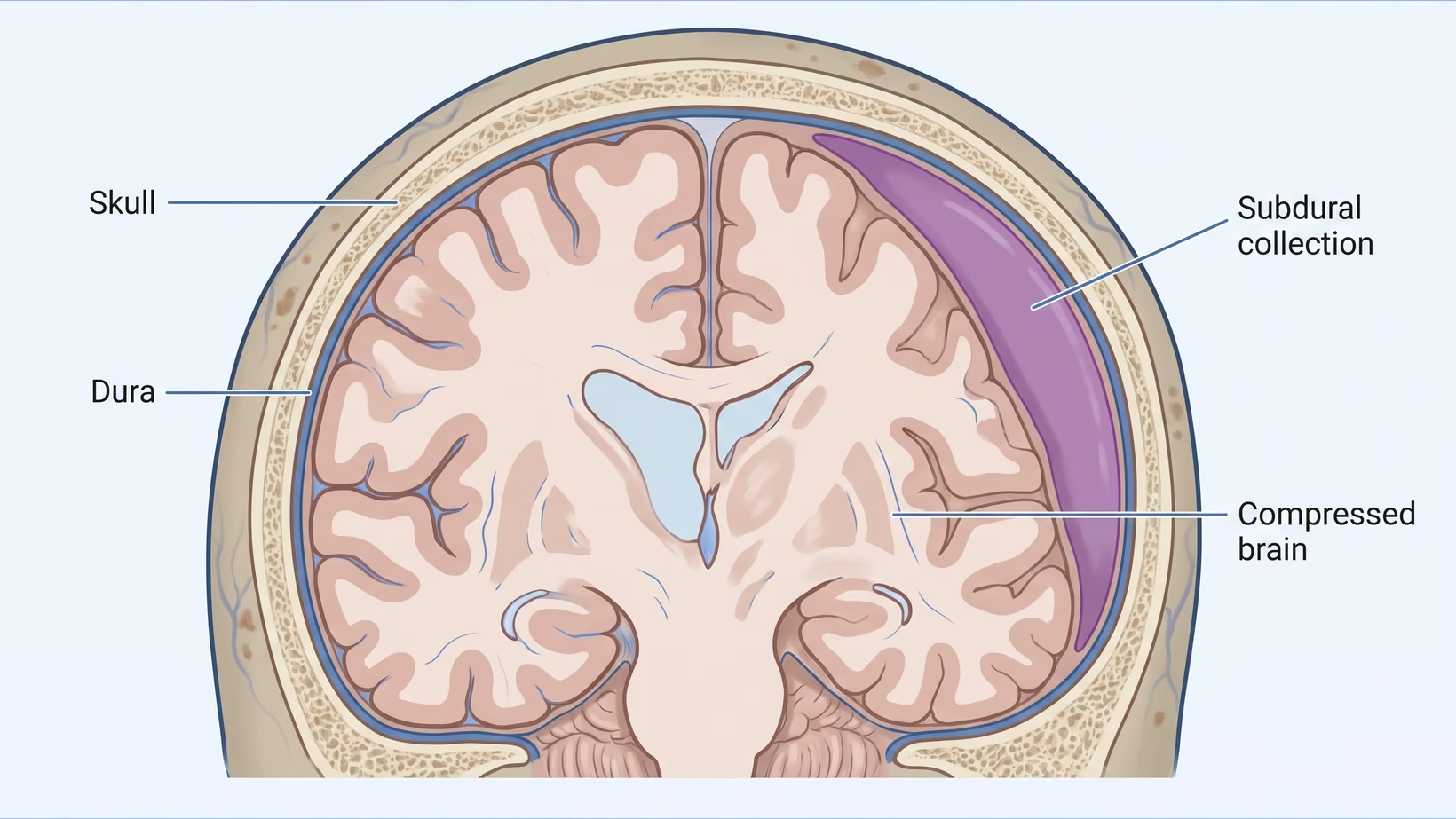
Sudden confusion in an older person means something inside the head has changed, and a doctor needs to find out what. Confusion that came on over hours or a day needs the emergency room now; confusion that crept in over weeks needs a doctor this week. A chronic subdural hematoma is one possible cause. It is a collection of old blood under the dura, the tough membrane wrapped around the brain. It is typically a disease of older people.
Confusion that is new, or that your family can roughly date, should be checked by a doctor. Hindi ito basta katandaan hangga’t walang tumitingin.
The shrinkage of an older brain is the setting in which the collection forms. The bridging veins are small veins that run from the brain to the dura. They are fragile where they cross the gap under the dura (the subdural space), because they have thin walls and no support from the arachnoid, the thin inner covering of the brain.
What the family usually notices first
It is rarely one dramatic thing. It is usually several small changes: he repeats himself, he cannot find a word, he naps through the afternoon, he seems flat. In one study that followed 30 patients with this diagnosis, thinking and memory problems (cognitive impairment) were the main first symptom in 20 of them.
Headache, weakness down one side and slurred speech were the next most common findings in that study. A review of the condition names headache, confusion, one-sided weakness and difficulty with language as the usual presentations.
Why a fall weeks ago still matters
The bleed is usually a small one, and small bleeds take weeks to cause problems. Reviews describe head trauma as the usual cause and note that the injury is often trivial and may go unnoticed.
So the fall you are trying to remember may not have looked like anything. Umupo siya nang malakas sa banyo. Nauntog siya sa pinto ng sasakyan. Nobody brought him to a doctor, because at the time nothing seemed wrong.
Ulyanin, or something else?
Ulyanin is the everyday Filipino word for an older person who has become forgetful. It describes what the family sees. It does not say why. Dementia is common, and most of the time it is the cause. But when the word and the cause are treated as one thing, a treatable cause can go unexamined for months.
What the word covers, and what it hides
A population-based study in Marikina City found dementia in about 11 in 100 residents aged 60 and over (10.6 percent). The great majority of it was Alzheimer’s disease.
Why the label sticks before anyone has looked
The word seems to explain everything, and it costs nothing. Once the family uses it, new symptoms are blamed on it and nobody questions them. The time to scan passes without anyone noticing.
The formal criteria for Alzheimer’s disease say the opposite. They state that probable Alzheimer’s should not be diagnosed when there is evidence of another active neurological disease, meaning a disease of the brain or nerves, at the same time. The same applies to a condition or medicine that could strongly affect thinking. Blood pressing on the brain is exactly such a disease.
Is it dementia if it arrived in weeks, not years?
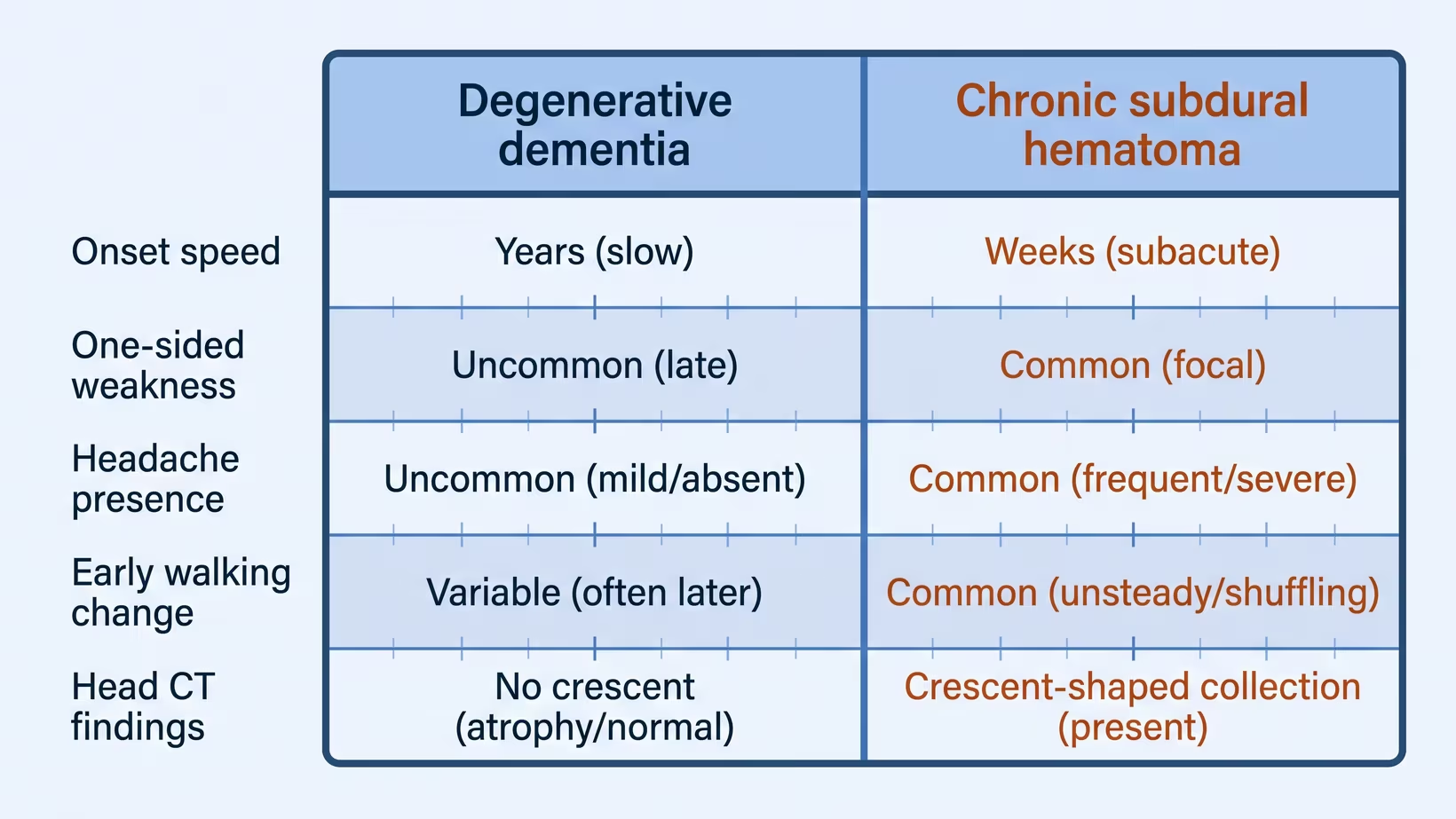
A change that arrived in weeks is usually not Alzheimer’s disease. The criteria for Alzheimer’s disease require insidious onset, meaning gradual onset over months to years, not a sudden start over hours or days. A chronic subdural hematoma is by definition older than 21 days. Its story usually covers weeks to a few months.
The tempo that should buy a scan
The two time windows overlap at the edges. So speed is only a clue, and it does not prove either one. A change your family can link to a particular month should be checked with a scan.
What travels with it
These signs should raise the question, because a degenerative dementia, one caused by slow loss of brain cells, does not usually bring them early:
- Headache, especially a new or persistent one
- Weakness, clumsiness or numbness down one side
- Slurred speech, or losing words suddenly rather than gradually
- A change in walking, or new falls
- New trouble controlling the bladder
- Stiffness and slowness resembling Parkinson’s disease but arriving over weeks
Reviews describe this stiffness and slowness (parkinsonism) as a recognized presentation of subdural hematoma. They advise that older people whose parkinsonism develops and worsens over weeks have a CT to separate it from Parkinson’s disease itself.
When the story has no fall in it at all
Sometimes there is no injury to find, and the question stays open. The same reviews describe cases caused by clotting problems and by blood thinners (anticoagulants). They also describe cases caused by antiplatelet drugs, which keep blood cells called platelets from sticking together, such as aspirin. Low pressure inside the skull after a spinal tap or spinal anesthesia is another cause.
Risk factors named there include long-term heavy alcohol use, long-term aspirin or anti-inflammatory use, anticoagulants, conditions that reduce clotting, head injury and old age. A Taiwanese population study of older people after minor head injury found three factors significantly linked to it: age 75 and above, male sex, and hydrocephalus (fluid building up inside the brain).
Seek care now
Which signs mean the emergency room now?
Some signs cannot wait for morning. Take him to the emergency room now if he is hard to wake, has a seizure, vomits again and again, or suddenly loses strength or speech. Changes over recent weeks in his thinking, walking or speech need a doctor this week, without waiting for a scheduled appointment.
Go now
- He becomes difficult to rouse, or will not wake properly
- A sudden severe headache, or one worsening by the hour
- Repeated vomiting
- A seizure
- Sudden weakness of the face, arm or leg on one side
- Sudden loss of speech, or speech that has become nonsense
- One pupil larger than the other
- Confusion that visibly worsens over a single day
- He takes a blood thinner and has hit his head in the last day, even if he seems fine
Go this week
See a doctor without waiting for a scheduled appointment if his thinking, walking or speech has changed over recent weeks, if he has fallen or hit his head recently, even a minor bump, or if he takes a blood thinner and anything has changed.
The reversible dementia a scan can find
A chronic subdural hematoma is one of the treatable causes of a dementia-like picture. Reviews name it as an important differential diagnosis in reversible dementia, meaning one of the conditions a doctor must rule out. It is not common. A scan can find it, and finding it changes what happens next.
How often a treatable cause actually turns up
Not often. A geriatric clinic in Bangkok reviewed 233 newly diagnosed dementia patients. It found potentially reversible causes in 17, or about 7 in 100 (7.3 percent). Chronic subdural hematoma accounted for about 4 in 1,000 (0.4 percent). Four patients improved after treatment, and all four improved only partially.
This study does not support scanning everyone with slow memory loss, and the clues in this post are still a reason to ask for a scan. It also records that the subdural and hydrocephalus cases were the ones doctors already suspected before testing. That is the reason to take the clues in this post seriously.
What draining the collection changes
Draining removes the pressure, and the brain underneath usually works better. Reviews describe reduced blood flow in the brain beneath the hematoma, improving after drainage.
The effect on thinking has been measured, but the studies are small. In that 30-patient study, 17 of the 20 patients whose mental test scores were in the impaired range before surgery had moved out of it a day afterwards. The authors concluded that dementia and other neurodegenerative disorders can look like this condition in older patients, and that these patients should have early imaging (a scan).
When the thinking does not come all the way back
Sometimes the collection was not the only problem, and it is better to know that before the operation than after. In a French study of 140 patients, more than a quarter still needed help with daily life three months after surgery.
A Finnish study followed 1,133 patients for a median of nearly five years. Dementia was the most common cause of death among them: about 21 in 100 (21 percent), against about 15 in 100 (15 percent) in matched people without the condition. Kung minsan, dalawa talaga ang nangyayari nang sabay.
Bring and ask
What to ask before accepting a dementia diagnosis
Before you accept a dementia diagnosis, ask the doctor to rule out a treatable cause such as a chronic subdural hematoma. Ruling causes in or out is what doctors do. Four questions and a short list of things to bring make the visit useful: the month the change started, his medicines, any fall, and any earlier scans.
The four questions
- When did this start, exactly? Name a month before you go.
- Has he had a head CT since the symptoms began?
- Any fall or bump to the head in the last three months, even a small one?
- Is anything on his medicine list a blood thinner, or does he drink regularly?
What to bring to the appointment
- Every medicine and supplement listed, or a photo of the boxes
- The dates of any fall, however minor it seemed
- A short timeline in your own words: what changed, and roughly when
- Any previous CT or MRI films and reports, not only the summary
- A relative who sees him daily, because the history is the test here
The scan a GP should order
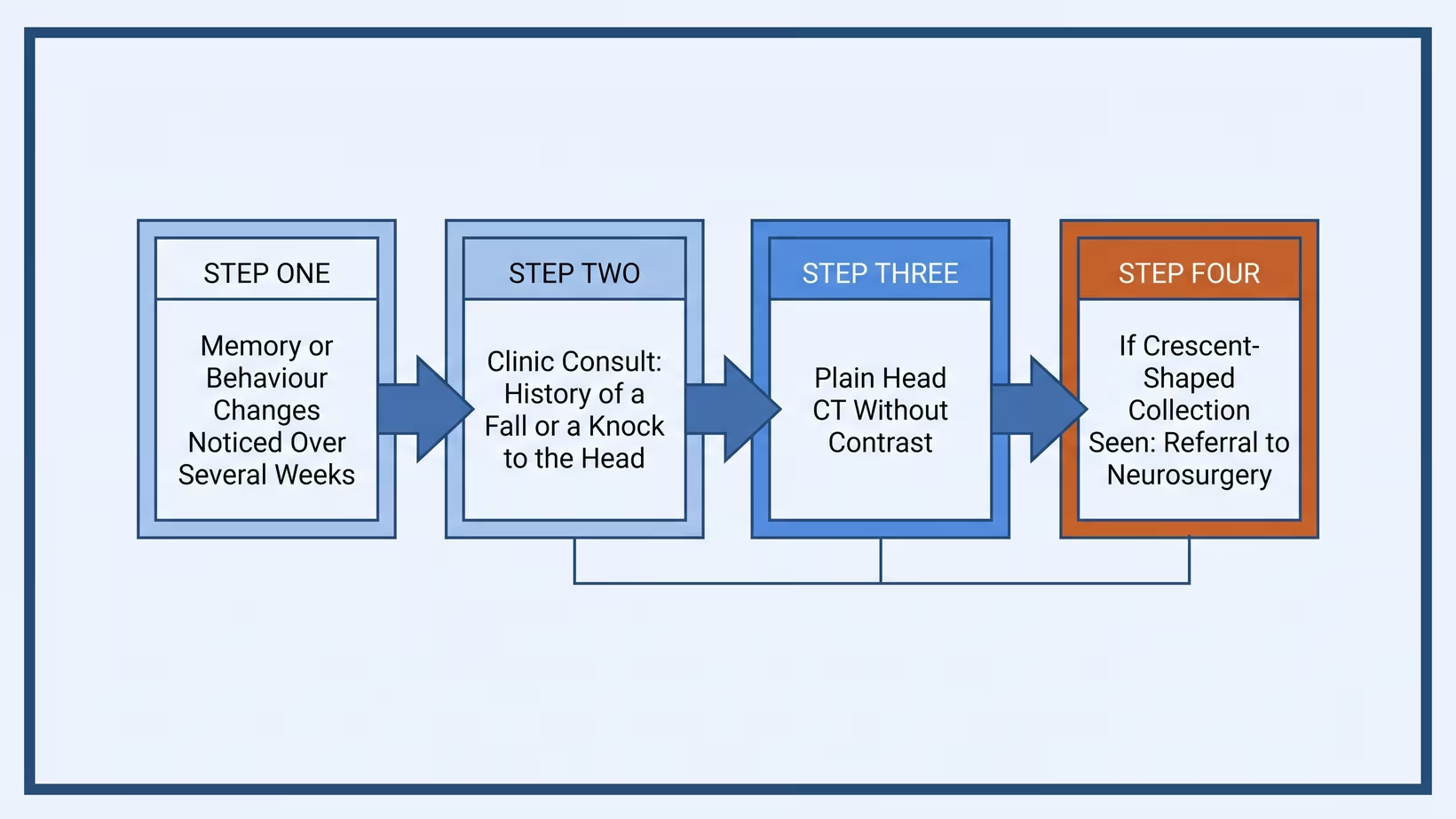
A GP should order a plain head CT without contrast dye, and it can be done the same day. Reviews state that a chronic subdural hematoma is usually diagnosed by CT. On the scan the collection is typically darker than the brain (low density). It may also look the same as the brain, or mixed.
The two ways a CT misleads
The first is a collection with the same density as the brain, which can be hard to see. This is most likely when there is one on each side and no midline shift, meaning the brain is not pushed off center. Reviews note that collections on both sides (bilateral) make diagnosis on CT difficult, and that MRI helps when the doubt remains.
The second is a normal CT taken as the final answer. A normal scan makes a surgical cause much less likely, though a collection on both sides can still hide on CT. It does not exclude metabolic causes, meaning problems with the body’s chemistry. In that Bangkok study, the low vitamin B12, low folate and thyroid cases were the ones nobody suspected.
When to refer, and how urgently
Same day, to an emergency department, for reduced consciousness, a rapidly worsening headache, seizure, vomiting, new weakness or numbness on one side of the body (a focal deficit), or an unequal pupil.
Urgently but as an outpatient for a confirmed collection in a patient who is awake and stable, with worsening thinking or walking. Neurosurgical guidance generally recommends removing (evacuating) hematomas wider than the thickness of the skull.
Burr-hole drainage, through a hole drilled in the skull, is the standard operation. In most patients it can be done under local anesthesia, which numbs only the area of the operation. Where the collection is small and symptoms are few, watching it without surgery is a reasonable choice, made with the neurosurgeon and with planned follow-up scans.
Do not stop or change a blood thinner or antiplatelet drug on your own; the doctors treating him decide this. A German study of 395 operated patients found complications from blood clots in about 9 in 100 (9.1 percent) after these drugs were stopped. The authors advise deciding this for each patient.
Frequently asked questions
Is he too old for the operation?
Age alone is not a reason to refuse surgery for a chronic subdural hematoma. A Scandinavian study of 1,254 patients compared those aged 90 and above with younger patients. It found no significant difference in the collection coming back and needing another operation, in overall complications, or in deaths within 30 days. Frailty does matter: a Canadian study found frail patients needed significantly more help when they left the hospital.
He takes blood thinners. Can he still have surgery?
A patient on blood thinners can usually still have surgery, and the surgical team manages the medicine around the operation. A 2026 review of studies covering 3,962 older patients found blood thinners (antithrombotic therapy) were not significantly linked to the collection coming back. It recommended restarting them as early as possible, because stopping them for a long time raises the risk of clots. When to restart is decided by his surgical team, not at home.
Will his memory go back to normal?
Nobody can promise that his memory will return to normal. The evidence shows that thinking often improves after drainage. Some patients are left with a deficit because a degenerative process was present as well.
Can it come back after surgery?
Yes, a chronic subdural hematoma can come back after surgery, often enough to plan for. Reviews put this at between about 5 in 100 and 33 in 100 patients (5 to 33 percent) across studies. In a Finnish population study, about 92 in 100 repeat operations (92 percent) happened within two months of the first. That is why the follow-up visits in those two months matter.
How common is this, anyway?
A chronic subdural hematoma is not common. Reviews put the number of new cases each year at roughly one to five per 100,000 people, and rising as populations age. In one Finnish region the rate among operated patients aged 80 and over rose from 36.6 to 91 per 100,000 per year between 1990 and 2015. No Philippine figure for new cases each year was available for this post.
What to do now
What to do this week
Huwag hintayin ang susunod na buwan. If the change in him is measured in weeks, see his primary doctor or an internist this week. Bring a timeline and his medicines, and ask whether a plain head CT is needed. If a collection is found, his doctor can refer him to a neurosurgeon, or you can book a consultation yourself.
These are the steps:
- Write the timeline tonight, while the dates are still in someone’s memory. One line per change, with a month attached.
- Photograph the medicine boxes, including any from another doctor.
- Book a consult with his primary doctor or an internist this week. Open with “this started about two months ago”, not “he has become forgetful”. Bring the timeline, the medicine photos and any earlier CT or MRI.
- Ask directly whether a plain head CT is needed. If there was a fall, say so first, because symptoms can appear weeks after a bump to the head.
- If a collection is found, he should see a neurosurgeon within days, not at the next routine opening. Ask his doctor for a referral, or book a consultation with a neurosurgeon yourself, and bring the scan.
- Being awake and stable does not mean it is safe to wait.
- While you wait, if he becomes hard to wake, vomits again and again, has a seizure, or suddenly loses strength or speech, go to the emergency room now.
If you would like me to see him, my neurosurgery clinic is at the Lung Center of the Philippines, Quezon City, on Tuesday and Thursday from 2 PM. Bring the scan and the timeline.
If the trip to Quezon City is too hard for him, you can book an online consult on the consultation page.
See sources
- Gill M, Maheshwari V, Narang A, Lingaraju TS. Impact on cognitive improvement following burr hole evacuation of chronic subdural hematoma: a prospective observational study. J Neurosci Rural Pract. 2018;9(4):457-460. PMID 30271033. doi:10.4103/jnrp.jnrp_126_18
- Yadav YR, Parihar V, Namdev H, Bajaj J. Chronic subdural hematoma. Asian J Neurosurg. 2016;11(4):330-342. PMID 27695533. doi:10.4103/1793-5482.145102
- McKhann GM, Knopman DS, Chertkow H, et al. The diagnosis of dementia due to Alzheimer’s disease: recommendations from the National Institute on Aging-Alzheimer’s Association workgroups on diagnostic guidelines for Alzheimer’s disease. Alzheimers Dement. 2011;7(3):263-269. PMID 21514250. doi:10.1016/j.jalz.2011.03.005
- Muangpaisan W, Petcharat C, Srinonprasert V. Prevalence of potentially reversible conditions in dementia and mild cognitive impairment in a geriatric clinic. Geriatr Gerontol Int. 2012;12(1):59-64. PMID 21794050. doi:10.1111/j.1447-0594.2011.00728.x
- Dominguez J, de Guzman MF, Reandelar M, Thi Phung TK. Prevalence of dementia and associated risk factors: a population-based study in the Philippines. J Alzheimers Dis. 2018;63(3):1065-1073. PMID 29710725. doi:10.3233/JAD-180095
- Majovsky M, Netuka D. Chronic subdural hematoma: review article. Rozhl Chir. 2018;97(6):253-257. PMID 30442003
- Rauhala M, Helen P, Huhtala H, et al. Chronic subdural hematoma: incidence, complications, and financial impact. Acta Neurochir (Wien). 2020;162(9):2033-2043. PMID 32524244. doi:10.1007/s00701-020-04398-3
- Rauhala M, Helen P, Seppa K, et al. Long-term excess mortality after chronic subdural hematoma. Acta Neurochir (Wien). 2020;162(6):1467-1478. PMID 32146525. doi:10.1007/s00701-020-04278-w
- Bartek J, Sjavik K, Stahl F, et al. Surgery for chronic subdural hematoma in nonagenarians: a Scandinavian population-based multicenter study. Acta Neurol Scand. 2017;136(5):516-520. PMID 28382656. doi:10.1111/ane.12764
- Hamou HA, Clusmann H, Schulz JB, Wiesmann M, Altiok E, Hollig A. Chronic subdural hematoma. Dtsch Arztebl Int. 2022;119(12):208-213. PMID 35236548. doi:10.3238/arztebl.m2022.0144
- Liu P, Liu L, Liu X, Li G, Zhou L. Anticoagulant and antiplatelet management in geriatric patients with chronic subdural hematoma: a systematic review. Neurosurg Rev. 2026;49(1):127. PMID 41535446. doi:10.1007/s10143-025-04052-5
- Leroy HA, Aboukais R, Reyns N, et al. Predictors of functional outcomes and recurrence of chronic subdural hematomas. J Clin Neurosci. 2015;22(12):1895-1900. PMID 26260114. doi:10.1016/j.jocn.2015.03.064
- Kesserwan M, Bergin B, Trivedi A, et al. Assessment of frailty in predicting surgical outcomes in patients with chronic subdural hematomas: retrospective chart review. World Neurosurg. 2020;146:e168-e174. PMID 33080405. doi:10.1016/j.wneu.2020.10.061
- Tseng JH, Tseng MY, Liu AJ, Lin WH, Hu HY, Hsiao SH. Risk factors for chronic subdural hematoma after a minor head injury in the elderly: a population-based study. Biomed Res Int. 2014;2014:218646. PMID 25295251. doi:10.1155/2014/218646