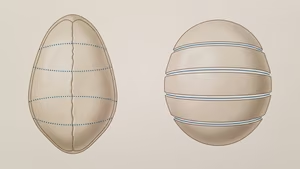

Hydrocephalus, often called water on the brain, is a build-up of cerebrospinal fluid, the clear liquid that cushions the brain, inside the ventricles, the fluid-filled spaces at the center of the brain. It happens when the fluid cannot drain or be absorbed as fast as it is made. It affects all ages, and the usual treatment is surgery.
What is hydrocephalus?
Hydrocephalus is too much cerebrospinal fluid inside the ventricles of the brain. The ventricles are connected spaces deep in the brain, and cerebrospinal fluid is the clear liquid made inside them that cushions the brain and carries waste away. It appears in newborns, in schoolchildren, in adults after an injury or an infection, and in people in their seventies.
The fluid is made all day, and it has to leave at the same rate. When the path out is blocked, or when the body cannot absorb the fluid back into the blood, it collects and the ventricles widen. That pressure pushes on brain tissue from the inside, and the pressure is what causes the symptoms.
This is not a rare problem. It is one of the most common brain disorders. A systematic review covering every World Health Organization region estimated that nearly 400,000 children develop hydrocephalus worldwide each year, and its authors called that figure likely an underestimate. It is an estimate based on models for children, not a hard statistic. No comparable estimate exists for adults.
Why is hydrocephalus called water on the brain?
Hydrocephalus is called water on the brain because fluid inside a baby’s head pushes the skull outwards, and families and old textbooks named what they saw. The fluid is not water. It is cerebrospinal fluid, which the brain makes and depends on, and it collects inside the brain’s own chambers, not on top of it.
In older children and adults the skull is a closed box, so the head cannot swell. The same build-up causes headache, vomiting, blurred vision or a change in alertness instead. A normal head size does not rule hydrocephalus out.
What a hydrocephalus diagnosis means for you or your child
A diagnosis of hydrocephalus means a problem with fluid drainage and pressure inside the head. It is not a statement about intelligence, character or what a person will achieve. It is treatable, and for many patients it is also a long-term condition.
The aim is to bring the pressure down and keep it down, which is why follow-up continues for years after an operation. Nobody can tell you the outcome for one person from the diagnosis alone. It depends on the cause, what else is going on in the brain, and how early the pressure was relieved. A neurosurgeon who has seen the scans can answer this for your case.
Seek care now
When should you see a doctor about hydrocephalus?
See a doctor as soon as the signs of rising pressure appear, and go to an emergency department if they come on quickly. What to watch for is different at every age, which is why the same disease is so often missed.
In a newborn or infant:
- A head growing faster than the rest of the body, or a cap that stops fitting
- A soft spot, the bumbunan, that is tense or bulging while the baby is calm
- Eyes that rest looking downward, so white shows above the colored part
- Repeated vomiting or unusual sleepiness
In an older child or adult:
- A new headache that is worse on waking or when lying flat
- Vomiting together with the headache
- Blurred or double vision
- Drowsiness, confusion, or a drop in school or work performance
In an older adult:
- An unsteady, shuffling walk, as if the feet were stuck to the floor
- Forgetfulness, slowed thinking, loss of interest in things
- Urgency, then loss of bladder control
Go to the nearest emergency room now, day or night, for any of these.
In a baby: a tense or bulging soft spot, eyes stuck looking downward, repeated vomiting or unusual sleepiness.
At any age: a sudden severe headache, repeated vomiting, a seizure, new drowsiness or confusion, or a person who cannot be woken properly.
Do not wait for the next clinic slot. Do not press or rub a bulging soft spot, and do not have a hilot treat it first; go to the emergency room.

If a sign came on slowly and none of the emergency signs above is present, book a consult within the week rather than waiting to see what happens. If anything gets worse while you wait, go to the emergency room. A soft spot that stays tense or bulging while the baby is calm and held upright is not something to book for later; take the baby to the nearest hospital emergency room now.
Book the consult with a neurosurgeon, or ask your own doctor to refer you. For the first neurosurgery appointment, bring the baby book with every head circumference measurement, and any previous scans on disc together with their reports. Bring a written list of when each sign started. Take a short phone video if the problem is the way someone walks.
What to do now
If you would like to see me
You may see me for hydrocephalus, at my clinic or online.
- I treat children with hydrocephalus at the Philippine Children’s Medical Center (PCMC). My clinic there is in Room 22, Quezon Avenue corner Agham Road, Diliman, Quezon City, on Wednesday from 2 PM.
- I see adults at the Lung Center of the Philippines, Room 1101, Quezon Avenue, Quezon City, on Tuesday and Thursday from 2 PM.
- If the trip to the clinic is not practical, book an online consult on the consultation page.
- Your own doctor can also refer you to me.
What to send when referring a patient with hydrocephalus
Send the imaging itself, not only the report. A referral that arrives with the images on disc, or with a link that opens, can be triaged the same day. One with a report alone usually cannot.
Include the history with dates, so the tempo of change is visible. For a child, include serial head circumference measurements plotted on the chart, not a single value. Include conscious level and pupils, and the eye findings: restricted upgaze, meaning the eyes do not turn upward, and fundoscopy if you have it. Include any shunt (a tube that drains fluid) already in place.
State plainly whether any of these are present in the medical history. Prematurity with intraventricular hemorrhage, meaning bleeding into the ventricles. Meningitis of any cause. Treated or suspected tuberculosis. Head injury. Previous brain surgery.
There were 134 neurosurgeons in the Philippines when the regional workforce was counted for a 2020 study, about one for every 807,000 people. That is why a complete first referral matters. The patient may be traveling a long way, and a second trip to collect a missing film costs weeks.
What causes hydrocephalus?
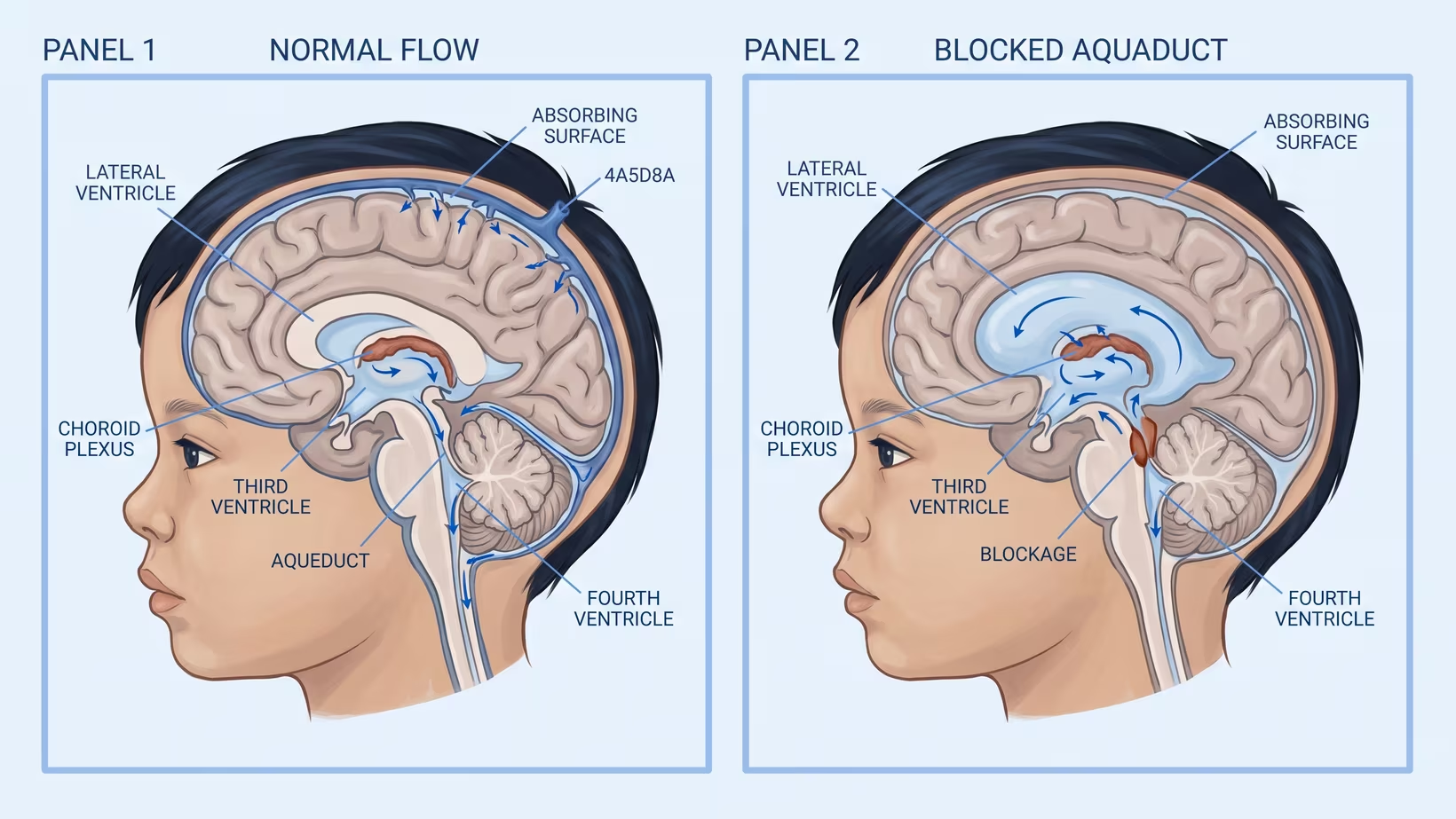
Hydrocephalus is caused by anything that interrupts the circulation of cerebrospinal fluid. The fluid is made continuously inside the ventricles, flows through a narrow channel system out to the surface of the brain, and is absorbed back into the bloodstream. Block that path, or damage the surfaces that absorb the fluid, and it accumulates behind the problem.
Some causes are present from birth. One is a narrowing of the aqueduct, the thin channel between the third and fourth ventricles, which is the tightest point on the whole route. Another is open spina bifida, where the spine and its coverings do not close during pregnancy, and hydrocephalus is expected alongside spina bifida. Other causes arrive later, after a bleed, an infection, an injury or a growth.
What is the main cause of hydrocephalus?
There is no single main cause of hydrocephalus. The answer depends on the patient’s age and on where they live. The same systematic review found that the African, Latin American and Southeast Asian regions together account for about three-quarters of new childhood cases worldwide.
In low- and middle-income countries, a larger share follows infection after birth and neural tube defects such as spina bifida. The review reports no breakdown for the Philippines. For one patient, the cause is found on the scan and in the history.
What are the types of hydrocephalus?
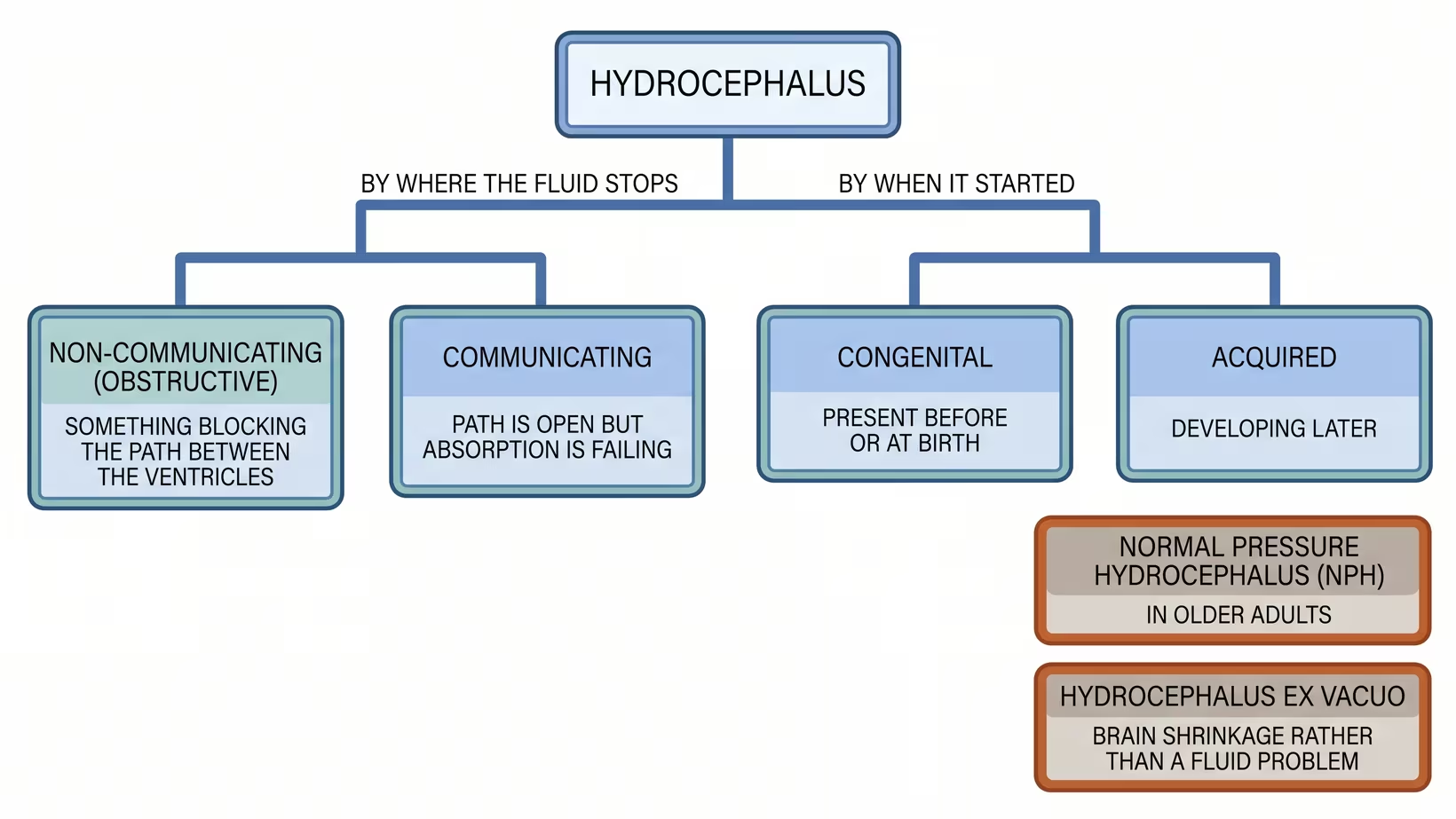
Hydrocephalus is sorted in two different ways, and both labels are used about the same patient. The first asks where the fluid stops: something blocks the path, or the path is open but the fluid is not absorbed. The second asks when the problem started: before birth, or later, after something happens to the brain.
By where the fluid stops:
- Non-communicating, also called obstructive: something physically blocks the path between the ventricles or out of them, so fluid cannot get past it.
- Communicating: the path is open, but the fluid is not being absorbed back into the blood fast enough.
By when it started:
- Congenital: present before or at birth.
- Acquired: it develops later, after something happens to the brain.
Normal pressure hydrocephalus is a slow-building form, usually of the communicating kind, in which the pressure can read as normal. When no cause is found, it is called idiopathic normal pressure hydrocephalus, meaning no known cause. It usually appears after the age of 60.
What is acquired hydrocephalus?
Acquired hydrocephalus is hydrocephalus that develops after birth, because of something that happened to the brain. The drainage was working, and then an illness, a bleed, an injury or a growth interfered with it. It can begin at any age. The name says nothing about how severe it is.
It can come on fast or slowly. Fluid that backs up over hours after a bleed is a surgical emergency. Fluid that accumulates over months may show only as a slow change in walking or concentration, which the family often notices before the patient does.
What causes acquired hydrocephalus?
Hydrocephalus that develops after birth is caused by anything that blocks the channels the fluid flows through, or damages the surfaces that absorb the fluid. The causes below are in no particular order. Reliable figures for how often adults develop hydrocephalus, and from which of these causes, do not exist in the published literature.
- A tumor pressing on or growing into the channels the fluid flows through, such as a meningioma sitting where fluid has to pass
- Bleeding in or around the brain, including bleeding into the ventricles of a premature baby
- Meningitis of any cause, including tuberculous meningitis, which leaves scarring behind
- A head injury
- Surgery or radiotherapy near the channels the fluid flows through
What is chronic hydrocephalus?
Chronic hydrocephalus is hydrocephalus that has built up slowly, over months or years, rather than over hours. Because it comes on slowly, the body adapts, and there may be no headache at all. The best known form is normal pressure hydrocephalus in older adults, where the pressure can look normal when it is measured once.
It causes three problems: trouble walking, slowed thinking and forgetfulness, and loss of bladder control. The walking problem is usually the first and most constant; not everyone has all three. These signs have to be told apart from dementia and from other causes of decline before anyone operates. This is one of the few causes of decline in an older person that can be treated.

What are the risk factors for hydrocephalus?
A risk factor raises the chance of hydrocephalus without directly causing it. They differ by age, and most people who carry one never develop hydrocephalus. They include spina bifida and very premature birth with a bleed inside the brain, and later in life meningitis, a head injury, a brain tumor or earlier brain surgery.
Before and around birth:
- A neural tube defect such as spina bifida. Folic acid taken before pregnancy and in early pregnancy lowers the risk of these defects. Ask your obstetrician or GP how much and for how long, because the amount is a prescribing decision.
- Being born very prematurely, especially with a severe bleed inside the brain. Some of those babies go on to have widening ventricles, and some of them need a shunt.
- A family history of a neural tube defect.
The folic acid trial measured neural tube defects rather than hydrocephalus, in women who had already had an affected pregnancy.
What are the complications of untreated hydrocephalus?
Untreated hydrocephalus can let the pressure keep rising, and the pressure is what does the damage. It can injure the optic nerves and permanently affect vision, it can hold back a child’s development and learning, and in severe cases it is fatal.
There is no timeline to give you. Act on the emergency signs above now, and book a consult within the week for slow ones. How quickly it matters depends on the cause, on the age of the patient, and on whether the build-up is sudden or slow. Nearly all the complications come from pressure, and surgery can lower pressure.
How is hydrocephalus diagnosed and treated?
Hydrocephalus is diagnosed with an examination and a picture of the brain, and treated with surgery. In a baby, the head circumference is measured and plotted over time. A CT scan or an MRI shows the ventricles at any age, and usually shows what is blocking them.
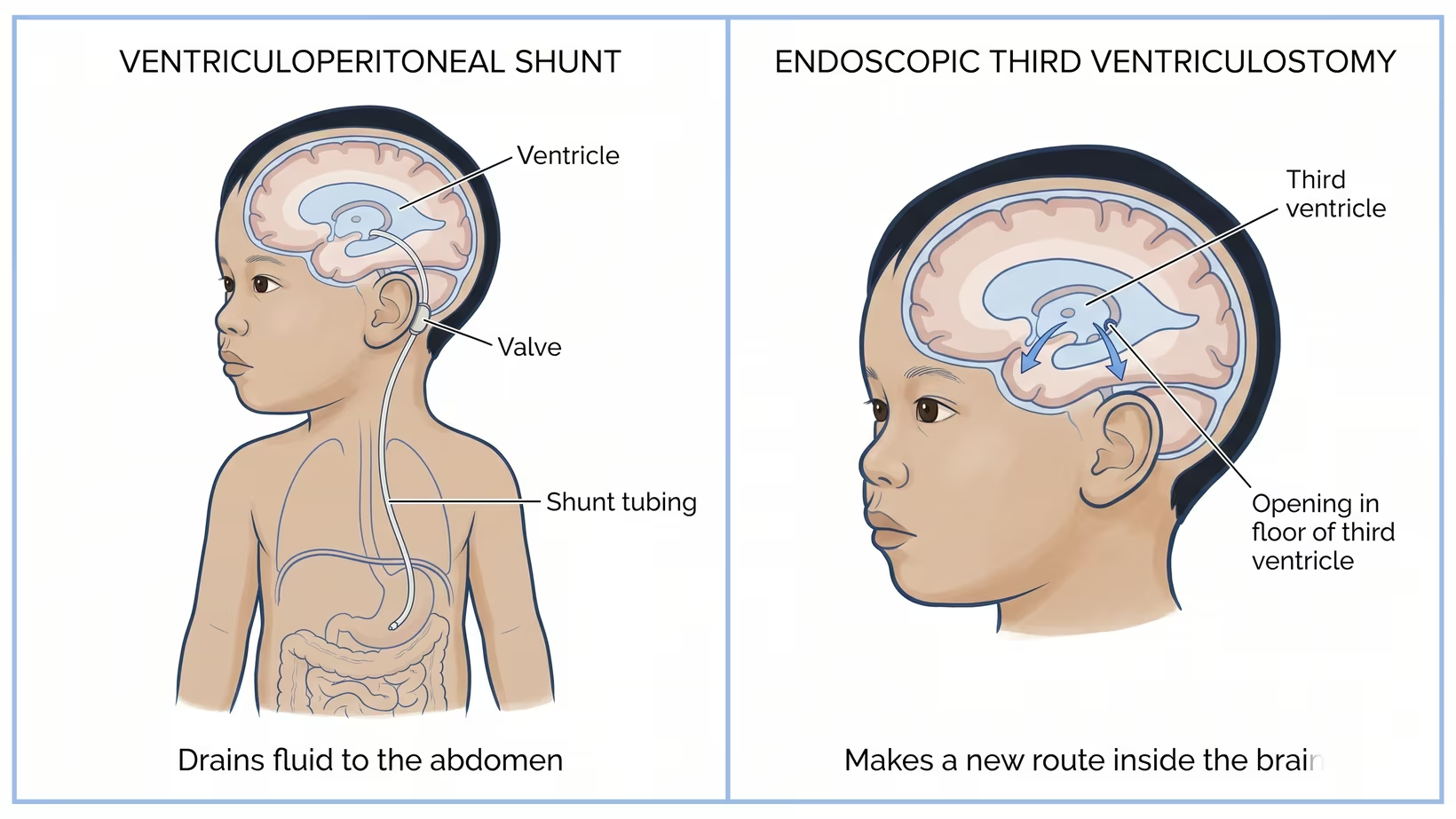
An ultrasound through the open soft spot can see the ventricles in a young infant without radiation. There are two main operations. A ventriculoperitoneal shunt is a thin tube with a valve that drains fluid under the skin to the abdomen, where it is absorbed. An endoscopic third ventriculostomy makes a small opening in the floor of the third ventricle, so fluid bypasses the blockage with no tube left behind. The surgeon chooses after reading the scans, and neither operation is a cure; both need follow-up.
How doctors define hydrocephalus
Doctors define hydrocephalus as an active disturbance of cerebrospinal fluid flow, with fluid accumulating in a way that harms the brain. Wide ventricles on a scan are not enough to make the diagnosis. Ventriculomegaly means the ventricles measure large, and that has two quite different causes.
One is hydrocephalus, where fluid is accumulating and pressing outwards. The other is atrophy, meaning brain tissue has shrunk with age or disease and left the ventricles wide. That is called hydrocephalus ex vacuo, meaning the ventricles are wide because tissue has shrunk. If an older person has wide ventricles on a scan and also has new trouble walking, thinking or holding urine, book a consult with a neurosurgeon within the week to review the scan with those changes in mind.
Frequently asked questions
Can hydrocephalus be cured? Hydrocephalus is often controlled rather than cured: the fluid is diverted and the pressure kept down, which can hold for many years. In some patients, for example when a tumor blocking the flow is removed, the hydrocephalus settles and no permanent drain is needed.
Does hydrocephalus always need surgery? Surgery is the main treatment for hydrocephalus, and no medicine reliably replaces it. A patient with stable findings and no symptoms may instead be watched with repeat imaging, and that decision belongs to the neurosurgeon who has seen the scans.
Can an adult develop hydrocephalus with no injury and no illness before it? Yes, an adult can develop hydrocephalus with no cause found. Idiopathic normal pressure hydrocephalus in older adults is exactly that, which is why guidelines keep it as a category of its own. It usually appears after the age of 60, and trouble walking is usually the first problem.
Is hydrocephalus hereditary? Hydrocephalus is usually not hereditary. A small number of cases run in families. The best known is an inherited form that passes through mothers to their sons, and neural tube defects such as spina bifida can also recur in families. Mention any family history at the first consult.
Will a child with hydrocephalus develop normally? A child’s development with hydrocephalus depends on the cause, on what else in the brain is affected, and on how early the pressure was relieved. Ask for development to be followed formally at each visit, so that a delay is found early.
Can hydrocephalus come back after it has been treated? Yes, hydrocephalus can return when the drainage fails again. A shunt can block, disconnect or stop working, and an opening made endoscopically can close. In anyone who has had either operation, returning headache, vomiting, sleepiness or a change in behavior means going to the nearest emergency room now, and telling the staff about the shunt or the operation. This is why follow-up continues for years after an operation.
Is hydrocephalus the same as a brain tumor? No, hydrocephalus and a brain tumor are different problems, but they meet often. A tumor sitting in the channels the fluid flows through is one cause of hydrocephalus, and the hydrocephalus is sometimes the reason the tumor is found. In some patients, removing the tumor lets the hydrocephalus settle, and no permanent drain is needed.
See sources
- Dewan MC, Rattani A, Mekary R, et al. Global hydrocephalus epidemiology and incidence: systematic review and meta-analysis. Journal of Neurosurgery. 2018. PMID 29701543. https://doi.org/10.3171/2017.10.JNS17439
- Halperin JJ, Kurlan R, Schwalb JM, et al; American Academy of Neurology. Practice guideline: idiopathic normal pressure hydrocephalus, response to shunting and predictors of response. Neurology. 2015. PMID 26644048. https://doi.org/10.1212/WNL.0000000000002193
- Nakajima M, Yamada S, Miyajima M, et al; Japanese Society of Normal Pressure Hydrocephalus. Guidelines for management of idiopathic normal pressure hydrocephalus, third edition. Neurologia medico-chirurgica. 2021. PMID 33455998. https://doi.org/10.2176/nmc.st.2020-0292
- Adzick NS, Thom EA, Spong CY, et al; MOMS Investigators. A randomized trial of prenatal versus postnatal repair of myelomeningocele. New England Journal of Medicine. 2011. PMID 21306277. https://doi.org/10.1056/NEJMoa1014379
- MRC Vitamin Study Research Group. Prevention of neural tube defects: results of the Medical Research Council Vitamin Study. The Lancet. 1991. PMID 1677062. https://pubmed.ncbi.nlm.nih.gov/1677062/
- de Vries LS, Groenendaal F, Liem KD, et al. Treatment thresholds for intervention in posthaemorrhagic ventricular dilation: a randomised controlled trial (ELVIS). Archives of Disease in Childhood, Fetal and Neonatal Edition. 2018. PMID 29440132. https://doi.org/10.1136/archdischild-2017-314206
- Kulkarni AV, Schiff SJ, Mbabazi-Kabachelor E, et al. Endoscopic treatment versus shunting for infant hydrocephalus in Uganda. New England Journal of Medicine. 2017. PMID 29262276. https://doi.org/10.1056/NEJMoa1707568
- Ferraris KP, Matsumura H, Wardhana DPW, et al. The state of neurosurgical training and education in East Asia: analysis and strategy development for this frontier of the world. Neurosurgical Focus. 2020. PMID 32114563. https://doi.org/10.3171/2019.12.FOCUS19814