

Heavy drinking causes a subdural hematoma in three ways. First, it shrinks the brain, so the small veins crossing to the skull are stretched and tear easily. Second, drunk patients have falls that tear them. And Third, it lowers the platelets that would otherwise plug a small tear before it grows.
Why Do Heavy Drinkers Bleed in the Brain?
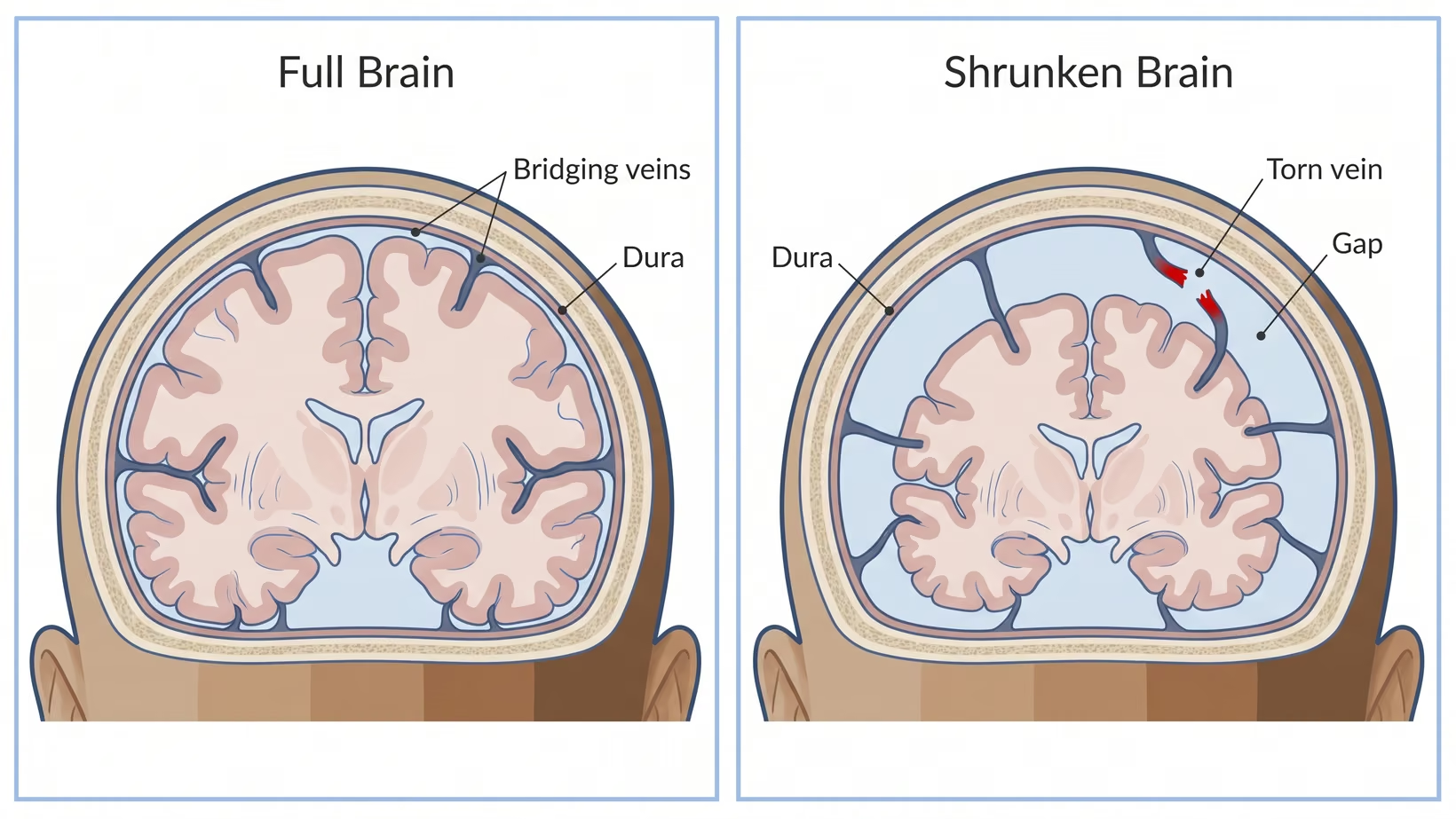
A subdural hematoma is blood collecting between the brain and its outer covering, and it starts when small veins crossing that space tear. Heavy drinking makes those veins easier to tear, makes the tearing more likely to happen, and makes the bleeding harder to stop.
This section is the first of those three: why the veins tear so easily.
What the Bridging Veins Are, and Why Drinking Stretches Them
Bridging veins are the small veins that run from the surface of the brain across a gap to the covering just under the skull. A chronic subdural hematoma is caused by rupture of those bridging veins, and the recognised risk factors for it include minor head injury, shrinkage of the brain, blood-thinning medicines and heavy alcohol use.
The gap is what matters. When the brain loses volume that gap widens, so the same veins have to stretch further to cross it, and cortical shrinkage stretching the bridging veins is what raises the chance they rupture after a head injury. In one review of patients treated for this condition, shrinkage of the brain was the largest single risk factor present, found in more than nine in ten of them.
Sustained heavy drinking is one of the causes of that shrinkage. Widespread brain shrinkage in people who are alcohol dependent has been consistently documented on both pathology and MRI studies. So the drinking does not cause the bleed directly. It builds the condition in which an ordinary bump on the head produces one. The bleed it sets up is usually the slow kind, and our main page explains what a chronic subdural hematoma is and why it takes weeks to show.
What the Numbers Actually Show
How much heavy drinking adds to the risk was measured most clearly in Denmark, where a national study followed 2.4 million people over the age of 50. Among those with no head injury recorded at any hospital, a history of alcohol addiction carried roughly three times the risk of needing surgery for a chronic subdural hematoma in the 50 to 64 age group, about twice the risk from 65 to 74, and a smaller but still raised risk from 75 to 84.
Read that age pattern carefully, because it is the opposite of what most people assume. The association was strongest in the youngest group and weakened with age. This is not only an old man’s problem. In the same study, chronic liver disease carried an even higher risk in the 50 to 64 group.
Those are Danish figures and Danish drinking patterns, not Filipino ones, and no Philippine series on alcohol-related subdural bleeding was found in the published literature. What we do have locally is the drinking itself. The World Health Organization country profile for the Philippines recorded that about 22 in 100 Filipino men aged 15 and over (21.7 percent), and about 48 in 100 Filipino men who drink at all (47.9 percent), had at least one heavy drinking occasion in the previous month.
How Do Falls While Drunk Cause a Bleed You Do Not Remember?
Because the fall is usually minor, and because the bleed then takes weeks to grow large enough to cause symptoms. By the time you feel unwell, the night you hit your head is far behind you, and you may not have thought it mattered at the time. This is the second of the three ways: the bump that tears the stretched vein.
The Fall You Do Not Count as a Fall
Alcohol addiction is a well-recognised risk factor for injury during intoxication, and head injury is the part of that which matters here. In a United States study of emergency department visits for falls on stairs, traumatic brain injury was close to three times as common among patients who arrived intoxicated as among those who were not.
The falls that cause this are rarely dramatic. A slip going into the bathroom at night. Catching the door frame with your temple. Sitting down harder than you meant to and knocking your head on the wall. Nobody writes those down, and nobody mentions them at a consult a month later.
Why Nothing Happens for Weeks
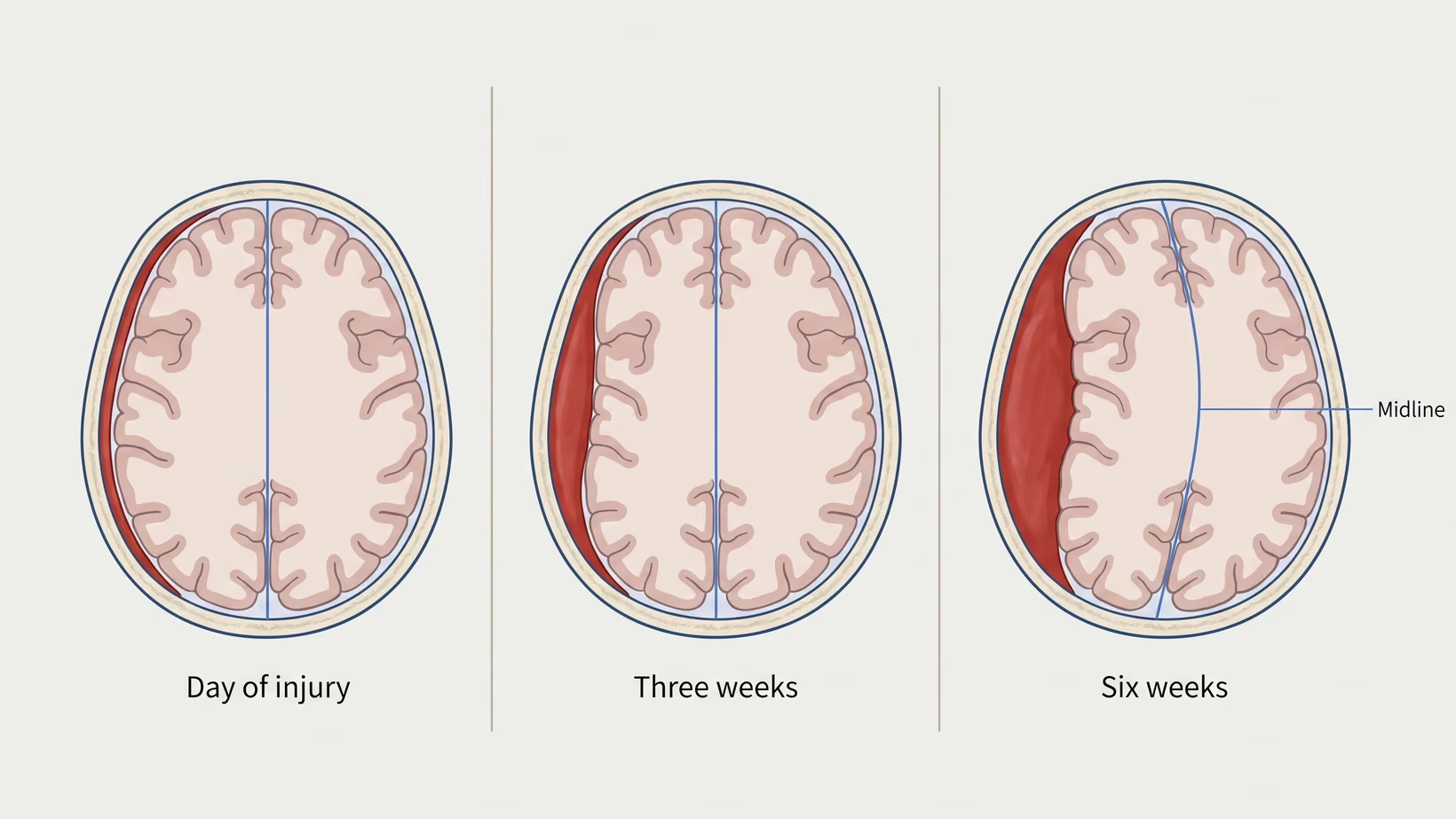
A chronic subdural hematoma becomes symptomatic weeks to months after the head injury, not on the day. Its course is usually described in three stages: the injury, a latent period in which nothing is felt, and only then the period when symptoms appear. That slow course is what sets it apart from the acute bleed that shows itself within hours.
That delay is why so many patients cannot recall any head injury at all. It is also why the Danish study found most cases surfacing within about 90 days of a recorded head injury, after which the rate of new cases flattened off.
Most of these bleeds are found within three months of the bump, but mention any bump to the doctor, however long ago, and the signs below need attention whenever the bump was. The symptoms that arrive weeks after you hit your head have their own page. The ones that cannot wait are below.
Seek care now
Which Signs Mean the Emergency Room Now?
Go to the nearest emergency room now for any of these:
- A headache that keeps getting worse over hours or days, or one that wakes you from sleep
- Repeated vomiting
- Weakness, numbness or clumsiness down one side of the body
- Slurred speech, or trouble finding words
- New confusion, or becoming difficult to rouse
- A seizure
- One pupil larger than the other
Be seen within a day, at a neurosurgeon’s clinic or any emergency room with a CT scanner, without waiting for it to pass, for any of these:
- A bump on the head in the last three months, even a minor one, followed by not feeling right since
- Memory or personality changes that the people around you have noticed
- Unsteadiness on your feet that is new, or falling more often than you used to
- A persistent headache that is not like your usual one
The trap on this topic is worth naming plainly. In someone who drinks heavily, confusion, unsteadiness and slowed speech are assumed by everyone, including the patient, to be the drinking. A subdural hematoma produces exactly those signs. If the people around you say you seem different, that is information, not an insult. The same slow change is also easy to mistake for dementia, and our page on how a subdural hematoma is told apart from dementia explains the difference.
Who to see: a neurosurgeon, or any emergency room with a CT scanner. If you would like me to be the one to check you, I see adults with this problem at my clinic at the Lung Center of the Philippines.
What to bring: the names of every medicine you take, especially anything for the heart or for thinning the blood, and a full account of how much you drink and when you last drank. What to expect: a plain CT scan of the head, which takes minutes and answers the question.
What Does the Liver Have to Do With Clotting?
The liver makes most of the proteins that let blood clot, and heavy drinking damages both the liver and the bone marrow that makes platelets. With too few platelets, a small tear is slower to plug. This is the third of the three ways: once a vein tears, the bleeding is harder to stop. What a scarred liver does to clotting is less simple than thinning the blood, and the next two sections are why.
What Alcohol Does to Platelets
Platelets are the cell fragments that plug a small tear first, before any clotting protein arrives. Alcohol suppresses the normal production of blood cells in the marrow, which lowers the white cells, the red cells and the platelets together. Low platelet counts turn up often in heavy drinkers whose blood counts are investigated, which is one of the reasons a complete blood count, the CBC, is taken early.
What a Scarred Liver Does to the Clotting Proteins
In cirrhosis, a scarred liver, the platelet count falls and the levels of several clotting proteins fall with it. That much is the part most people have heard, usually in the form of the idea that alcohol thins the blood.
Why a Normal Clotting Test Is Not a Clean Bill of Health
The full picture is different, and it matters when you read your own results. In cirrhosis the anticlotting proteins fall at the same time as the clotting ones, so the system settles into a balance rather than simply tipping toward bleeding. It is now widely accepted that clotting in cirrhosis stays balanced because the pro-clotting and anti-clotting systems change together.
The practical consequence is that the routine tests are a poor guide on their own. The standard clotting test and the platelet count do not measure the anticlotting side at all, so they overestimate the risk of bleeding, and treating on the strength of them alone can cause clots instead. Ang ibig sabihin po nito, hindi sapat ang isang normal na resulta para sabihing walang problema, at hindi rin awtomatikong delikado ang abnormal.
Show any result to a doctor, who decides what it means for you. No team decides anything from one number.
Should You Stop Drinking Before Surgery?
If the operation can wait, yes, with a doctor’s help to stop safely, because stopping suddenly on your own can bring on withdrawal. The effect of stopping is measurable. Risky drinking is linked to more complications after surgery of any kind, including infections, heart and lung problems and bleeding. Not every collection needs an operation, and when a subdural hematoma is watched instead of drained has its own page.
What Stopping Before an Operation Is Shown to Do
A Cochrane review pooled the randomised trials of intensive programmes to stop drinking before an operation. Across three trials, complications needing treatment occurred in 20 of 61 patients in the programmes against 33 of 61 in the comparison groups. The reviewers concluded that intensive programmes running four to eight weeks and aimed at complete cessation before surgery probably reduce the number of complications afterwards.
Two caveats belong with that. The trials were few and small, so the size of the benefit is not settled, and all three were done in Denmark. The direction is the useful part.
What to Do If the Operation Cannot Wait
Often it cannot, and that is not a failure. Do not delay coming in, and do not try to manage the stopping on your own; the team will do that. Tell the team instead, exactly and without rounding down, how much you drink and when you last drank. Stopping suddenly without cover is what brings on withdrawal, and the team can prevent that far more safely than you can. The next section is how.
What Happens With Withdrawal in the Hospital?
The team expects it and plans around it, which is the whole reason they ask. Alcohol withdrawal in hospital is prevented rather than waited for, and patients judged to be at risk are given medicine before symptoms start rather than after.
Why the Team Asks How Much You Drink
Because the answer changes what they do, before anything else happens. The strongest predictors of a severe withdrawal are a high blood alcohol level on arrival, a previous episode of withdrawal, and loss of control over drinking, and checking for those is meant to be part of the emergency check and the pre-operative check, which means the check before an operation.
There is a second reason, specific to an operation. A general anesthetic can mask the beginning of withdrawal, so the hours when the first signs would ordinarily appear are the hours you are asleep. The team needs to know beforehand, because afterwards the first sign is easy to miss.
What They Give You So Withdrawal Does Not Start
There are medicines that hold the nervous system steady while the alcohol leaves it, given according to the symptoms you actually have and adjusted as they change. Managing withdrawal that way, by symptom and by protocol, shortens the hospital stay and reduces complications compared with reacting late.
Vitamin B1, also called thiamine, is given to anyone who is alcohol dependent and undernourished, and it is given early. It is not optional and it is not a tonic. Hindi po kayo ang unang pasyenteng dumaan dito, at hindi po ito ginagawa para husgahan kayo. It is done because it works better than the alternative.
Frequently Asked Questions
Can a Subdural Hematoma Happen Without Any Fall at All?
It can appear with no head injury that anyone recorded or remembered, which is exactly the group the Danish study set out to examine. Whether that means no injury occurred, or only that a minor one went unrecorded, is still argued.
Does Stopping Drinking Make the Bleed Go Away?
No. A collection that is already there is managed on its own terms, most often by draining it through a small opening in the skull, and stopping drinking does not substitute for that. What stopping does is lower the chance of the next one and improve how you come through the treatment of this one.
Will It Come Back If I Drink Again?
The evidence is mixed. Somewhere between one in ten and one in five of these collections recur after surgery, and while some series list drinking habits among the factors linked to recurrence, at least one found no significant relation to known alcohol misuse. What is better established is that alcohol misuse is linked to more deaths over the long term after a chronic subdural hematoma.
Is It Still Worth Cutting Down If the Damage Is Already Done?
Yes, and there is a specific reason beyond the general one. Some of the lost brain volume returns during sustained abstinence, which is one of the few findings in this area that points the right way.
Bring and ask
What to Bring and What to Ask
Bring to the consult:
- Every medicine you take, in the box, including anything bought over the counter
- Any previous CT or MRI scan of the head, the images themselves and not only the report
- A short written note of when you last hit your head, even if you are unsure of the date
- An accurate figure for how much you drink in a week, and when you last drank
- Someone who sees you daily, because they will have noticed changes you cannot
Ask the doctor:
- Is this an acute bleed or a chronic collection, and does that change the timing
- Does it need draining now, or can it be watched with a repeat scan
- What is the case rate for this admission, what does PhilHealth cover, and what is out of pocket
- What will you give me so that withdrawal does not start while I am admitted
- What am I watching for at home, and at what point do I come straight back
What to do now
What to Do Now
If you have had any bump on the head in the last three months and you have not felt right since, see a neurosurgeon or go to an emergency room with a CT scanner within a day, and go now if any of the emergency signs above appear. The CT scan is quick, it is widely available, and it shows whether a collection of blood is present. Do not wait for the headache to settle on its own.
At kung kayo po ang asawa, anak o kapatid na nagbabasa nito para sa kanya: hindi po kailangang maayos muna ang pag-inom bago siya magpatingin. The bleed is dealt with first. The drinking is a separate conversation, and it goes better after the scan, not before it.
If you would like to see me about this:
- At my clinic: Lung Center of the Philippines, Room 1101, Quezon Avenue, Quezon City, on Tuesday and Thursday from 2 PM
- Online, if you live too far to come in and have none of the signs above: book a time on the consultation page. An online consult does not replace a CT scan; if you have any of the signs, go to an emergency room first.
- Or ask your own doctor to refer you to me
See sources
- Muehl-Benninghaus R. Middle meningeal artery embolization for treatment of chronic subdural hematoma. Radiologie, 2022. PMID 36194287. DOI 10.1007/s00117-022-01074-8
- Jensen TSR, Thiesson EM, Fugleholm K, Wohlfahrt J, Munch TN. Inflammatory risk factors for chronic subdural hematoma in a nationwide cohort. Journal of Inflammation Research, 2024. PMID 39525314. DOI 10.2147/JIR.S472849
- Marshman LAG, Manickam A, Carter D. Risk factors for chronic subdural haematoma formation do not account for the established male bias. Clinical Neurology and Neurosurgery, 2015. PMID 25643694. DOI 10.1016/j.clineuro.2015.01.009
- Zou X, Durazzo TC, Meyerhoff DJ. Regional brain volume changes in alcohol-dependent individuals during short-term and long-term abstinence. Alcoholism: Clinical and Experimental Research, 2018. PMID 29672876. DOI 10.1111/acer.13757
- World Health Organization. Global status report on alcohol and health 2018: Philippines country profile. https://cdn.who.int/media/docs/default-source/country-profiles/substances-abuse/phl.pdf
- Hammig B, Haldeman S. Stair-related falls in the USA: traumatic brain injury and the role of alcohol intoxication. Journal of Epidemiology and Community Health, 2022. PMID 36328421. DOI 10.1136/jech-2022-219396
- Yang W, Huang J. Chronic subdural hematoma: epidemiology and natural history. Neurosurgery Clinics of North America, 2017. PMID 28325454. DOI 10.1016/j.nec.2016.11.002
- Smith C, Gasparetto M, Jordan C, Pollyea DA, Vasiliou V. The effects of alcohol and aldehyde dehydrogenases on disorders of hematopoiesis. Advances in Experimental Medicine and Biology, 2015. PMID 25427917. DOI 10.1007/978-3-319-09614-8_20
- Latvala J, Parkkila S, Niemelae O. Excess alcohol consumption is common in patients with cytopenia: studies in blood and bone marrow cells. Alcoholism: Clinical and Experimental Research, 2004. PMID 15100613. DOI 10.1097/01.alc.0000122766.54544.3b
- Lisman T, Caldwell SH, Intagliata NM. Haemostatic alterations and management of haemostasis in patients with cirrhosis. Journal of Hepatology, 2022. PMID 35589251. DOI 10.1016/j.jhep.2021.11.004
- Singh AD, Mucha SR, Lindenmeyer CC. Cirrhotic coagulopathy: a rebalanced hemostasis. Cleveland Clinic Journal of Medicine, 2022. PMID 37907441. DOI 10.3949/ccjm.89a.21018
- Egholm JWM, Pedersen B, Moller AM, Adami J, Juhl CB, Tonnesen H. Perioperative alcohol cessation intervention for postoperative complications. Cochrane Database of Systematic Reviews, 2018. PMID 30408162. DOI 10.1002/14651858.CD008343.pub3
- Ungur AL, Neumann T, Borchers F, Spies C. Perioperative management of alcohol withdrawal syndrome. Visceral Medicine, 2020. PMID 32775345. DOI 10.1159/000507595
- Feghali J, Yang W, Huang J. Updates in chronic subdural hematoma: epidemiology, etiology, pathogenesis, treatment, and outcome. World Neurosurgery, 2020. PMID 32593768. DOI 10.1016/j.wneu.2020.06.140
- Honda M, Maeda H. Intraoperative hematoma volume can predict chronic subdural hematoma recurrence. Surgical Neurology International, 2021. PMID 34221563. DOI 10.25259/SNI_97_2021
- Zawy Alsofy S, Lewitz M, Meyer K, Fortmann T, Wilbers E, Nakamura M, Ewelt C. Retrospective analysis of risk factors for recurrence of chronic subdural haematoma after surgery. Journal of Clinical Medicine, 2024. PMID 38337502. DOI 10.3390/jcm13030805
- Rauhala M, Helen P, Seppa K, Huhtala H, Iverson GL, Niskakangas T, Ohman J, Luoto TM. Long-term excess mortality after chronic subdural hematoma. Acta Neurochirurgica, 2020. PMID 32146525. DOI 10.1007/s00701-020-04278-w