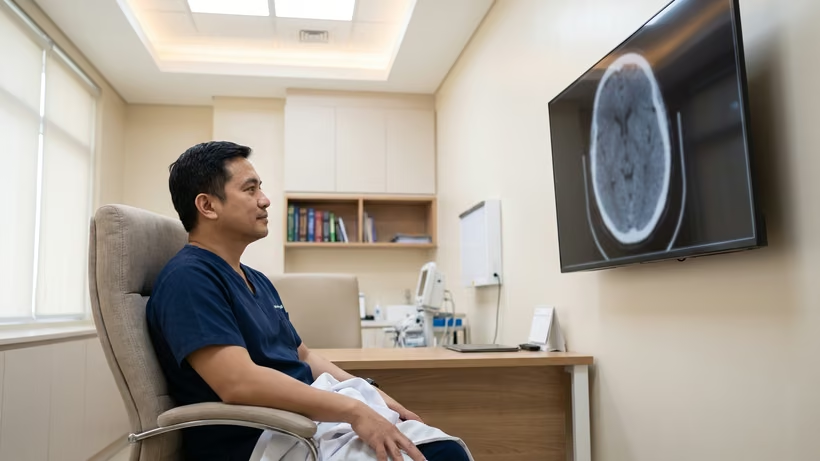

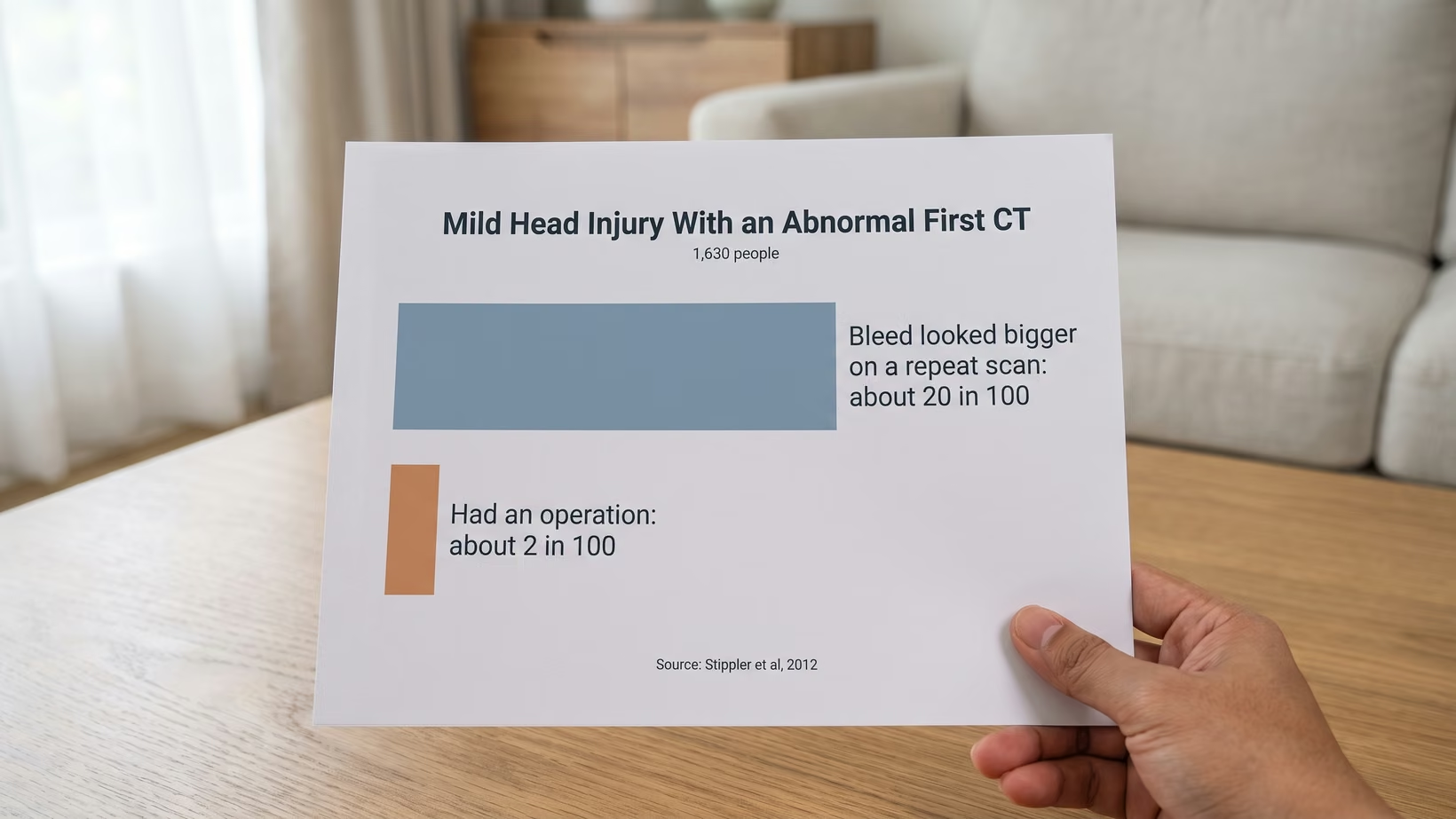
A small brain bleed after a head injury usually does not need an operation. Of 1,630 people with a mild head injury whose first scan showed a problem, about 2 in 100 had surgery. Go to the emergency room now for a worsening headache, vomiting, drowsiness, confusion, weakness or a seizure.
What Counts as a Small Brain Bleed After a Head Injury?
A small brain bleed is a little blood in or around the brain, found on a CT scan (a head scan that uses X-rays) after a head injury. The NICE guideline from the United Kingdom, used through this page, gives no size that makes a bleed “small”. Your doctor judges it from the scan, how awake you are and how you feel.
A head injury can cause blood clots in or around the brain, or swelling of the brain. Doctors score how awake you are on the Glasgow Coma Scale, which runs from 3 to 15. A score of 15 means you respond normally. A score of 13 to 15 is called a mild head injury.
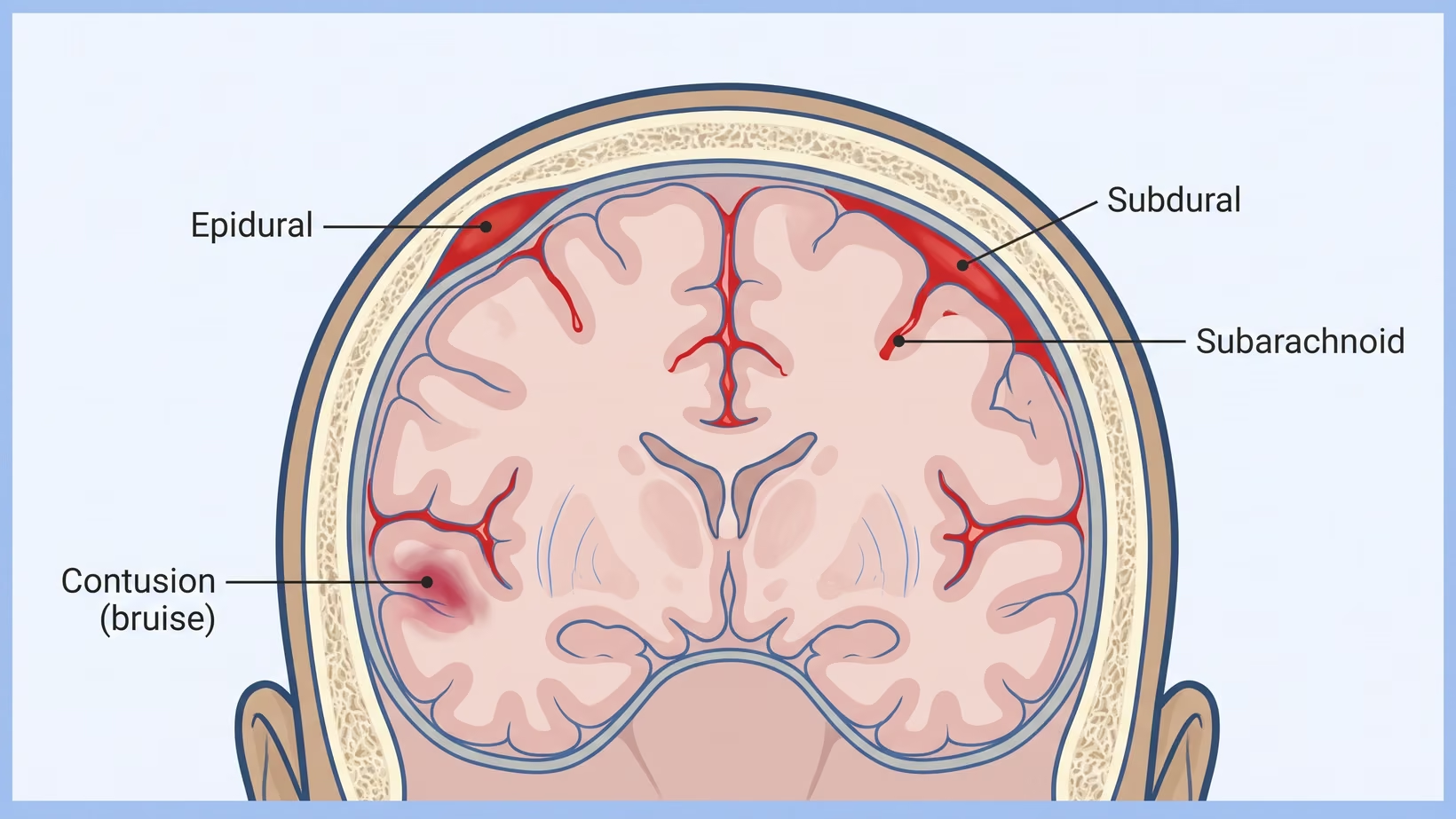
Your CT report may name where the blood sits. Epidural means blood between the skull and the brain’s tough covering, the dura. Subdural means blood under the dura. Subarachnoid means blood in the fluid spaces on the brain’s surface. A contusion is a bruise in the brain itself. These are the main types of brain bleed after a head injury.
Keep the report and bring it to every visit. Knowing how to read the words on your CT scan report helps you ask your doctor clear questions.
They Found a Small Bleed and Sent Us Home: Is That Safe?
Whether it is safe to go home with a small bleed is decided by the treating team. They look at the scan, your examination and who is at home to watch you. If you were sent home and are unsure why, it is fair to ask the doctor what the plan is.
The NICE guideline lists a new, important finding on the scan among its reasons to admit someone after a head injury. It does not say how big a bleed must be to count. It also advises that anyone with a scan finding that may need surgery be discussed with a neurosurgeon, a brain and spine surgeon.
The same guideline lets admitted patients go home once their important symptoms and signs have settled, if someone suitable can watch them at home. A person with no carer at home goes home only when supervision has been arranged. The other case is when doctors judge the risk of late problems to be so small it can be ignored.
Before you leave, ask:
- Did a neurosurgeon see my scan?
- Do I need a repeat scan?
- When is my check-up, and with whom?
- Which of my medicines should I ask about?
Who Is Watched in Hospital and Who Goes Home
Small bleeds are watched in hospital when other risks come with them. The scan is one part of the decision. How awake you are, your symptoms and your medicines are the other parts.
Under NICE, a person whose Glasgow Coma Scale score has not returned to 15, or to its level before the injury, is admitted whatever the scan shows. So is someone with worrying symptoms, such as persistent vomiting, severe headaches or seizures.
A Scandinavian guideline suggests admission for observation, whatever the CT shows, for some adults. These include a score of 13 or less, a seizure after the injury, signs of certain skull fractures, or a new weakness or other nerve problem. It calls this a weak suggestion based on low-quality evidence.
Seek care now
When to Go Back to the Emergency Room
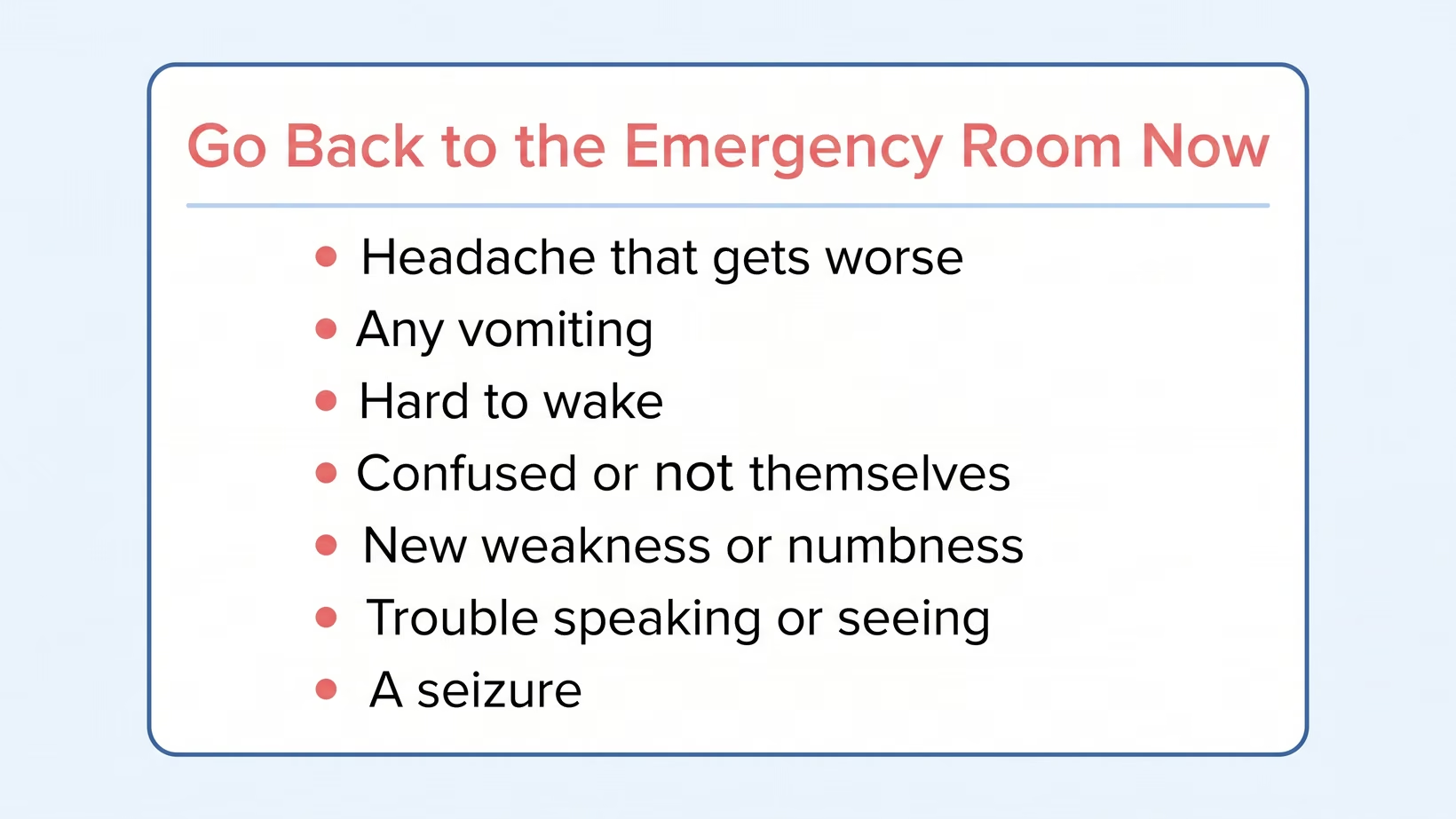
Go back to the nearest emergency room now, with someone else driving, if any of these signs appears after a head injury with a small bleed. Do not wait for your check-up date, and do not wait to see if it passes.
- A headache that will not go away, or one that gets worse
- Any vomiting
- Being very sleepy, hard to wake, or unable to keep the eyes open
- Confusion, agitation, or not acting like yourself
- Fainting, even for a moment
- New weakness or numbness of the face, an arm or a leg
- Trouble speaking, understanding, seeing, walking or keeping your balance
- Memory loss for events since the injury
- A seizure (fit)
The First 24 Hours at Home
A responsible adult should stay with you for the first 24 hours after the injury, under the NICE guideline. That person watches for the signs in the box and takes you back if one appears. Keep the hospital’s contact numbers where they can find them.
The guideline also says some people seem to recover quickly but later have problems or complications. So someone can feel fine after a head injury and then get worse, and a good first evening does not end the watching.
When Does a Small Bleed Still Need Watching?
A small bleed needs closer watching when the scan or the person points to a higher chance of getting worse. A review of 37 studies looked at 17,857 adults with a mild head injury who had a repeat scan in hospital. Three findings on the scan were linked to a higher chance of getting worse.
- A bleed bigger than 10 ml, about two teaspoons of blood
- More than one bleed or bruise
- A contusion in the temporal lobe, the side of the brain above the ear
These findings went together with getting worse. The review does not show that they cause it. It also included people with no bleed on their first scan.
Watching continues whenever the person changes. NICE asks hospital doctors to check a patient again urgently for agitation, unusual behavior, a severe or increasing headache, or persistent vomiting. New weakness of one side or pupils of unequal size are on the same list. If a change is confirmed, the guideline says to consider a CT scan straight away.
Blood Thinners and a Small Bleed
If you take a blood thinner (anticoagulant), tell every doctor who sees you after the head injury. A Scandinavian guideline suggests that adults on an anticoagulant, or with a bleeding disorder, be admitted for observation after a head injury, whatever the CT shows. It calls this a weak suggestion based on low-quality evidence.
Do not stop or restart a blood thinner on your own. That decision belongs to the doctor who prescribed it and to the neurosurgeon, so ask them both before you leave the hospital, or today if you are already home.
Do You Need a Repeat Scan for a Small Bleed?
A repeat CT scan for a small bleed is recommended when you get worse. A Scandinavian guideline recommends one when your alertness or nerve function worsens, or your coma scale score drops by 2 points or more. Most of the evidence it reviewed found routine repeat scans unnecessary in people who are not getting worse.
The figures come from a review of 19 studies. It included 1,630 people with a mild head injury and an abnormal first CT scan. On a routine repeat scan, the bleed looked bigger in about 20 in 100 people (19.9 percent). Only 39 people, about 2 in 100, had an operation.
A bigger bleed on the scan is a different thing from needing surgery. Routine repeat scans did not predict who needed surgery. Scans done because a person had become worse did.
A larger review of 37 studies found operations in about 3 in 100 patients. That was the same whether repeat scans were routine or done only when needed.
The Scandinavian group could not agree about follow-up scans for people on a blood thinner or with lasting nerve problems. When to repeat your scan is for the doctor who saw your first scan to decide.
Headache After a Small Brain Bleed: What Is Normal?
A headache after a small brain bleed is common, and for some people it lasts a long time. A headache that is severe, keeps getting worse or will not go away needs the emergency room now. So does a headache with vomiting. If you cannot tell whether a headache is the common kind or a warning sign, go to the emergency room now. Ask the doctor before you leave what kind of headache to expect.
NICE lists headache among the symptoms of post-concussion syndrome, the group of complaints that can follow a head injury. Others are dizziness, nausea, tiredness, trouble concentrating and irritability. The guideline says this syndrome is seen after head injuries of every severity, and is often missed after mild ones.
A review of 12 studies counted 1,670 people with a brain injury of any severity. Of them, 966 had a long-lasting headache, about 58 in 100. Among civilians, about 75 in 100 people with a mild brain injury reported long-lasting pain of any kind. After a moderate or severe injury, the figure was about 32 in 100.
These studies were not limited to people with a bleed on the scan. They also do not say how long the headache lasts or what treats it.
Which medicine to take for the headache is your doctor’s choice. Ask before you leave, and name every medicine you already take.
Going Back to Work With a Small Brain Bleed
Most adults are back at work within six months of a mild head injury. The right day for you is one to agree with your doctor. NICE says the advice you get at discharge should cover returning to work, sports and driving. Ask about your own job before you leave the hospital.
In a review of adults with a mild head injury, about 56 in 100 were back at work after one month. About 83 in 100 were back by six months, and about 89 in 100 by twelve months. Average times back to work ranged from 13 to 93 days across the studies.
The authors note that most of those studies had weaknesses in their design. The figures are for mild head injury in general, not only for people with a bleed on the scan.
An international review found early signs that some things go together with a later return to work. These were less than 11 years of schooling, nausea or vomiting on admission, and injuries elsewhere in the body. Severe head or body pain early on, and a job with little say over how the work is done, were also linked. The authors call this evidence preliminary.
If your work is heavy, at heights or involves driving, ask your doctor about it by name. For problems that last, NICE says to consider a referral to a clinician trained in brain injury, such as a neurologist, a neurosurgeon or a rehabilitation team.
When Can a Small Bleed Be Followed in the Province?
Whether a small bleed can be followed in the province depends on the hospital near you. If a warning sign appears, go to the nearest emergency room now, even if you live far from a neurosurgeon. Ask whether it can repeat a CT scan if you get worse, and whether a neurosurgeon has seen your scan. NICE advises that anyone with a scan finding that may need surgery be discussed with a neurosurgeon.
A 2023 count found 174 neurosurgeons in the Philippines, about one for every 600,000 people. Thirty-five provinces had none, and nine more had one only part-time. About 24 million people lived in those underserved areas.
Before you go home to the province, keep a copy of everything. Ask for the CT images on a disc or a link, the radiologist’s report (written by the doctor who reads the scan) and the discharge summary (the paper the hospital gives you when you leave). A doctor anywhere can then compare a new scan with the first one.
If you live far from Quezon City, I also see patients by online consult. Have the scan, the report and the discharge summary ready for it. A warning sign cannot wait for a consult: go to the nearest emergency room now.
For the Doctor Following the Patient
NICE (1.4.16) advises discussing the care plan with a neurosurgeon, regardless of imaging, for any of these. Persisting coma means a Glasgow Coma Scale (GCS) score of 8 or less after resuscitation.
- Persisting coma
- Unexplained confusion lasting more than 4 hours
- A falling GCS, with more weight on the motor score
- Progressive focal signs, meaning nerve problems in one part of the body
- A seizure without full recovery
- A penetrating injury
- A cerebrospinal fluid (CSF) leak, such as clear fluid from the nose or ear
Reassess urgently for agitation, a 1-point GCS drop lasting 30 minutes or more, severe or increasing headache, persistent vomiting, or new pupil or limb asymmetry. If confirmed, consider an immediate CT (1.9.13 and 1.9.15).
The Scandinavian guideline recommends repeat CT for neurological or GCS deterioration of 2 points or more. It reached no consensus on follow-up scans for anticoagulated patients. When you refer, send the images on a disc or a link, the radiology report, the GCS trend and the full medicine list.
What to do now
Who Should Follow Up a Small Brain Bleed, and How Soon?
Follow up a small brain bleed with the doctor who discharged you, on the date they gave. If you were given no date, book a consultation with a neurosurgeon. If a warning sign appears at any time, go to the nearest emergency room now.
Bring these to the visit:
- The CT images on a disc, or a link to them
- The radiologist’s report
- The discharge summary
- A list of all your medicines, including any blood thinner or aspirin
If you are near Quezon City, I see adults at my clinic at the Lung Center of the Philippines, Room 1101, Quezon Avenue, Quezon City, on Tuesday and Thursday from 2 PM.
If travel is not practical, you can book an online consult on the consultation page. Your doctor can also refer you to me.
Knowing what happens at a first neurosurgery appointment helps you prepare.
Frequently Asked Questions
Can Someone With a Small Brain Bleed Sleep at Home?
Ask the discharging doctor before you leave whether the person should be woken during sleep. If you are already home and did not ask, call the hospital that discharged you today and ask. If they are hard to wake, or are not acting like themselves when woken, go to the emergency room now.
Can I Take Medicine for the Headache?
Medicine for a headache after a small brain bleed should be chosen by your doctor, so ask before you take any painkiller. Tell the doctor every medicine you already take, including aspirin or a blood thinner. A headache that is severe, gets worse or will not go away needs the emergency room now.
Can a Small Bleed Get Bigger Days Later?
A small bleed can get bigger after the first scan. In the review of 1,630 people, the bleed looked bigger on a routine repeat scan in hospital in about 20 in 100. About 2 in 100 had an operation. Some people seem to recover quickly and later have problems, so keep watching for the warning signs at home for as long as the discharging doctor advised. If one appears, even days later, go to the nearest emergency room now.
Can I Drive After a Small Brain Bleed?
Driving after a small brain bleed is something to ask your doctor about before you leave the hospital. NICE says the advice given at discharge should cover driving. It gives no waiting time, and the other sources on this page give none either.
Will a Small Brain Bleed Leave Lasting Damage?
Lasting damage after a small brain bleed was not measured on its own in the studies on this page. After a mild head injury in general, about 89 in 100 adults were back at work by twelve months. Some people have symptoms that last or start later. NICE says to tell people who to contact if that happens.
See sources
- National Institute for Health and Care Excellence (NICE). Head injury: assessment and early management (NICE guideline NG232). 2023. https://www.nice.org.uk/guidance/ng232. Summary: BMJ 2023;381:p1130, doi:10.1136/bmj.p1130, PMID 37253484.
- Undén J, Ingebrigtsen T, Romner B, et al; Scandinavian Neurotrauma Committee (SNC). Scandinavian guidelines for initial management of minimal, mild and moderate head injuries in adults: an evidence and consensus-based update. BMC Medicine. 2013. PMID 23432764; doi:10.1186/1741-7015-11-50.
- Stippler M, Smith C, McLean AR, Carlson A, et al. Utility of routine follow-up head CT scanning after mild traumatic brain injury: a systematic review of the literature. Emergency Medicine Journal. 2012. PMID 22307924; doi:10.1136/emermed-2011-200162.
- Taddei G, Caproni S, Pietrantonio A, Petrella G, et al. Evidence-based indications for repeat head CT after mild traumatic brain injury: a systematic review and meta-analysis. Neurosurgical Review. 2025. PMID 40304799; doi:10.1007/s10143-025-03549-3.
- Nampiaparampil DE. Prevalence of chronic pain after traumatic brain injury: a systematic review. JAMA. 2008. PMID 18698069; doi:10.1001/jama.300.6.711.
- Bloom B, Thomas S, Ahrensberg JM, Weaver R, et al. A systematic review and meta-analysis of return to work after mild traumatic brain injury. Brain Injury. 2018. PMID 30307758; doi:10.1080/02699052.2018.1532111.
- Cancelliere C, Kristman VL, Cassidy JD, Hincapié CA, et al. Systematic review of return to work after mild traumatic brain injury: results of the International Collaboration on Mild Traumatic Brain Injury Prognosis. Archives of Physical Medicine and Rehabilitation. 2014. PMID 24581906; doi:10.1016/j.apmr.2013.10.010.
- Baticulon RE, Lucena LLN, Gimenez MLA, et al. The Neurosurgical Workforce of the Philippines. Neurosurgery. 2023. PMID 37931081; doi:10.1227/neu.0000000000002630.