
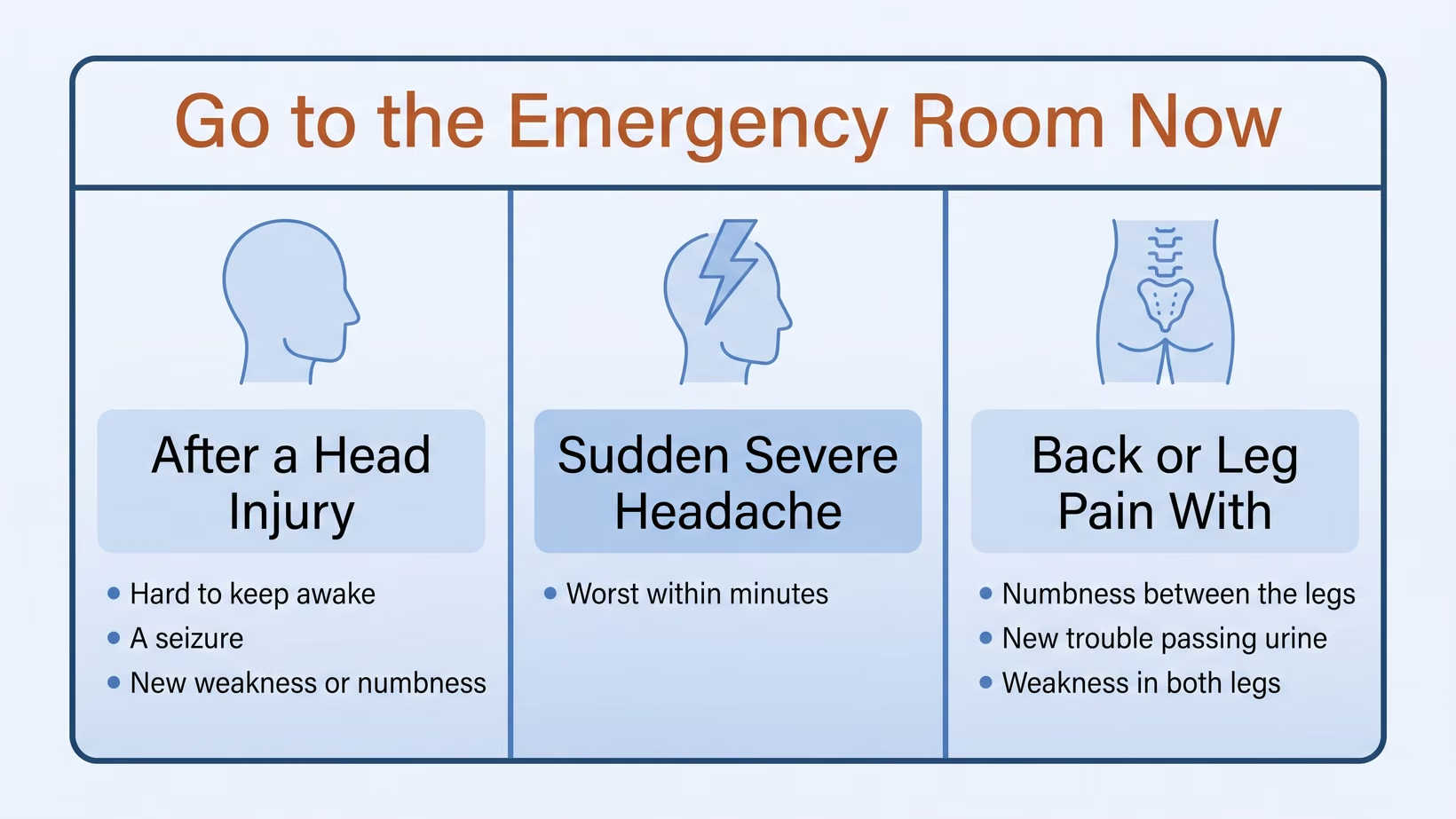
See a neurosurgeon when a brain, spine or nerve problem may need surgery or a surgeon’s opinion. Examples are a scan showing a growth or a bleed, or weakness that keeps getting worse. Go to the emergency room now for a sudden severe headache, a seizure or drowsiness after a head injury, or back pain with numbness between the legs.
What does a neurosurgeon do?
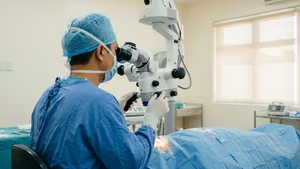
A neurosurgeon is a doctor trained to diagnose and operate on problems of the brain, the spinal cord, the spine and the nerves. Part of the work is deciding when an operation is needed and when it is not. The neurosurgeon also follows patients after treatment, with check-ups and repeat scans.
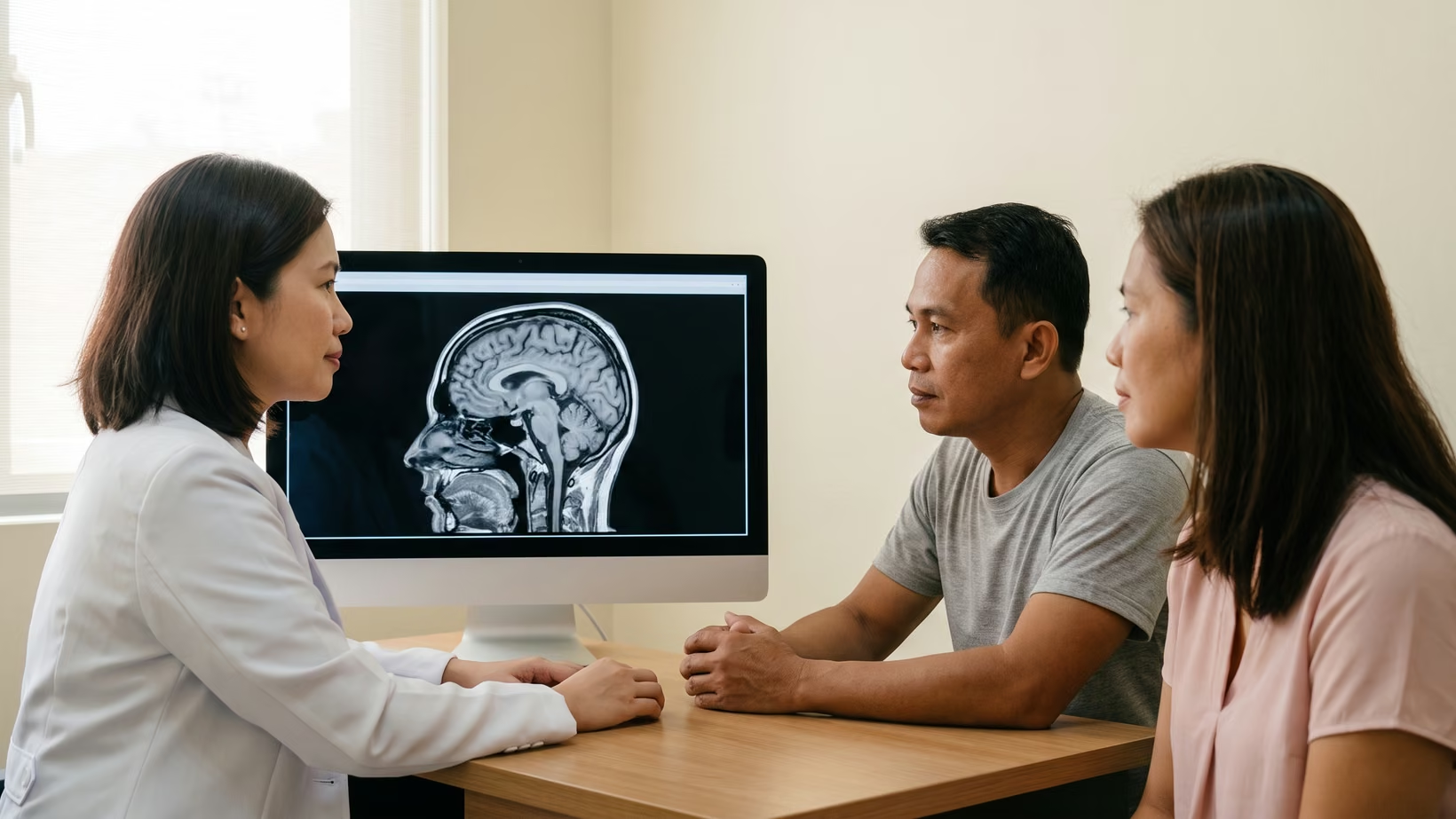
At a clinic visit, the neurosurgeon asks how the problem started and how it has changed. Then comes an examination of strength, feeling, reflexes and balance. The neurosurgeon looks at the scan pictures themselves, not only the written report, and explains what they show.
The plan can be an operation, a repeat scan later, medicine, therapy, or a referral to another specialist. When an operation is offered, the neurosurgeon explains what it involves, its risks, and what may happen if you wait.
The main difference between a neurosurgeon and a neurologist is the operation. A neurologist also treats the brain and nerves, but with medicines and tests, and does not operate. The two can care for the same patient at different times.
Which symptoms mean you should see a neurosurgeon?
See a neurosurgeon when a sign suggests that something is pressing on the brain, spinal cord or nerves, or that they are slowly losing function. Some of these signs can wait for a clinic visit. Others need the emergency room first, where the doctor decides whether to call a neurosurgeon.
These are reasons to book a neurosurgery clinic visit:
- Head and brain: a loss of strength, feeling, balance or coordination that comes on slowly and keeps getting worse. For adults with this, a UK guideline says to consider an urgent MRI, a scan that uses a strong magnet to picture the brain, to check for a tumor.
- Head and brain: a scan that shows a growth, a bleed, or fluid building up inside the head.
- Neck: an MRI showing that worn discs or bone press on the spinal cord in the neck. When this pressure causes signs that the spinal cord is affected, it is called degenerative cervical myelopathy.
- Lower back and legs: severe leg pain from a slipped disc in the lower back, called sciatica.
- Back, in a person who has or had cancer: back pain that is severe and does not ease, keeps getting worse, worsens with coughing or straining, or wakes them at night. Tell your cancer doctor the same day.
A UK guideline lists those last back pain features as signs that a cancer may have spread to the spine, and says to ask a specialist about them within 24 hours. They apply to people with cancer, not to everyone with back pain.
Seek care now
Which of these signs cannot wait for a clinic visit?
Go to the nearest hospital emergency room now, with someone else driving, for an adult or a child, if you see any of these:
- After a head injury: drowsiness or trouble keeping the eyes open
- After a head injury: a seizure, new weakness or numbness, a deep wound or suspected break in the skull, fainting, even briefly, vomiting, confusion, or a headache that keeps getting worse
- After any head injury in a person who takes a blood thinner: go even without these signs
- A sudden, severe headache that reaches its worst within about one to five minutes
- Back or leg pain with new numbness between the legs or around the anus, which can be a sign of pressure on the nerves at the bottom of the spine
- Back or leg pain with new trouble starting to pass urine, or weakness in both legs
- In a person who has or had cancer: new trouble walking, weakness or numbness of the arms or legs, or bladder or bowel problems
A sudden severe headache still needs the emergency room now. Most people with a sudden severe headache do not have bleeding around the brain (subarachnoid hemorrhage), but a UK guideline says this should still not stop doctors from checking for it.
Pressure on the nerves at the bottom of the spine is called cauda equina syndrome. If it is not treated in time, it can cause permanent leg paralysis and permanent loss of bladder, bowel and sexual function. No single symptom proves it, and NHS England guidance sends these patients for an emergency MRI.
What conditions does a neurosurgeon treat?
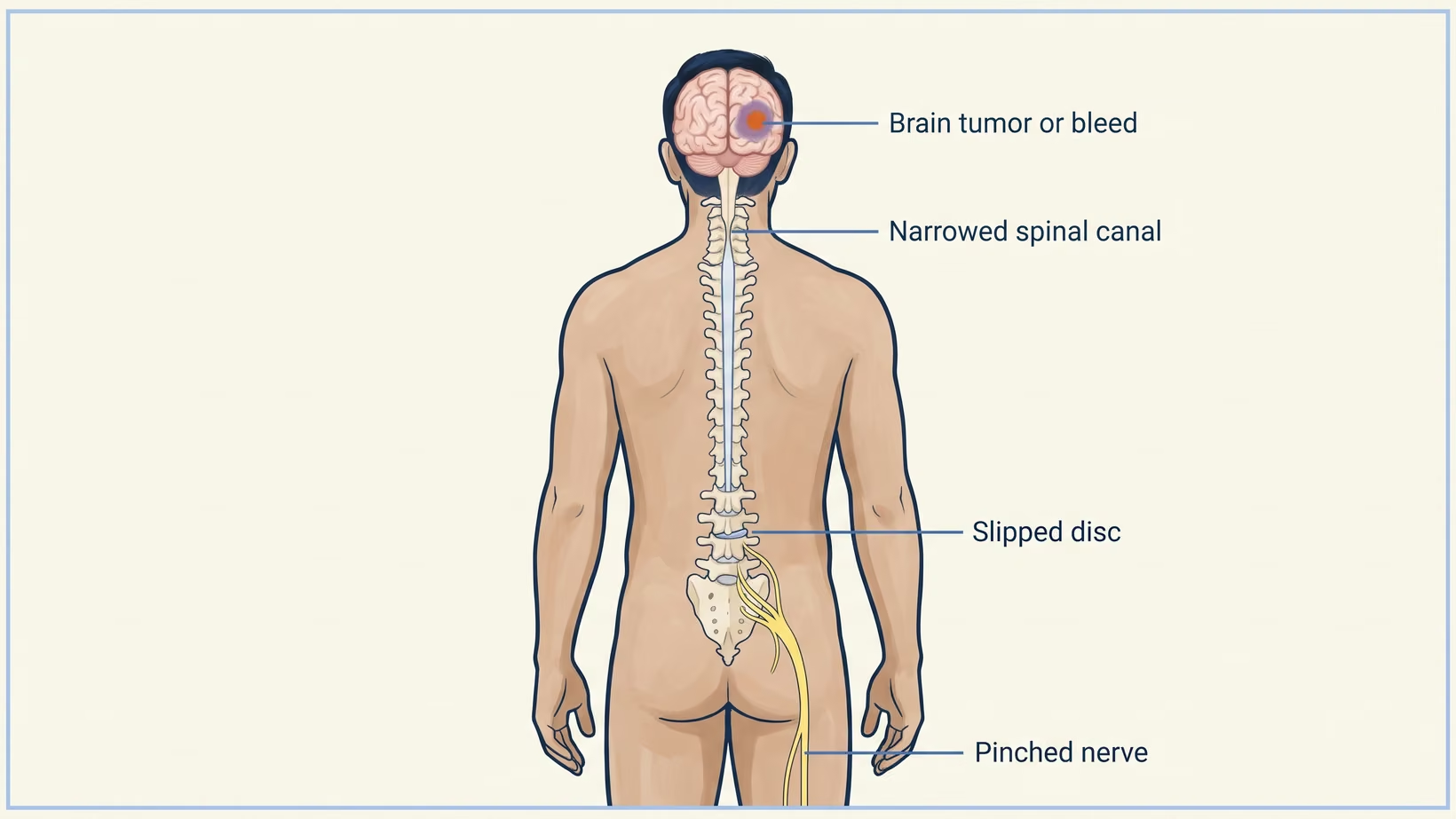
A neurosurgeon treats problems of the brain, spine and nerves that may need an operation, in newborns, children, adults and the elderly. The main groups are head injuries and bleeds, tumors, fluid build-up in the brain, and spine problems that press on nerves. Some blood vessel problems and conditions a child is born with are also treated.
- Head injury and bleeding inside the skull, including the different kinds of brain bleed after a head injury
- Tumors of the brain and spinal cord, both cancer and non-cancer
- Fluid build-up inside the brain, called hydrocephalus, which can happen at any age
- Slipped discs and a narrowed spinal canal that press on nerves or the spinal cord, in the neck or the lower back
- Some aneurysms, meaning bulges on a brain artery, and some bleeds from a stroke
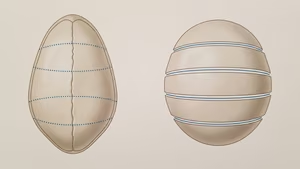
- Problems a child is born with, such as a skull seam that closes too early (craniosynostosis) or an open spine (spina bifida)
- Some kinds of epilepsy and movement problems, where surgery is one of the treatment options
In the Philippines, a survey published in 2023 asked neurosurgeons what they operate on. The top operations they reported were for head injury, for stroke, and to sample or remove brain tumors.
Does a child see a neurosurgeon too?
Babies, children and teenagers see a neurosurgeon for problems of the brain, the spine or the shape of the head. The warning signs in the emergency list apply to children too.
A UK cancer guideline says to consider a very urgent referral for a child or young person with new problems of balance, coordination or other brain function. It sets the appointment within 48 hours, to check for a brain or spinal cord cancer.
I treat children’s brain and spine problems with my team at the Philippine Children’s Medical Center (PCMC) in Quezon City. It is the government’s specialty hospital for children, and nearly every children’s specialty is there under one roof.
Why are you referred to a neurosurgeon after an MRI?
You are referred to a neurosurgeon after an MRI when the scan shows something that may need a surgeon’s opinion. It may be a growth, a bleed, fluid build-up, or a disc pressing on a nerve. A referral does not mean an operation has been decided.
Sometimes the finding has nothing to do with why the scan was done. This is called an incidental finding, meaning found by chance. A review pooled studies of people with no brain symptoms who had a brain MRI for research or screening.
In that review, about one in every 37 people scanned had some finding. A growth was found in about seven in 1,000 people. Other kinds of findings, leaving out three types of small spot, appeared in about two in 100. Growths found by chance were more common in older people.
The review did not measure how many of these findings needed surgery. The neurosurgeon looks at the pictures and compares them with any earlier scans. Then the neurosurgeon decides whether the finding needs an operation, a repeat scan, or no further visits. Bring the scan on a disc or as printed films, and the written report.
Does seeing a neurosurgeon mean you will need surgery?
Seeing a neurosurgeon does not always mean surgery. For some spine problems, non-surgical care can come first, with surgery if it becomes needed. The choice depends on the condition, the signs and the scan.
In a Dutch trial, 283 people had had severe sciatica for six to 12 weeks. About half were assigned to early surgery. The other half continued non-surgical care, with surgery if needed. Of the 142 in that group, 55 (about four in 10) had surgery during the year.
Early surgery relieved leg pain faster. The two groups’ disability scores over the first year were not clearly different. After one year, about 95 in 100 people in both groups felt they had recovered.
For pressure on the spinal cord in the neck from wear and tear, an international guideline recommends surgery for moderate and severe disease. For mild disease, it suggests surgery or a supervised trial of rehabilitation.
For people whose MRI shows the cord pressed but who have no signs that the cord or a nerve root is affected, the guideline suggests not operating to prevent problems. Instead, they are taught the warning signs and checked at later visits.
These results apply to these two spine problems only. They do not show what happens in other conditions.
Which doctor treats a head injury?
A head injury that needs a hospital check is first treated by the emergency room doctor. That doctor checks the person, decides whether a CT scan of the head is needed, and calls a neurosurgeon when the scan or the signs require one. A UK guideline names CT as the main test for an important brain injury.
That guideline says the emergency team should discuss with a neurosurgeon anyone whose scan shows a new problem that may need surgery. Whatever the scan shows, it also lists these reasons to discuss the patient with a neurosurgeon:
- Deep coma after first treatment, with a Glasgow Coma Scale (a 3 to 15 score of how awake a person is) of 8 or less
- Confusion with no clear cause that lasts more than four hours
- A falling level of awareness, or weakness that keeps getting worse
- A seizure without full recovery
- A wound that has gone, or may have gone, through the skull
- A leak of the clear fluid around the brain (cerebrospinal fluid)
A neurosurgeon is not available in every province. A 2023 survey counted 174 neurosurgeons in the Philippines, about one for every 600,000 people. Thirty-five provinces had none, and nine had one only part-time.
Where a neurosurgeon works in the hospital, the emergency room doctor asks for a neurosurgery consult there. Where none is available, and the patient is checked and safe to go home, book a clinic visit with a neurosurgeon. A concussion, a mild brain injury from a bump of the head, is checked in the emergency room in the same way.
Do you need a referral to see a neurosurgeon?
Whether you need a referral depends on where you go. A private clinic may let you book a neurosurgeon directly. Some HMOs and some hospital clinics ask for a referral letter first, so ask them before the visit.
Even when no referral is needed, a short letter from the doctor who ordered your scan helps. It says why the scan was done, what was found, and what medicines you take. It also lets the neurosurgeon write back to your doctor.
If you go through an HMO, ask which neurosurgeons it covers and what it needs from you before the consult. For an emergency, you need no referral: go to the nearest emergency room.
What to do now
What should you do next, and how soon?
Match the next step to the signs:
- Emergency room now: any sign in the warning list, for an adult or a child.
- Within 48 hours: a child with new trouble with balance or coordination, as a UK guideline says to consider. If the child becomes drowsy, keeps vomiting or has a seizure, or no visit can be had within 48 hours, go to the emergency room now.
- Neurosurgery clinic visit, booked now: weakness, numbness or balance trouble that keeps getting worse. If it comes with new numbness between the legs, trouble starting to pass urine or weakness in both legs, go to the emergency room now.
- A scan finding with no warning sign: book a clinic visit now, and ask the doctor who read the scan how soon you need to be seen. If the report names a bleed or fluid building up inside the head, ask that doctor whether you should go to the emergency room today.
- Bring the scan on a disc or films, the written report, earlier scans, and a list of every medicine.
If you are near Quezon City, you may see me at my clinic. I see adults at the Lung Center of the Philippines, Room 1101, Quezon Avenue, on Tuesday and Thursday from 2 PM. I see children at the Philippine Children’s Medical Center, Room 22, on Wednesday from 2 PM.
If travel is not practical, you can book an online consult on the consultation page. Your doctor can also refer you to me.
Which patients should a GP send straight to neurosurgery?
A general practitioner (GP) should send a patient to an emergency room now for a head injury with risk factors, a suspected bleed around the brain, or suspected cauda equina syndrome. Suspected spinal cord compression from cancer is treated as an emergency too. For worsening brain or spinal cord function, the guidance says to consider an urgent scan or referral. The criteria below are from UK guidelines and an international spine guideline, and access here differs.
Emergency:
- Head injury: a GCS below 15 at first check, any loss of consciousness, a new focal deficit (weakness or numbness in one area), amnesia for the event, a persistent headache, or any vomiting.
- For vomiting in children 12 and under after a head injury, the guideline leaves the decision to the doctor who examines the child; parents should still bring the child to the emergency room.
- Head injury, also: a seizure, previous brain surgery, a high-energy injury, a bleeding or clotting disorder, intoxication, safeguarding concerns, or treatment with a blood thinner (anticoagulant or antiplatelet) other than aspirin alone.
- Suspected subarachnoid hemorrhage: refer to an emergency department immediately. The risk of rebleeding is highest within 24 hours of the first symptoms, and CT is most accurate within six hours.
- Suspected cauda equina syndrome: back or leg pain, plus recent (14 days or fewer) or worsening trouble starting urine or feeling its flow, or numbness of the saddle area or genitals.
- Cauda equina, also: severe or progressive weakness of both legs, loss of the feeling of a full rectum, or new sexual dysfunction. Refer to the nearest hospital with emergency MRI.
- Pain spreading down both legs may be a warning that cauda equina syndrome could occur. No single symptom has good diagnostic accuracy.
- Known or suspected cancer with bladder or bowel dysfunction, difficulty walking, limb weakness, sensory loss or radicular pain (pain along a nerve): treat as an oncological emergency, with MRI as soon as possible and always within 24 hours.
Refer urgently:
- Adults with progressive, sub-acute (gradual) loss of central neurological function: consider an urgent direct-access MRI of the brain, or CT if MRI is unsafe for the patient.
- Children and young people with newly abnormal cerebellar (balance and coordination) or other central neurological function: consider a very urgent referral, for an appointment within 48 hours.
Refer for a surgical opinion:
- Degenerative cervical myelopathy: surgery is recommended for moderate and severe disease, and surgery or supervised rehabilitation is suggested for mild disease, with surgery if the patient worsens.
Send the images on a disc as well as the report, a short timeline, the GCS trend for a head injury, and every medicine, marking any anticoagulant or antiplatelet. If you refer a patient to me, send the same items with your letter.
Frequently asked questions
Is a neurosurgeon the same as a neurologist?
A neurosurgeon is not the same as a neurologist. Both treat the brain, spine and nerves, but only the neurosurgeon operates. A neurologist treats with medicines and tests. The two can care for one patient together, for example when a scan finding may need surgery.
Does a neurosurgeon treat back pain?
A neurosurgeon treats back pain that comes from a spine problem that may need surgery, such as a slipped disc pressing on a nerve, a narrowed spinal canal, or a tumor. In one trial of severe sciatica, early surgery relieved leg pain faster. At one year, about 95 in 100 in both groups felt recovered.
Can I consult a neurosurgeon online?
You can consult a neurosurgeon online to review your scans, explain the findings and plan the next step when travel is not practical. The neurosurgeon cannot examine you through a screen, so a clinic visit may still be needed. An online consult is not for the warning signs: those need the emergency room.
What should I bring to my first neurosurgery consultation?
Bring the scan itself on a disc or films, the written report, and any earlier scans. Add a list of every medicine you take and letters or results from other doctors. At a first neurosurgery appointment, a family member who knows the history can help answer questions.
See sources
- National Institute for Health and Care Excellence (NICE). Head injury: assessment and early management (NICE guideline NG232). NICE, UK; 2023. https://www.nice.org.uk/guidance/ng232
- National Institute for Health and Care Excellence (NICE). Subarachnoid haemorrhage caused by a ruptured aneurysm: diagnosis and management (NICE guideline NG228). NICE, UK; 2022. https://www.nice.org.uk/guidance/ng228
- National Institute for Health and Care Excellence (NICE). Suspected cancer: recognition and referral (NICE guideline NG12), section 1.9 Brain and central nervous system cancers. NICE, UK; 2015. https://www.nice.org.uk/guidance/ng12
- National Institute for Health and Care Excellence (NICE). Spinal metastases and metastatic spinal cord compression (NICE guideline NG234). NICE, UK; 2023. https://www.nice.org.uk/guidance/ng234
- Getting It Right First Time (GIRFT), NHS England. Spinal Surgery: National Suspected Cauda Equina Syndrome (CES) Pathway. 2023, updated March 2026. https://gettingitrightfirsttime.co.uk/wp-content/uploads/2026/04/National-Suspected-Cauda-Equina-Pathway-March-2026.pdf
- Morris Z, Whiteley WN, Longstreth WT, et al. Incidental findings on brain magnetic resonance imaging: systematic review and meta-analysis. BMJ. 2009. PMID 19687093; doi:10.1136/bmj.b3016
- Peul WC, van Houwelingen HC, van den Hout WB, et al. Surgery versus prolonged conservative treatment for sciatica. N Engl J Med. 2007. PMID 17538084; doi:10.1056/NEJMoa064039
- Fehlings MG, Tetreault LA, Riew KD, et al. A clinical practice guideline for the management of patients with degenerative cervical myelopathy: recommendations for patients with mild, moderate, and severe disease and nonmyelopathic patients with evidence of cord compression. Global Spine J. 2017. PMID 29164035; doi:10.1177/2192568217701914
- Baticulon RE, Lucena LLN, Gimenez MLA, Sabalza MN, Soriano JA. The neurosurgical workforce of the Philippines. Neurosurgery. 2023. PMID 37931081; doi:10.1227/neu.0000000000002630